The texts from the Roman Catholic Lectionary today, the Solemnity of Saints Peter and Paul, Apostles, invite us to contemplate the personal transformation that builds the Church.
The Reading from the Acts of the Apostles presents Herod’s Persecution of the Christians.
* [12:1–19] Herod Agrippa ruled Judea A.D. 41–44. While Luke does not assign a motive for his execution of James and his intended execution of Peter, the broad background lies in Herod’s support of Pharisaic Judaism. The Jewish Christians had lost the popularity they had had in Jerusalem (Acts 2:47), perhaps because of suspicions against them traceable to the teaching of Stephen.
* [12:2] James, the brother of John: this James, the son of Zebedee, was beheaded by Herod Agrippa ca. A.D. 44.
* [12:3, 4] Feast of Unleavened Bread…Passover: see note on Lk 22:1. (Acts of the Apostles, CHAPTER 12 | USCCB, n.d.)
Psalm 34 teaches the “poor,” those who are defenseless, to trust in God alone.
* [Psalm 34] A thanksgiving in acrostic form, each line beginning with a successive letter of the Hebrew alphabet. In this Psalm one letter is missing and two are in reverse order. The psalmist, fresh from the experience of being rescued (Ps 34:5, 7), can teach the “poor,” those who are defenseless, to trust in God alone (Ps 34:4, 12). God will make them powerful (Ps 34:5–11) and give them protection (Ps 34:12–22). (Psalms, PSALM 34 | USCCB, n.d.)
The Reading from the Second Letter of Timothy presents the Reward for Fidelity
* [4:6] The apostle recognizes his death through martyrdom to be imminent. He regards it as an act of worship in which his blood will be poured out in sacrifice; cf. Ex 29:38–40; Phil 2:17.
* [4:7] At the close of his life Paul could testify to the accomplishment of what Christ himself foretold concerning him at the time of his conversion, “I will show him what he will have to suffer for my name” (Acts 9:16).
* [4:8] When the world is judged at the parousia, all who have eagerly looked for the Lord’s appearing and have sought to live according to his teachings will be rewarded. The crown is a reference to the laurel wreath placed on the heads of victorious athletes and conquerors in war; cf. 2 Tm 2:5; 1 Cor 9:25.
* [4:14–18] Alexander: an opponent of Paul’s preaching (2 Tm 4:14–15), perhaps the one who is mentioned in 1 Tm 1:20. Despite Paul’s abandonment by his friends in the province of Asia (cf. 2 Tm 1:15–16), the divine assistance brought this first trial to a successful issue, even to the point of making the gospel message known to those who participated in or witnessed the trial (2 Tm 4:16–17). (2 Timothy, CHAPTER 4 | USCCB, n.d.)
The Gospel of Matthew presents Peter’s Confession About Jesus.
* [16:13–20] The Marcan confession of Jesus as Messiah, made by Peter as spokesman for the other disciples (Mk 8:27–29; cf. also Lk 9:18–20), is modified significantly here. The confession is of Jesus both as Messiah and as Son of the living God (Mt 16:16). Jesus’ response, drawn principally from material peculiar to Matthew, attributes the confession to a divine revelation granted to Peter alone (Mt 16:17) and makes him the rock on which Jesus will build his church (Mt 16:18) and the disciple whose authority in the church on earth will be confirmed in heaven, i.e., by God (Mt 16:19).
* [16:13] Caesarea Philippi: situated about twenty miles north of the Sea of Galilee in the territory ruled by Philip, a son of Herod the Great, tetrarch from 4 B.C. until his death in A.D. 34 (see note on Mt 14:1). He rebuilt the town of Paneas, naming it Caesarea in honor of the emperor, and Philippi (“of Philip”) to distinguish it from the seaport in Samaria that was also called Caesarea. Who do people say that the Son of Man is?: although the question differs from the Marcan parallel (Mk 8:27: “Who…that I am?”), the meaning is the same, for Jesus here refers to himself as the Son of Man (cf. Mt 16:15).
* [16:14] John the Baptist: see Mt 14:2. Elijah: cf. Mal 3:23–24; Sir 48:10; and see note on Mt 3:4. Jeremiah: an addition of Matthew to the Marcan source.
* [16:16] The Son of the living God: see Mt 2:15; 3:17. The addition of this exalted title to the Marcan confession eliminates whatever ambiguity was attached to the title Messiah. This, among other things, supports the view proposed by many scholars that Matthew has here combined his source’s confession with a post-resurrectional confession of faith in Jesus as Son of the living God that belonged to the appearance of the risen Jesus to Peter; cf. 1 Cor 15:5; Lk 24:34.
* [16:17] Flesh and blood: a Semitic expression for human beings, especially in their weakness. Has not revealed this…but my heavenly Father: that Peter’s faith is spoken of as coming not through human means but through a revelation from God is similar to Paul’s description of his recognition of who Jesus was; see Gal 1:15–16, “…when he [God]…was pleased to reveal his Son to me….”
* [16:18] You are Peter, and upon this rock I will build my church: the Aramaic word kēpā’ meaning rock and transliterated into Greek as Kēphas is the name by which Peter is called in the Pauline letters (1 Cor 1:12; 3:22; 9:5; 15:4; Gal 1:18; 2:9, 11, 14) except in Gal 2:7–8 (“Peter”). It is translated as Petros (“Peter”) in Jn 1:42. The presumed original Aramaic of Jesus’ statement would have been, in English, “You are the Rock (Kēpā’) and upon this rock (kēpā’) I will build my church.” The Greek text probably means the same, for the difference in gender between the masculine noun petros, the disciple’s new name, and the feminine noun petra (rock) may be due simply to the unsuitability of using a feminine noun as the proper name of a male. Although the two words were generally used with slightly different nuances, they were also used interchangeably with the same meaning, “rock.” Church: this word (Greek ekklēsia) occurs in the gospels only here and in Mt 18:17 (twice). There are several possibilities for an Aramaic original. Jesus’ church means the community that he will gather and that, like a building, will have Peter as its solid foundation. That function of Peter consists in his being witness to Jesus as the Messiah, the Son of the living God. The gates of the netherworld shall not prevail against it: the netherworld (Greek Hadēs, the abode of the dead) is conceived of as a walled city whose gates will not close in upon the church of Jesus, i.e., it will not be overcome by the power of death.
* [16:19] The keys to the kingdom of heaven: the image of the keys is probably drawn from Is 22:15–25 where Eliakim, who succeeds Shebna as master of the palace, is given “the key of the House of David,” which he authoritatively “opens” and “shuts” (Is 22:22). Whatever you bind…loosed in heaven: there are many instances in rabbinic literature of the binding-loosing imagery. Of the several meanings given there to the metaphor, two are of special importance here: the giving of authoritative teaching, and the lifting or imposing of the ban of excommunication. It is disputed whether the image of the keys and that of binding and loosing are different metaphors meaning the same thing. In any case, the promise of the keys is given to Peter alone. In Mt 18:18 all the disciples are given the power of binding and loosing, but the context of that verse suggests that there the power of excommunication alone is intended. That the keys are those to the kingdom of heaven and that Peter’s exercise of authority in the church on earth will be confirmed in heaven show an intimate connection between, but not an identification of, the church and the kingdom of heaven.
* [16:20] Cf. Mk 8:30. Matthew makes explicit that the prohibition has to do with speaking of Jesus as the Messiah; see note on Mk 8:27–30. (Matthew, CHAPTER 16 | USCCB, n.d.)
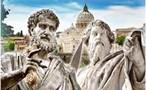
Candice Tucci, OSF, reflects upon the Painting: St. Peter and St. Paul that is a detail
from the left panel of the St. Zeno of Verona Altar Piece by artist Andrea Mantegna.
Gazing upon these two images of Peter and Paul, I see keys, a scroll, and a sword. Peter received keys. Not one key but keys! What might they be?
What is needed to enter into heaven? What is needed to unlock the gate of our hearts? What did Jesus teach? He taught, love, compassion, forgiveness, hospitality, and peace. Each of these is one key to open our hearts and enter into everlasting life. What key are you lacking?
Paul is holding a sword and a scroll. He was martyred by the sword while during his lifetime scripted the letters we know as the Epistles in the New Testament. Words of hope, peace, encouragement and lessons in living a Christian life.
There is the proverb, The pen is mightier than the sword. Perhaps we can see Paul as one who in a nonviolent way through the teachings of Jesus, addressed the violence of his time. The life and peaceful teachings of Christ prevailed and continues to do so at the highest cost of discipleship. But do not fear!
This is another theme that is strong in our readings today. It is that of safety and security. Do not be afraid. In Acts 12, Peter is rescued from prison. The angel of the Lord rescues those who fear him. In awe (fear), before our God, we are rescued by Jesus who conquered death. (Acts of the Apostles, CHAPTER 12 | USCCB, n.d.)
Don Schwager quotes “Only by hope,” by Basil the Great, 329-379 A.D
"'Turn, O my soul, into your rest: for the Lord has been bountiful to you' (Psalm 114:7). The brave contestant applies to himself the consoling words, very much like to Paul, when he says: 'I have fought the good fight, I have finished the course, I have kept the faith. For the rest, there is laid up for me a crown of justice.' These things the prophet also says to himself: Since you have fulfilled sufficiently the course of this life, turn then to your rest, 'for the Lord has been bountiful to you.' For, eternal rest lies before those who have struggled through the present life observant of the laws, a rest not given in payment for a debt owed for their works but provided as a grace of the munificent God for those who have hoped in him." (excerpt from HOMILIES 22) (Schwager, n.d.)
The Word Among Us Meditation on Matthew 16:13-19 comments that Peter and Paul were formed by the Lord in the fire of difficulties and failures that left them humbled and reliant on the Spirit’s grace and power. As a result, their hearts were captured by Jesus’ love and his call for their lives.
We are all called to be saints, each in our own way. And that’s possible because the same Spirit who transformed Peter and Paul is at work in us. Our holiness grows as we receive God’s grace and allow him to lead us and change us. So how is Jesus calling you to follow him today?
“I love you, Lord. Make me the saint that you want me to be.” (Meditation on Matthew 16:13-19, n.d.)
Friar Jude Winkler comments that in Acts 12, Herod kills James and arrests Peter but an angel frees Peter indicating that God will protect the Church. The text in 2 Timothy along with the Pastoral Letters is spiritually more developed than Paul’s earlier work. Paul describes his life poured out like a libation, a liquid offering to the Lord. In prison, he realizes that he has reached the end. He has accepted God’s will. In the Gospel of Matthew, Jesus is at Caesarea Philippi, situated about twenty miles north of the Sea of Galilee where the Jordan surfaces and he asks Who the Son of Man is? Peter answers “Son of the Living God,” which is more than a hero but a chosen one. Jesus responds by blessing Simon who is named Peter or perhaps “Rocky” because the Church is to be built on the solid foundation. In Aramaic the “rock” is more thick headed but here Jesus means the “leader of the Church”, an institution that will follow His Ascension. The gates of the nether world were imagined near the cave where the Pam was worshipped, an image of satanic power in the Hebrew Testament. Friar Jude notes that Yahweh has the keys of life, death and rain and is now given to Peter to wield authority over loose and bind the laws that were originally the rabbinic powers, as Peter becomes the chief rabbi.
Father Richard Rohr, OFM, points to God’s covenant with the Jewish people to illustrate how the choosing rests entirely on God’s side, not on our own merit. The Bible shows a relentless movement toward intimacy and divine union between Creator and creatures. For this to happen, there needs to be some degree of compatibility, likeness, or even “sameness” between the two parties. In other words, there has to be a little bit of God in us that wants to find itself.
God doesn’t love the ancient Hebrew people or anybody else because we are good. God loves us from a free and deliberate choice. Receiving God’s love has never been a worthiness contest. This is very hard for almost everyone to accept. It is finally a surrendering and never a full understanding. The proud will seldom submit until they are “brought down from their thrones,” as Mary put it (Luke 1:52). It just does not compute inside our binary, judging, competing, and comparing brains.
God does not love you because you are good; God loves you because God is good, and then you can be good because you draw upon such an Infinite Source of Goodness. The older I get, the more I am sure that God does all the giving and we do all the receiving. God is always and forever the initiator in my life, and I am, on occasion, the half-hearted respondent. My mustard seed of a response seems to be more than enough for a humble God, even though the mustard seed is “the tiniest of all the seeds” (Matthew 13:32).
God makes use of everything that we offer and thus expands our freedom. Otherwise, it would not be a covenant love, but a mere coercion. God implants the desire within us to desire even more intimacy with God. (Rohr, 2026)
We ponder the transformation of Peter and Paul as they were inspired to become leaders of the Church and seek the enlightenment of the Spirit for our transformation.
References
Acts of the Apostles, CHAPTER 12 | USCCB. (n.d.). Daily Readings. Retrieved June 30, 2026, from https://bible.usccb.org/bible/acts/12?1
Matthew, CHAPTER 16 | USCCB. (n.d.). Daily Bible Readings, Audio and Video Every Morning | USCCB. Retrieved June 29, 2026, from https://bible.usccb.org/bible/matthew/16?13
Meditation on Matthew 16:13-19. (n.d.). Word Among Us. Retrieved June 29, 2026, from https://wau.org/meditations/2026/06/29/1602551/
Psalms, PSALM 34 | USCCB. (n.d.). Daily Readings. Retrieved June 30, 2026, from https://bible.usccb.org/bible/psalms/34?2
Rohr, R. (2026, June 29). The Grace Is From God's Side — Center for Action and Contemplation. Center for Action and Contemplation. Retrieved June 29, 2026, from https://cac.org/daily-meditations/the-grace-is-from-gods-side/
Schwager, D. (n.d.). You Are the Christ - the Son of the Living God. Daily Scripture Readings and Meditations – Daily Scripture Readings and Meditations. Retrieved June 29, 2026, from https://www.dailyscripture.net/daily-meditation/
Tucci, C. (2026, June 30). Daily Reflection June 29, 2026 | Creighton Online Ministries. Creighton Online Ministries. Retrieved June 29, 2026, from https://onlineministries.creighton.edu/daily-reflections/daily-reflection-june-29-2026
2 Timothy, CHAPTER 4 | USCCB. (n.d.). Daily Readings. Retrieved June 30, 2026, from https://bible.usccb.org/bible/2timothy/4?6

