Showing posts with label persecution. Show all posts

Thursday, July 16, 2026

Straight and Narrow Path

 The texts from the Roman Catholic Lectionary today exhort us to ponder the path that we are establishing in the field of our life and contemplate a better fitting yoke with Jesus Way.

Shared Path with Christ


In the Reading from the Book of the Prophet Isaiah is a prayer that God may quickly bring about the longed-for salvation.


* [26:119] This text is a mixture of praise for the salvation that will take place, a confession of Judah’s inability to achieve deliverance on its own, and earnest prayer that God may quickly bring about the longed-for salvation.


* [26:19] This verse refers not to resurrection of the dead, but to the restoration of the people; cf. Ez 37. The population of Judah was radically reduced by the slaughter and deportations that the historical disasters of the late eighth and seventh centuries B.C. brought upon the country. In this context, a major concern for the future was for an increase in the population, a rebirth of the nation’s life. (Isaiah, CHAPTER 26 | USCCB, n.d.)


Psalm 94 is the lament of an individual who is threatened by wicked people


* [Psalm 94] A lament of an individual who is threatened by wicked people. The danger affects the whole community. Calling upon God as judge (Ps 94:12), the Psalm complains about oppression of the holy community by people within (Ps 94:37). Bold declarations of faith follow: denunciation of evildoers (Ps 94:811) and assurance to the just (Ps 94:1215). The Psalm continues with further lament (Ps 94:1619) and ends with strong confidence in God’s response (Ps 94:2023). (Psalms, PSALM 94 | USCCB, n.d.)


In the Gospel of Matthew, we are invited to accept The Gentle Mastery of Christ.


* [11:2829] These verses are peculiar to Matthew and are similar to Ben Sirach’s invitation to learn wisdom and submit to her yoke (Sir 51:23, 26).

* [11:28] Who labor and are burdened: burdened by the law as expounded by the scribes and Pharisees (Mt 23:4).

* [11:29] In place of the yoke of the law, complicated by scribal interpretation, Jesus invites the burdened to take the yoke of obedience to his word, under which they will find rest; cf. Jer 6:16. (Matthew, CHAPTER 11 | USCCB, n.d.)


George Butterfield comments that a yoke is placed upon an animal so that, connected to another animal, the two can work together and pull a load. That doesn’t sound like an opportunity for rest. That sounds like hard work.


Yet, Jesus says that it is under that yoke that we will find rest. How can that be? First, Jesus has already done the heavy lifting. He has done everything necessary to save us and grant us peace. It is not as if there is some huge mountain we have to climb to get to God. When we take on Jesus’ yoke we are yoked to Jesus. Thus, Jesus says that, wearing his yoke, we can learn from him. When we want to go the wrong way, Jesus pulls us in the right direction. That is why his yoke is easy. In essence, we are simply following him. His yoke is easy and his burden is light. Yoked to him, we learn meekness and humility of heart. Many people look at the Christian path and think, That looks too hard for me. It is, if you try to do it on your own. However, yoked to Jesus, the word our Lord uses is “easy.” Actually, Jesus’ words here come as somewhat of a shock. I am thinking that the hard part is keeping his yoke on. If we do that, we will be with him and find rest. (Butterfield, n.d.)


Don Schwager quotes “Grace bear us,” by an anonymous early author from the Greek church.


"'My yoke is easy and my burden light.' ... The prophet says this about the burden of sinners: 'Because my iniquities lie on top of my head, so they have also placed a heavy burden on me' (Psalm 38:4)' ...'Place my yoke upon you, and learn from me that I am gentle and humble of heart.' Oh, what a very pleasing weight that strengthens even more those who carry it! For the weight of earthly masters gradually destroys the strength of their servants, but the weight of Christ rather helps the one who bears it, because we do not bear grace; grace bears us. It is not for us to help grace, but rather grace has been given to aid us.' (excerpt from INCOMPLETE WORK ON MATTHEW, HOMILY, the Greek fathers). (Schwager, n.d.)


Friar Jude Winkler comments Isaiah 24 -27 is different in tone from “First Isaiah” where individual nations are punished. Today a judgment upon the entire earth is part of the second half. The punishment for our sins is like a woman in labour but we give birth to "wind”. This cynical, even humorous comment identifies a land of shades that gives birth as a reference to resurrection of the dead. This passage shows a resurrection belief growing during the Exile. In the Gospel of Matthew, Jesus invites us to “take my yoke”. In the ancient world, the yoke was made for two oxen. It was made custom for the oxen, not generic, but tailored for the particular ox. Friar Jude notes that the yoke we carry is planned for us. Jesus will help to create the straight (and narrow?) furrow.


The Word Among Us Meditation on Matthew 11:28-30 notes that receiving Jesus’ rest doesn’t necessarily mean being able to take it easy.


That’s why Jesus urges us to take up his easy “yoke” (Matthew 11:29). To be yoked to the Lord doesn’t mean the immediate end of suffering, but it does mean that we are not alone. We have someone who cares for us and who promises to walk beside us every day. Being yoked to Jesus also means that the challenges we face in this life won’t have the final word. Each one, no matter how hard, can become an instrument of transformation for us as we remain open to Jesus’ wisdom and healing. In place of despair, he can give us hope: hope for this life and, ultimately, the hope of heaven, where we will experience his rest in ways we never knew possible.


“Jesus, I come to you. Help me to take up your yoke so that I can rest in you.” (Meditation on Matthew 11:28-30, n.d.)


Father Richard Rohr, OFM, considers how this beatitude challenges Jesus’s listeners to prepare for the consequences of following him.


Jesus appears to be saying that the disciples’ response is a prophetic action itself. To live joyfully in the midst of misunderstanding and persecution points beyond our smaller “kingdoms” to the larger kingdom of God. Jesus promises us that when we live joyfully under persecution, the world won’t understand. In fact, it will hate us. Many before me have said that a clear sign that something is the true gospel is if it engenders criticism and a spreading of falsehoods, what we used to call “calumny.” Goodness can never be attacked directly; the messengers or the motivation must be discredited.


Luke’s Gospel presents the same message in the opposite form: “Alas for you when the world speaks well of you! This was the way their ancestors treated the false prophets” (Luke 6:26 emphases added). Too much praise or widespread acceptance is probably an indication that something is not the full gospel. In either case, Jesus clearly knew that his teaching would turn conventional values on their head. (Rohr, n.d.)


We are inspired by the Spirit to reflect upon the furrow of our life and contemplate the difficult days of lack of direction that were made “straighter” when we acknowledged the Presence of Christ supporting our shared “yoke”.


References

Butterfield, G. (n.d.). Daily Reflection July 16, 2026 | Creighton Online Ministries. Creighton Online Ministries. Retrieved July 16, 2026, from https://onlineministries.creighton.edu/daily-reflections/daily-reflection-july-16-2026 

Isaiah, CHAPTER 26 | USCCB. (n.d.). Daily Readings. Retrieved July 16, 2026, from https://bible.usccb.org/bible/isaiah/26

Matthew, CHAPTER 11 | USCCB. (n.d.). Daily Readings. Retrieved July 16, 2026, from https://bible.usccb.org/bible/matthew/11?28 

Meditation on Matthew 11:28-30. (n.d.). Word Among Us. Retrieved July 16, 2026, from https://wau.org/meditations/2026/07/16/1624196/ 

Psalms, PSALM 94 | USCCB. (n.d.). Daily Readings. Retrieved July 16, 2026, from https://bible.usccb.org/bible/psalms/94?5 

Rohr, R. (n.d.). Rejoice in Persecution? Center for Action and Contemplation. Retrieved July 16, 2026, from https://cac.org/daily-meditations/rejoice-in-persecution/ 

Schwager, D. (n.d.). Take My Yoke upon You and Learn from Me. Daily Scripture Readings and Meditations – Daily Scripture Readings and Meditations. Retrieved July 16, 2026, from https://www.dailyscripture.net/daily-meditation/ 


Saturday, July 11, 2026

Called to Respond with Love

 The texts from the Roman Catholic Lectionary today invite us to consider the encounters with the Divine on our journey and our response to the experience.

Respond with Love


The Reading from the Book of the Prophet Isaiah presents The Sending of Isaiah.


* [6:1] In the year King Uzziah died: probably 742 B.C., although the chronology of this period is disputed. A high and lofty throne: within the holy of holies of the Jerusalem Temple stood two cherubim, or winged sphinxes, whose outstretched wings served as the divine throne (1 Kgs 6:2328; Ez 1:428; 10:1, 20). The ark of the covenant was God’s footstool (Ps 132:78; 1 Chr 28:2), placed under the cherubim (1 Kgs 8:67). Temple: the holy place, just in front of the holy of holies.

* [6:2] Seraphim: the plural of saraph (“to burn”), a term used to designate the “fiery” serpents of the wilderness (Nm 21:8; Dt 8:15), and to refer to “winged” serpents (Is 14:29; 30:6). Here, however, it is used adjectivally of the cherubim, who are not serpent-like, as seen in the fact that they have faces and sexual parts (“feet”). See the adaptation of these figures by Ezekiel (Ez 1:1012; 10:415).

* [6:3] Holy, holy, holy: these words have been used in Christian liturgy from the earliest times.

* [6:4] Smoke: reminiscent of the clouds which indicated God’s presence at Mount Sinai (Ex 19:1619; Dt 4:11) and which filled the tabernacle (Ex 40:3438) and the Temple (1 Kgs 8:1011) at their dedication.

* [6:5] Doomed: there are two roots from which the verb here could be derived; one means “to perish, be doomed,” the other “to become silent,” and given Isaiah’s delight in puns and double entendre, he probably intended to sound both notes. “I am doomed!” is suggested by the popular belief that to see God would lead to one’s death; cf. Gn 32:31; Ex 33:20; Jgs 13:22. “I am struck silent!” is suggested by the emphasis on the lips in vv. 56, and such silence is attested elsewhere as the appropriate response to the vision of the Lord in the Temple (Hb 2:20).

* [6:7] Touched your lips: Isaiah is thus symbolically purified of sin in preparation for his mission as God’s prophet. (Isaiah, CHAPTER 6 | USCCB, n.d.)


Psalm 93 is a hymn celebrating the kingship of God,


* [Psalm 93] A hymn celebrating the kingship of God, who created the world (Ps 93:12) by defeating the sea (Ps 93:34). In the ancient myth that is alluded to here, Sea completely covered the land, making it impossible for the human community to live. Sea, or Flood, roars in anger against God, who is personified in the storm. God’s utterances or decrees are given authority by the victory over Sea (Ps 93:5).

* [93:1] The LORD is king: lit., “the LORD reigns.” This Psalm, and Ps 47; 9699, are sometimes called enthronement Psalms. They may have been used in a special liturgy during which God’s ascent to the throne was ritually reenacted. They have also been interpreted eschatologically, pointing to the coming of God as king at the end-time.

* [93:3] The flood: the primordial sea was tamed by God in the act of creation. It is a figure of chaos and rebellion, cf. Ps 46:4. (Psalms, PSALM 93 | USCCB, n.d.)


In the Gospel of Matthew, Jesus inspires us to have Courage Under Persecution.


* [10:25] Beelzebul: see Mt 9:34 for the charge linking Jesus with “the prince of demons,” who is named Beelzebul in Mt 12:24. The meaning of the name is uncertain; possibly, “lord of the house.”

* [10:26] The concealed and secret coming of the kingdom is to be proclaimed by them, and no fear must be allowed to deter them from that proclamation.

* [10:3233] In the Q parallel (Lk 12:89), the Son of Man will acknowledge those who have acknowledged Jesus, and those who deny him will be denied (by the Son of Man) before the angels of God at the judgment. Here Jesus and the Son of Man are identified, and the acknowledgment or denial will be before his heavenly Father. (Matthew, CHAPTER 10 | USCCB, n.d.)


David Crawford recalls friends, a retired missionary couple, Neville and Emma, who had served close to half a century as Baptist missionaries in West Africa.


David recalls them saying how, when they were called to missionary work in French-speaking colonies in West Africa in the late 1940s, Neville explained to God (in prayer) and the missionary board (in person) all the reasons why the missionary board must be mistaken.


Surely an English-speaking locale with familiar foods and pleasant climate was where they should go. Finally, accepting (as Jesus tells us in Matthew 10) that he was the disciple who should not place himself above the teacher, Neville and Emma blessed others, and were blessed abundantly themselves, by years of service and ministry in Africa.

I am inspired by the artists, like Dan Schutte and Donald Jackson. I am inspired by the examples of Joyce, Neville and Emma. I am inspired by Isaiah.

Loving God, inspire me – inspire us – not just to be thrilled by Your words and the examples of others, but to be stirred to action as we heed Your call. (Crawford, 2026)


Don Schwager quotes “Do not bewail death - but sin,” by Augustine of Hippo (354-430 AD).


"The gospel is life. Impiety and infidelity are the death of the soul. So then, if the soul can die, how then is it yet immortal? Because there is always a dimension of life in the soul that can never be extinguished. And how does it die? Not in ceasing to be life but by losing its proper life. For the soul is both life to something else, and it has it own proper life. Consider the order of the creatures. The soul is the life of the body. God is the life of the soul. As the life that is the soul is present with the body, that the body may not die, so the life of the soul (God) ought to be with the soul that it may not die."


"How does the body die? By the departure of the soul. I say, by the departure of the soul the body dies, and it lies there as a mere carcass, what was a little before a lively, not a contemptible, object. There are in it still its several members, the eyes and ears. But these are merely the windows of the house; its inhabitant is gone. Those who bewail the dead cry in vain at the windows of the house. There is no one there within it to hear... Why is the body dead? Because the soul, its life, is gone. But at what point is the soul itself dead? When God, its life, has forsaken it... This then we can know and hold for certain: the body is dead without the soul, and the soul is dead without God. Every one without God has a dead soul. You who bewail the dead rather should bewail sin. Bewail ungodliness. Bewail disbelief." (excerpt from SERMON 65.5-7) (Schwager, n.d.)


Friar Jude Winkler comments that Isaiah’s inaugural vision of the prophecy of heaven is a moment of encountering the angels and responding “Woe is me… I am doomed” Two reactions are usual of people in an encounter with the Divine, to draw closer, or a fear that they are insignificant sinners. God cleans the lips of the Prophet Chosen, for His own reason, even if we don't understand. Jesus speaks to the disciples about sending them and the persecution where they can kill the body and not the soul. Jesus evokes images of the Temple dump as a good image of hell. He exhorts us to be afraid of those who can cast us into hell. Friar Jude reminds us that as God protects sparrows He certainly will protect us.


The Word Among Us Meditation on Isaiah 6:1-8 comments that this passage is one of many examples in Scripture of the way that an encounter with the Lord always brings about a response. And how could it not? As Isaiah discovered, holiness and sinfulness go together about as well as oil and water. A reaction is inevitable!


You immediately know you are a man or woman of “unclean lips,” but you also know that through Christ your sin can be washed away (Isaiah 6:5). So you cry out to the Lord, confessing how much you need his mercy—and he cleanses you! Now, freed from your guilt and sin, you are ready to do whatever he asks of you. Washed in the blood of his Son, you are eager to share the good news of redemption with everyone.


When he calls out, “Whom shall I send?” (Isaiah 6:8), all eyes settle on you. How will you respond?


“Here I am, Lord! Send me!” (Meditation on Isaiah 6:1-8, n.d.)


Father Richard Rohr, OFM, introduces Franciscan sister Patricia Jordan who invites us to contemplate the Beatitudes as a way to transform our hearts.


The beauty portrayed in the Beatitudes is a yardstick for you to measure the areas of brokenness that are still operative within your heart. Perhaps you may wish to reflect on each one separately in order to see how the Beatitudes address your false symbols of security, power and self-esteem that the false self struggles to satisfy.


Our starting point is the heart. Blessed are the pure in heart: they shall see God. What an astonishing promise! The purity Jesus speaks of in this Beatitude presupposes a heart where affections, intellect and will are integrated in a love that is a participation in the life of God himself. (Rohr, n.d.)


We implore the Spirit to reveal the opportunities we have today to activate our Baptismal anointing as priest, prophet, and leader supported by our trust in God.


References

Crawford, D. (2026, July 11). Daily Reflection July 11, 2026 | Creighton Online Ministries. Creighton Online Ministries. Retrieved July 11, 2026, from https://onlineministries.creighton.edu/daily-reflections/daily-reflection-july-11-2026 

Isaiah, CHAPTER 6 | USCCB. (n.d.). Daily Readings. Retrieved July 11, 2026, from https://bible.usccb.org/bible/isaiah/6

Matthew, CHAPTER 10 | USCCB. (n.d.). Daily Readings. Retrieved July 11, 2026, from https://bible.usccb.org/bible/matthew/10

Meditation on Isaiah 6:1-8. (n.d.). Word Among Us. Retrieved July 11, 2026, from https://wau.org/meditations/2026/07/11/1612123/ 

of Hippo, A., & Schwager, D. (n.d.). Fear Him Who Can Destroy Soul and Body in Hell. Daily Scripture Readings and Meditations – Daily Scripture Readings and Meditations. Retrieved July 11, 2026, from https://www.dailyscripture.net/daily-meditation/ 

Psalms, PSALM 93 | USCCB. (n.d.). Daily Bible Readings, Audio and Video Every Morning | USCCB. Retrieved July 11, 2026, from https://bible.usccb.org/bible/psalms/93?1 

Rohr, R. (n.d.). The Beatitudes: Week One: Weekly Summary. Center for Action and Contemplation. Retrieved July 11, 2026, from https://cac.org/daily-meditations/ 


Tuesday, June 30, 2026

Transformed to Take Our Task

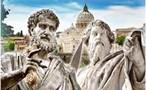
 The texts from the Roman Catholic Lectionary today, the Solemnity of Saints Peter and Paul, Apostles, invite us to contemplate the personal transformation that builds the Church.

From Basilica of St. Peter


The Reading from the Acts of the Apostles presents Herod’s Persecution of the Christians.


* [12:119] Herod Agrippa ruled Judea A.D. 41–44. While Luke does not assign a motive for his execution of James and his intended execution of Peter, the broad background lies in Herod’s support of Pharisaic Judaism. The Jewish Christians had lost the popularity they had had in Jerusalem (Acts 2:47), perhaps because of suspicions against them traceable to the teaching of Stephen.

* [12:2] James, the brother of John: this James, the son of Zebedee, was beheaded by Herod Agrippa ca. A.D. 44.

* [12:3, 4] Feast of Unleavened Bread…Passover: see note on Lk 22:1. (Acts of the Apostles, CHAPTER 12 | USCCB, n.d.)


Psalm 34 teaches the “poor,” those who are defenseless, to trust in God alone.


* [Psalm 34] A thanksgiving in acrostic form, each line beginning with a successive letter of the Hebrew alphabet. In this Psalm one letter is missing and two are in reverse order. The psalmist, fresh from the experience of being rescued (Ps 34:5, 7), can teach the “poor,” those who are defenseless, to trust in God alone (Ps 34:4, 12). God will make them powerful (Ps 34:511) and give them protection (Ps 34:1222). (Psalms, PSALM 34 | USCCB, n.d.)


The Reading from the Second Letter of Timothy presents the Reward for Fidelity


* [4:6] The apostle recognizes his death through martyrdom to be imminent. He regards it as an act of worship in which his blood will be poured out in sacrifice; cf. Ex 29:3840; Phil 2:17.

* [4:7] At the close of his life Paul could testify to the accomplishment of what Christ himself foretold concerning him at the time of his conversion, “I will show him what he will have to suffer for my name” (Acts 9:16).

* [4:8] When the world is judged at the parousia, all who have eagerly looked for the Lord’s appearing and have sought to live according to his teachings will be rewarded. The crown is a reference to the laurel wreath placed on the heads of victorious athletes and conquerors in war; cf. 2 Tm 2:5; 1 Cor 9:25.

* [4:1418] Alexander: an opponent of Paul’s preaching (2 Tm 4:1415), perhaps the one who is mentioned in 1 Tm 1:20. Despite Paul’s abandonment by his friends in the province of Asia (cf. 2 Tm 1:1516), the divine assistance brought this first trial to a successful issue, even to the point of making the gospel message known to those who participated in or witnessed the trial (2 Tm 4:1617). (2 Timothy, CHAPTER 4 | USCCB, n.d.)


The Gospel of Matthew presents Peter’s Confession About Jesus.


* [16:1320] The Marcan confession of Jesus as Messiah, made by Peter as spokesman for the other disciples (Mk 8:2729; cf. also Lk 9:1820), is modified significantly here. The confession is of Jesus both as Messiah and as Son of the living God (Mt 16:16). Jesus’ response, drawn principally from material peculiar to Matthew, attributes the confession to a divine revelation granted to Peter alone (Mt 16:17) and makes him the rock on which Jesus will build his church (Mt 16:18) and the disciple whose authority in the church on earth will be confirmed in heaven, i.e., by God (Mt 16:19).

* [16:13] Caesarea Philippi: situated about twenty miles north of the Sea of Galilee in the territory ruled by Philip, a son of Herod the Great, tetrarch from 4 B.C. until his death in A.D. 34 (see note on Mt 14:1). He rebuilt the town of Paneas, naming it Caesarea in honor of the emperor, and Philippi (“of Philip”) to distinguish it from the seaport in Samaria that was also called Caesarea. Who do people say that the Son of Man is?: although the question differs from the Marcan parallel (Mk 8:27: “Who…that I am?”), the meaning is the same, for Jesus here refers to himself as the Son of Man (cf. Mt 16:15).

* [16:14] John the Baptist: see Mt 14:2. Elijah: cf. Mal 3:23–24; Sir 48:10; and see note on Mt 3:4. Jeremiah: an addition of Matthew to the Marcan source.

* [16:16] The Son of the living God: see Mt 2:15; 3:17. The addition of this exalted title to the Marcan confession eliminates whatever ambiguity was attached to the title Messiah. This, among other things, supports the view proposed by many scholars that Matthew has here combined his source’s confession with a post-resurrectional confession of faith in Jesus as Son of the living God that belonged to the appearance of the risen Jesus to Peter; cf. 1 Cor 15:5; Lk 24:34.

* [16:17] Flesh and blood: a Semitic expression for human beings, especially in their weakness. Has not revealed this…but my heavenly Father: that Peter’s faith is spoken of as coming not through human means but through a revelation from God is similar to Paul’s description of his recognition of who Jesus was; see Gal 1:1516, “…when he [God]…was pleased to reveal his Son to me….”

* [16:18] You are Peter, and upon this rock I will build my church: the Aramaic word kēpā’ meaning rock and transliterated into Greek as Kēphas is the name by which Peter is called in the Pauline letters (1 Cor 1:12; 3:22; 9:5; 15:4; Gal 1:18; 2:9, 11, 14) except in Gal 2:78 (“Peter”). It is translated as Petros (“Peter”) in Jn 1:42. The presumed original Aramaic of Jesus’ statement would have been, in English, “You are the Rock (Kēpā’) and upon this rock (kēpā’) I will build my church.” The Greek text probably means the same, for the difference in gender between the masculine noun petros, the disciple’s new name, and the feminine noun petra (rock) may be due simply to the unsuitability of using a feminine noun as the proper name of a male. Although the two words were generally used with slightly different nuances, they were also used interchangeably with the same meaning, “rock.” Church: this word (Greek ekklēsia) occurs in the gospels only here and in Mt 18:17 (twice). There are several possibilities for an Aramaic original. Jesus’ church means the community that he will gather and that, like a building, will have Peter as its solid foundation. That function of Peter consists in his being witness to Jesus as the Messiah, the Son of the living God. The gates of the netherworld shall not prevail against it: the netherworld (Greek Hadēs, the abode of the dead) is conceived of as a walled city whose gates will not close in upon the church of Jesus, i.e., it will not be overcome by the power of death.

* [16:19] The keys to the kingdom of heaven: the image of the keys is probably drawn from Is 22:1525 where Eliakim, who succeeds Shebna as master of the palace, is given “the key of the House of David,” which he authoritatively “opens” and “shuts” (Is 22:22). Whatever you bind…loosed in heaven: there are many instances in rabbinic literature of the binding-loosing imagery. Of the several meanings given there to the metaphor, two are of special importance here: the giving of authoritative teaching, and the lifting or imposing of the ban of excommunication. It is disputed whether the image of the keys and that of binding and loosing are different metaphors meaning the same thing. In any case, the promise of the keys is given to Peter alone. In Mt 18:18 all the disciples are given the power of binding and loosing, but the context of that verse suggests that there the power of excommunication alone is intended. That the keys are those to the kingdom of heaven and that Peter’s exercise of authority in the church on earth will be confirmed in heaven show an intimate connection between, but not an identification of, the church and the kingdom of heaven.

* [16:20] Cf. Mk 8:30. Matthew makes explicit that the prohibition has to do with speaking of Jesus as the Messiah; see note on Mk 8:2730. (Matthew, CHAPTER 16 | USCCB, n.d.)


Candice Tucci, OSF, reflects upon the Painting: St. Peter and St. Paul that is a detail 

from the left panel of the St. Zeno of Verona Altar Piece by artist Andrea Mantegna.


Gazing upon these two images of Peter and Paul, I see keys, a scroll, and a sword. Peter received keys. Not one key but keys! What might they be? 

What is needed to enter into heaven? What is needed to unlock the gate of our hearts? What did Jesus teach? He taught, love, compassion, forgiveness, hospitality, and peace. Each of these is one key to open our hearts and enter into everlasting life. What key are you lacking?


Paul is holding a sword and a scroll. He was martyred by the sword while during his lifetime scripted the letters we know as the Epistles in the New Testament. Words of hope, peace, encouragement and lessons in living a Christian life.


There is the proverb, The pen is mightier than the sword. Perhaps we can see Paul as one who in a nonviolent way through the teachings of Jesus, addressed the violence of his time. The life and peaceful teachings of Christ prevailed and continues to do so at the highest cost of discipleship. But do not fear!


This is another theme that is strong in our readings today. It is that of safety and security. Do not be afraid. In Acts 12, Peter is rescued from prison. The angel of the Lord rescues those who fear him. In awe (fear), before our God, we are rescued by Jesus who conquered death. (Acts of the Apostles, CHAPTER 12 | USCCB, n.d.)


Don Schwager quotes “Only by hope,” by Basil the Great, 329-379 A.D


"'Turn, O my soul, into your rest: for the Lord has been bountiful to you' (Psalm 114:7). The brave contestant applies to himself the consoling words, very much like to Paul, when he says: 'I have fought the good fight, I have finished the course, I have kept the faith. For the rest, there is laid up for me a crown of justice.' These things the prophet also says to himself: Since you have fulfilled sufficiently the course of this life, turn then to your rest, 'for the Lord has been bountiful to you.' For, eternal rest lies before those who have struggled through the present life observant of the laws, a rest not given in payment for a debt owed for their works but provided as a grace of the munificent God for those who have hoped in him." (excerpt from HOMILIES 22) (Schwager, n.d.)


The Word Among Us Meditation on Matthew 16:13-19 comments that Peter and Paul were formed by the Lord in the fire of difficulties and failures that left them humbled and reliant on the Spirit’s grace and power. As a result, their hearts were captured by Jesus’ love and his call for their lives.


We are all called to be saints, each in our own way. And that’s possible because the same Spirit who transformed Peter and Paul is at work in us. Our holiness grows as we receive God’s grace and allow him to lead us and change us. So how is Jesus calling you to follow him today?


“I love you, Lord. Make me the saint that you want me to be.” (Meditation on Matthew 16:13-19, n.d.)


Friar Jude Winkler comments that in Acts 12, Herod kills James and arrests Peter but an angel frees Peter indicating that God will protect the Church. The text in 2 Timothy along with the Pastoral Letters is spiritually more developed than Paul’s earlier work. Paul describes his life poured out like a libation, a liquid offering to the Lord. In prison, he realizes that he has reached the end. He has accepted God’s will. In the Gospel of Matthew, Jesus is at Caesarea Philippi, situated about twenty miles north of the Sea of Galilee where the Jordan surfaces and he asks Who the Son of Man is? Peter answers “Son of the Living God,” which is more than a hero but a chosen one. Jesus responds by blessing Simon who is named Peter or perhaps “Rocky” because the Church is to be built on the solid foundation. In Aramaic the “rock” is more thick headed but here Jesus means the “leader of the Church”, an institution that will follow His Ascension. The gates of the nether world were imagined near the cave where the Pam was worshipped, an image of satanic power in the Hebrew Testament. Friar Jude notes that Yahweh has the keys of life, death and rain and is now given to Peter to wield authority over loose and bind the laws that were originally the rabbinic powers, as Peter becomes the chief rabbi.


Father Richard Rohr, OFM, points to God’s covenant with the Jewish people to illustrate how the choosing rests entirely on God’s side, not on our own merit. The Bible shows a relentless movement toward intimacy and divine union between Creator and creatures. For this to happen, there needs to be some degree of compatibility, likeness, or even “sameness” between the two parties. In other words, there has to be a little bit of God in us that wants to find itself.


God doesn’t love the ancient Hebrew people or anybody else because we are good. God loves us from a free and deliberate choice. Receiving God’s love has never been a worthiness contest. This is very hard for almost everyone to accept. It is finally a surrendering and never a full understanding. The proud will seldom submit until they are “brought down from their thrones,” as Mary put it (Luke 1:52). It just does not compute inside our binary, judging, competing, and comparing brains.


God does not love you because you are good; God loves you because God is good, and then you can be good because you draw upon such an Infinite Source of Goodness. The older I get, the more I am sure that God does all the giving and we do all the receiving. God is always and forever the initiator in my life, and I am, on occasion, the half-hearted respondent. My mustard seed of a response seems to be more than enough for a humble God, even though the mustard seed is “the tiniest of all the seeds” (Matthew 13:32).


God makes use of everything that we offer and thus expands our freedom. Otherwise, it would not be a covenant love, but a mere coercion. God implants the desire within us to desire even more intimacy with God. (Rohr, 2026)


We ponder the transformation of Peter and Paul as they were inspired to become leaders of the Church and seek the enlightenment of the Spirit for our transformation.


References

Acts of the Apostles, CHAPTER 12 | USCCB. (n.d.). Daily Readings. Retrieved June 30, 2026, from https://bible.usccb.org/bible/acts/12?1 

Matthew, CHAPTER 16 | USCCB. (n.d.). Daily Bible Readings, Audio and Video Every Morning | USCCB. Retrieved June 29, 2026, from https://bible.usccb.org/bible/matthew/16?13 

Meditation on Matthew 16:13-19. (n.d.). Word Among Us. Retrieved June 29, 2026, from https://wau.org/meditations/2026/06/29/1602551/ 

Psalms, PSALM 34 | USCCB. (n.d.). Daily Readings. Retrieved June 30, 2026, from https://bible.usccb.org/bible/psalms/34?2 

Rohr, R. (2026, June 29). The Grace Is From God's Side — Center for Action and Contemplation. Center for Action and Contemplation. Retrieved June 29, 2026, from https://cac.org/daily-meditations/the-grace-is-from-gods-side/ 

Schwager, D. (n.d.). You Are the Christ - the Son of the Living God. Daily Scripture Readings and Meditations – Daily Scripture Readings and Meditations. Retrieved June 29, 2026, from https://www.dailyscripture.net/daily-meditation/ 
Tucci, C. (2026, June 30). Daily Reflection June 29, 2026 | Creighton Online Ministries. Creighton Online Ministries. Retrieved June 29, 2026, from https://onlineministries.creighton.edu/daily-reflections/daily-reflection-june-29-2026 

2 Timothy, CHAPTER 4 | USCCB. (n.d.). Daily Readings. Retrieved June 30, 2026, from https://bible.usccb.org/bible/2timothy/4?6