Showing posts with label St. Sharbel (Charbel) Makhloof. Show all posts

Wednesday, July 24, 2019

Providing for growth

The texts from the Roman Catholic Lectionary on the Memorial of Lebanese Saint Sharbel Makhlūf connect us to ancient examples of Providence and modern neglect of the disinherited.
Source: https://www.franciscanmedia.org/wp-content/uploads/2016/07/SOD-0724-SaintSharbelMakhlouf-790x480.jpg

The passage from the Book of Exodus describes the complaints of the Israelites in the Wilderness of Sin and the response from God of Bread from heaven.
 * [16:4] Bread from heaven: as a gift from God, the manna is said to come down from the sky. Cf. Ps 78:24–25; Wis 16:20. Perhaps it was similar to a natural substance that is still found in small quantities on the Sinai peninsula—probably the honey-like resin from the tamarisk tree—but here it is, at least in part, clearly an extraordinary sign of God’s providence. With reference to Jn 6:32, 49–52, the Christian tradition has regarded the manna as a type of the Eucharist. Test: as the text stands, it seems to leave open the question whether the test concerns trusting in God to provide them with the daily gift of food or observing the sabbath instructions.1
Psalm 78 prays about the manna and the quail.
* [78:23–31] On the manna and the quail, see Ex 16 and Nm 11. Unlike Ex 16, here both manna and quail are instruments of punishment, showing that a divine gift can become deadly because of Israel’s apostasy.2 
In the text from the Gospel from Matthew, Jesus offers the Parable of the Sower.
* [13:3–8] Since in Palestine sowing often preceded plowing, much of the seed is scattered on ground that is unsuitable. Yet while much is wasted, the seed that falls on good ground bears fruit in extraordinarily large measure. The point of the parable is that, in spite of some failure because of opposition and indifference, the message of Jesus about the coming of the kingdom will have enormous success.3 
Tom Quinn comments that Jesus’ simple parable summarizes our own struggle to seek the best ground to nurture our faith.
 If we successfully avoid the weeds that we all live among, and spiritually dry and shallow places, we will thrive and produce fruit “a hundred-fold”.  Seek the good earth, grow in the spirit, and praise God. We surely will produce in many ways. Our daily lives, those whom we influence or influence us, and our service to others will, in fact, provide the good soil that faith must have in order to flourish.4
Don Schwager quotes “Shallow and rootless minds,” by Cyril of Alexandria (375-444 AD).
 "Let us look, as from a broader perspective, at what it means to be on the road. In a way, every road is hardened and foolish on account of the fact that it lies beneath everyone's feet. No kind of seed finds there enough depth of soil for a covering. Instead, it lies on the surface and is ready to be snatched up by the birds that come by. Therefore those who have in themselves a mind hardened and, as it were, packed tight do not receive the divine seed but become a well-trodden way for the unclean spirits. These are what is here meant by 'the birds of the heaven.' But 'heaven' we understand to mean this air, in which the spirits of wickedness move about, by whom, again, the good seed is snatched up and destroyed. Then what are those upon the rock? They are those people who do not take much care of the faith they have in themselves. They have not set their minds to understand the touchstone of the mystery [of communion with Christ]. The reverence these people have toward God is shallow and rootless. It is in times of ease and fair weather that they practice Christianity, when it involves none of the painful trials of winter. They will not preserve their faith in this way, if in times of tumultuous persecution their soul is not prepared for the struggle." (Excerpt from FRAGMENT 168)5
The Daily Meditation from the Word Among Us on Exodus 16:1-5, 9-15 suggests how easy it can be for us to lose sight of the gift that Jesus gives us in the Bread of Life. After all, we believe that at every Mass, no matter what else happens, ordinary bread and wine are transformed into Jesus’ sacred Body and Blood. Day in, day out, year after year, the same miracle happens on countless altars throughout the world.

On one level, it’s understandable that receiving the Eucharist can become routine for us. We might even begin to lose sight of how special it is. Don’t let that happen! Don’t ever lose faith in what Jesus can do for you through the Eucharist! Before God gave them the manna, the Israelites faced the very real threat of starving to death in the harsh wilderness of Sinai. Similarly, if we didn’t have Jesus’ Body and Blood to nourish and empower us, we too would be lost in the desert of this world. We too would have little hope of reaching the promised land of heaven.
So treasure this gift. At every Mass, be sure you call to mind what it is that you are receiving. Let the truths behind the Bread of Life bring you to the altar with a new openness to God’s power and grace.6 

In the Franciscan Media reflection on Saint Sharbel Makhluf John Paul II is cited as saying that the Church has two lungs—East and West—and it must learn to breathe using both of them. Remembering saints like Sharbel helps the Church to appreciate both the diversity and unity present in the Catholic Church. Like all the saints, Sharbel points us to God and invites us to cooperate generously with God’s grace, no matter what our situation in life may be. As our prayer life becomes deeper and more honest, we become more ready to make that generous response.
Following the example of the fifth-century Saint Maron, Sharbel lived as a hermit from 1875, until his death. His reputation for holiness prompted people to seek him to receive a blessing and to be remembered in his prayers. He followed a strict fast and was very devoted to the Blessed Sacrament. When his superiors occasionally asked him to administer the sacraments to nearby villages, Sharbel did so gladly.7
Friar Jude Winkler explains the seemingly continuous ingratitude of the Israelites in the desert. The parable of the sower connects to the ancient commandment to Love God. Friar Jude connects the parable to the commandment.


Parable of the sower
Shema Israel
Friar Jude associations
path
heart
intellect
Rocky ground
soul
Life in persecution
thorns
strength
Physical possessions


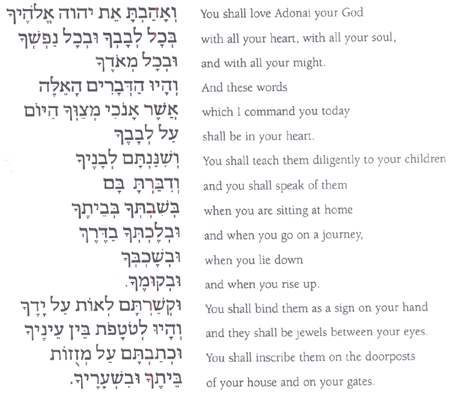
The Jewish Virtual Library declares the Shema is an affirmation of Judaism and a declaration of faith in one God.
The Shema is an affirmation of Judaism and a declaration of faith in one God. The obligation to recite the Shema is separate from the obligation to pray and a Jew is obligated to say Shema in the morning and at night (Deut. 6:7).8 
First & Main Paragraph of the Shema8


Fr. Richard Rohr, OFM, notes that Howard Thurman lovingly critiqued Christianity, which has often ignored the direct teaching and witness of Jesus in relationship with those who are oppressed. He shares an excerpt from one of Thurman’s most well-known books, “Jesus and the Disinherited”.
To those who need profound succor and strength to enable them to live in the present with dignity and creativity, Christianity often has been sterile and of little avail. The conventional Christian word is muffled, confused, and vague. Too often the price exacted by society for security and respectability is that the Christian movement in its formal expression must be on the side of the strong against the weak. This is a matter of tremendous significance, for it reveals to what extent a religion that was born of a people acquainted with persecution and suffering has become the cornerstone of a civilization and of nations whose very position in modern life has too often been secured by a ruthless use of power applied to weak and defenseless peoples.9 
Taking Providence for granted may harden our hearts and limit the fruit of our efforts as disciples of Jesus.

References

1
(n.d.). Exodus, chapter 16 - United States Conference of Catholic Bishops. Retrieved July 24, 2019, from http://www.usccb.org/bible/exodus/16 
2
(n.d.). Psalms, chapter 78 - United States Conference of Catholic Bishops. Retrieved July 24, 2019, from http://www.usccb.org/bible/psalms/78 
3
(n.d.). Matthew, chapter 13 - United States Conference of Catholic Bishops. Retrieved July 24, 2019, from http://www.usccb.org/bible/mt/13:3535 
4
(n.d.). Creighton U Daily Reflections - OnlineMinistries - Creighton University. Retrieved July 24, 2019, from http://onlineministries.creighton.edu/CollaborativeMinistry/daily.html 
5
(n.d.). Daily Scripture Readings and Meditations. Retrieved July 24, 2019, from https://dailyscripture.servantsoftheword.org/ 
6
(n.d.). Meditations - The Word Among Us. Retrieved July 24, 2019, from https://wau.org/meditations/2019/07/24/ 
7
(n.d.). Saint Sharbel Makhluf - Franciscan Media. Retrieved July 24, 2019, from https://www.franciscanmedia.org/saint-sharbel-makhluf/ 
8
(n.d.). The Shema - Jewish Virtual Library. Retrieved July 24, 2019, from https://www.jewishvirtuallibrary.org/the-shema 
9
(2019, July 24). A Subtle Peril — Center for Action and Contemplation. Retrieved July 24, 2019, from https://cac.org/a-subtle-peril-2019-07-24/ 

Tuesday, July 24, 2018

Harmony with the will of God

The texts from the Roman Catholic Lectionary today invite us to contemplate restoration of our relationship with God as we seek to be present to the meaning of being His intimate family members.
Saint Sharbel Makhluf – Franciscan Media. Retrieved July 24, 2018, from https://www.franciscanmedia.org/saint-sharbel-makhluf/

The Prophet Micah describes the restoration of Judah by God who delights in mercy.
* [7:18–20] The final lines of the book contain a hymn of praise for the incomparable God, who pardons sin and delights in mercy. Thus the remnant, those left after the exile, is confident in God’s compassion and in the ancient promises sworn to the ancestors.
In the Gospel from Matthew, Jesus uses the arrival of His biological family to declare the attitude of those who are living as His spiritual family.
* [12:46–50] See Mk 3:31–35. Matthew has omitted Mk 3:20–21 which is taken up in Mk 3:31 (see note on Mt 12:22–32), yet the point of the story is the same in both gospels: natural kinship with Jesus counts for nothing; only one who does the will of his heavenly Father belongs to his true family.
The Catholic Culture Website marks the optional memorial for St. Sharbel (Charbel) Makhloof with a quote from Thomas Merton. On May 8, 1828 in a mountain village of Beka'kafra, the highest village in the near-east, St. Sharbel (Charbel) Makhloof was born to a poor Maronite family. From childhood his life revealed a calling to "bear fruit as a noble Cedar of Lebanon".
The spirit of Charbel still lives in many people. His miracles include numerous healings of the body and of the spirit. Thomas Merton, the American Hermit, wrote in his journal: "Charbel lived as a hermit in Lebanon—he was a Maronite. He died. Everyone forgot about him. Fifty years later, his body was discovered incorrupt and in short time he worked over 600 miracles. He is my new companion. My road has taken a new turning. It seems to me that I have been asleep for 9 years—and before that I was dead."
Scott McClure notes that Jesus was countercultural in his time on this Earth. Although we are told how countercultural our faith truly is, he feels as though sometimes we can see the world through such a lens of faith and fix our focus on holy men and women as models for our lives to such a point that we can forget this truth.
Who is your neighbor?

To use the words of Fr. Greg Boyle, SJ, Jesus models how expansive and inclusive his jurisdiction is. With an outstretched hand, he welcomes all who do the Father's will. The fullness of our Christian faith cannot exist apart from community just as the love of God derives from God's trinitarian being. Communion is not an abstract theological concept simply to understand but rather a truth to be lived. May we hold each other as brothers and sisters, expand our own jurisdictions and so bring to our world the realization of God's unfailing love.
Don Schwager quotes Gregory the Great (540-604 AD) on “My mother through faith”.
"If someone can become the brother of the Lord by coming to faith, we must ask how one can become also his mother. We must realize that the one who is Christ’s brother and sister by believing becomes his mother by preaching. It is as though one brings forth the Lord and infuses him in the hearts of one's listeners. And that person becomes his mother if through one's voice the love of the Lord is generated in the mind of his neighbor. (excerpt from FORTY GOSPEL HOMILIES 3.2)
The Word Among Us Meditation on Matthew 12:46-50 comments that in today’s Gospel, Jesus is saying is that something more powerful than a bloodline defines who belongs to his family.
Jesus placed this band of disciples on par with his own mother—sit with this truth for a moment. Now tell yourself that he thinks the same about you. You are in exactly the same situation: you are brother or sister or mother to Jesus. You want to please him; you want to follow him; you want to become more like him. Of course you’re going to stumble along the way, but you can still be sure of this reality: Jesus loves you just as you are right now.
Isaac Villegas is pastor of Chapel Hill (N.C.) Mennonite Fellowship. He comments that Mary reveals the passive power of surrender to God—“I am the servant of the Lord. Be it done to me according to your word.” The Most High comes to rest in the weak.
God desires people who offer their lives as spaces where good news is born. Mary’s hospitality to God, Moore writes, shows the kind of surrender that leads to “the forming of Christ in us as in her womb.” When we surrender ourselves to God, the Holy Spirit overshadows our body and begins to form Christ’s presence. Christians are weak people who make room for God. Discipleship is our unceasing struggle to welcome God into our midst, as Mary does, so that something unspeakably new and wonderful may be born in our world.
Franciscan Media reflects on the memorial of Saint Sharbel Makhluf. John Paul II often said that the Church has two lungs—East and West—and it must learn to breathe using both of them.
Remembering saints like Sharbel helps the Church to appreciate both the diversity and unity present in the Catholic Church. Like all the saints, Sharbel points us to God and invites us to cooperate generously with God’s grace, no matter what our situation in life may be. As our prayer life becomes deeper and more honest, we become more ready to make that generous response.
Friar Jude Winkler comments on the restoration of the Israelites and the way that Micah links it to the Exodus from Egypt. Jesus is told his “cousins” are outside in Catholic Tradition that Mary had one child. Our familiarity can often blind us to the gifts that others see in our love ones, Friar Jude suggests.

Fr. Richard Rohr, OFM, declares that in all his life as a Catholic, He has held the orthodox belief that the “Real Presence” of Christ is communicated in the bread and wine of the sacred meal (rather shockingly taught by Jesus in John 6:35-58). This is not a magical idea, but simply the mystery of incarnation taken to its logical conclusion.
The Eucharist is an encounter of the heart, knowing Presence through our available presence. In the Eucharist, we move beyond mere words or rational thought and go to that place where we don’t talk about the Mystery; we begin to chew on it
We must move our knowing to the bodily, cellular, participative, and unitive level. Then we keep eating and drinking the Mystery until one day it dawns on us, in an undefended moment, “My God, I really am what I eat!” Henceforth we can trust and allow what has been true since the first moment of our existence: We are the very Body of Christ.

References

(n.d.). Micah, chapter 7 - United States Conference of Catholic Bishops. Retrieved July 24, 2018, from http://www.usccb.org/bible/micah/7

(n.d.). Matthew, chapter 12 - United States Conference of Catholic Bishops. Retrieved July 24, 2018, from http://www.usccb.org/bible/matthew/12

(2018, July 24). Optional Memorial of St. Sharbel (Charbel) Makhloof ... - Catholic Culture. Retrieved July 24, 2018, from https://www.catholicculture.org/culture/liturgicalyear/calendar/day.cfm?date=2018-07-24

(n.d.). Creighton U Daily Reflections .... Retrieved July 24, 2018, from http://onlineministries.creighton.edu/CollaborativeMinistry/daily.html

(n.d.). Daily Scripture Readings and Meditations. Retrieved July 24, 2018, from http://dailyscripture.servantsoftheword.org/

(n.d.). Saint Bridget, Religious (Optional Memorial - Mass Readings and .... Retrieved July 24, 2018, from https://wau.org/meditations/

(n.d.). Pregnant with God - The Mennonite. Retrieved July 24, 2018, from https://themennonite.org/opinion/pregnant-god/

(n.d.). Saint Sharbel Makhluf – Franciscan Media. Retrieved July 24, 2018, from https://www.franciscanmedia.org/saint-sharbel-makhluf/

(n.d.). Daily Meditations Archives - Center for Action and Contemplation. Retrieved July 24, 2018, from https://cac.org/category/daily-meditations/