Showing posts with label disinherited. Show all posts

Friday, July 23, 2021

Living the Great Commandment

The texts from the Roman Catholic Lectionary today invite us to exercise our freedom and ponder the details of our surrender to the direction of the Great Commandment.
Direction for the journey


The reading from the Book of Exodus presents the Ten Commandments.

* [20:117] The precise numbering and division of these precepts into “ten commandments” is somewhat uncertain. Traditionally among Catholics and Lutherans vv. 16 are considered as only one commandment, and v. 17 as two. The Anglican, Greek Orthodox, and Reformed churches count vv. 16 as two, and v. 17 as one. Cf. Dt 5:621. The traditional designation as “ten” is not found here but in 34:28 (and also Dt 4:13 and 10:4), where these precepts are alluded to literally as “the ten words.” That they were originally written on two tablets appears in Ex 32:1516; 34:2829; Dt 4:13; 10:24.1
 

Psalm 19 praises God’s Glory in Creation and the Law.

* [Psalm 19] The heavenly elements of the world, now beautifully arranged, bespeak the power and wisdom of their creator (Ps 19:27). The creator’s wisdom is available to human beings in the law (Ps 19:811), toward which the psalmist prays to be open (Ps 19:1214). The themes of light and speech unify the poem.2 

In the Gospel of Matthew, the Parable of the Sower is explained by Jesus.

* [13:1823] See Mk 4:1420; Lk 8:1115. In this explanation of the parable the emphasis is on the various types of soil on which the seed falls, i.e., on the dispositions with which the preaching of Jesus is received. The second and third types particularly are explained in such a way as to support the view held by many scholars that the explanation derives not from Jesus but from early Christian reflection upon apostasy from the faith that was the consequence of persecution and worldliness, respectively. Others, however, hold that the explanation may come basically from Jesus even though it was developed in the light of later Christian experience. The four types of persons envisaged are (1) those who never accept the word of the kingdom (Mt 13:19); (2) those who believe for a while but fall away because of persecution (Mt 13:2021); (3) those who believe, but in whom the word is choked by worldly anxiety and the seduction of riches (Mt 13:22); (4) those who respond to the word and produce fruit abundantly (Mt 13:23).3 

Jeanne Schuler notes that for some, laws are engraved in black and white. They rule with a rod.  Don’t ask questions. Don’t think. Just obey. Only the few with authority get to judge. These views diminish our humanity. If God wants robots, there is no need for law.

Law depends on freedom.  As reflection deepens, the law illumines diverse strands in the situations we face.  We ponder complexity, seek understanding, and detest hypocrisy.  The commandments we memorized as children continue to go deeper.  Young and old bring insights to the table.  The spirit speaks through this motley crowd.  We listen closely and stumble forward together. Some are aware of their freedom and frailty.  Sinners, they are not immobilized by their defects.  The seed drops into their soul and erupts with energy.  The poor know the richness of God.4
 

Don Schwager quotes “God's word is like good seed sown in the heart,” by Jerome (347-420 AD).

"'And the one sown upon good ground is he who hears the word, understands it and bears fruit.' Even as on bad ground there were three diverse situations (by the path, upon rocky ground and among thorns), so too on good ground the diversity is of three types: fruit of one hundredfold, sixtyfold and thirtyfold. Both in one and the other there is a change that takes place in the will, not in the nature itself. In both the unbelievers and believers it is the heart that receives the seed. 'The wicked one comes,' he says, 'and snatches away what has been sown in his heart.' In the second and third cases, he says, 'That is he who hears the word.' In the explanation of the good ground, he is the one who hears the word. First we must listen, then understand; after understanding, we must bear the fruits of good teaching and yield fruit either one hundredfold, sixtyfold or thirtyfold." (excerpt from COMMENTARY ON MATTHEW 2.13.23)5 

The Word Among Us Meditation on Matthew 13:18-23 comments that Jesus identifies three types of obstacles in the parable: the lies of the devil, the lack of deep roots, and the lures and anxieties of the world. First, the devil can steal away the seed of truth by whispering into our hearts lies that close us off to the gospel message. Second, if we lack deep roots in the word of God, suffering and challenges can drain our joy in the Lord. Lastly, the anxieties and ambitions of the world can crowd our hearts, leaving little room for the word of God to grow and take root.

So don’t look only at the person you are. Remember the person God made you to be. Let Jesus become the gardener of your heart. He can make even the rockiest ground into the richest of soil! “Jesus, help me remove any obstacles to your word in my heart. Lord, I want to bear great fruit for you!”6
 

Franciscan Media for the memorial of St. Bridget notes that in 1999, Bridget, Saint Catherine of Siena and Saint Teresa Benedicta of the Cross, were named co-patronesses of Europe.

Bridget’s visions, rather than isolating her from the affairs of the world, involved her in many contemporary issues, whether they be royal policy or the years that the legitimate Bishop of Rome lived in Avignon, France. She saw no contradiction between mystical experience and secular activity, and her life is a testimony to the possibility of a holy life in the marketplace.7 

Friar Jude Winkler notes the Ten Commandments first treat our relationship to God and then address our life with our neighbours. In ancient times, the Commandments were a gift to people who feared offending God in unknown ways. Friar Jude connects the Parable of the Sower to the themes of the Great Commandment to love God with our mind, soul and material possessions.


Fr. Richard Rohr, OFM, considers the “disinherited,” using the term from the African American author and mystic Howard Thurman (1899–1981). Jesus’ primary audience for the Sermon on the Mount would have been the “disinherited,” God is mindful of the individual. This is of tremendous import in dealing with fear as a disease. In this world, the socially disadvantaged individual is constantly given a negative answer to the most important personal questions upon which mental health depends: “Who am I? What am I?”

The first question has to do with a basic self-estimate, a profound sense of belonging, of counting. If people feel that they do not belong in the way in which it is perfectly normal for other people to belong, then they develop a deep sense of insecurity. When this happens to a person, it provides the basic material for what the psychologist calls an inferiority complex. . . . The awareness of being a child of God tends to stabilize the ego and results in a new courage, fearlessness, and power. I have seen it happen again and again.8 

Our status as children of God and our awareness of our obligations to others strengthens our resolve to journey with Christ to fullness of life.


References

1

(n.d.). Exodus, CHAPTER 20 | USCCB. Retrieved July 23, 2021, from https://bible.usccb.org/es/node/3249 

2

(n.d.). Psalms, PSALM 19 | USCCB. Retrieved July 23, 2021, from https://bible.usccb.org/bible/psalms/19 

3

(n.d.). Matthew, CHAPTER 13 | USCCB. Retrieved July 23, 2021, from https://bible.usccb.org/bible/matthew/13 

4

(n.d.). Creighton U Daily Reflections - Online Ministries - Creighton University. Retrieved July 23, 2021, from https://onlineministries.creighton.edu/CollaborativeMinistry/072321.html 

5

(n.d.). Daily Scripture Readings and Meditations. Retrieved July 23, 2021, from https://www.dailyscripture.net/daily-meditation/?ds_year=2021&date=jul23 

6

(n.d.). The Word Among Us: Homepage. Retrieved July 23, 2021, from https://wau.org/meditations/2021/07/23/190377/ 

7

(n.d.). Saint Bridget of Sweden | Franciscan Media. Retrieved July 23, 2021, from https://www.franciscanmedia.org/saint-of-the-day/saint-bridget-of-sweden 

8

(2021, July 18). The Sermon on the Mount Archives — Center for Action and .... Retrieved July 23, 2021, from https://cac.org/preaching-to-the-disinherited-2021-07-23/ 

Wednesday, July 24, 2019

Providing for growth

The texts from the Roman Catholic Lectionary on the Memorial of Lebanese Saint Sharbel Makhlūf connect us to ancient examples of Providence and modern neglect of the disinherited.
Source: https://www.franciscanmedia.org/wp-content/uploads/2016/07/SOD-0724-SaintSharbelMakhlouf-790x480.jpg

The passage from the Book of Exodus describes the complaints of the Israelites in the Wilderness of Sin and the response from God of Bread from heaven.
 * [16:4] Bread from heaven: as a gift from God, the manna is said to come down from the sky. Cf. Ps 78:24–25; Wis 16:20. Perhaps it was similar to a natural substance that is still found in small quantities on the Sinai peninsula—probably the honey-like resin from the tamarisk tree—but here it is, at least in part, clearly an extraordinary sign of God’s providence. With reference to Jn 6:32, 49–52, the Christian tradition has regarded the manna as a type of the Eucharist. Test: as the text stands, it seems to leave open the question whether the test concerns trusting in God to provide them with the daily gift of food or observing the sabbath instructions.1
Psalm 78 prays about the manna and the quail.
* [78:23–31] On the manna and the quail, see Ex 16 and Nm 11. Unlike Ex 16, here both manna and quail are instruments of punishment, showing that a divine gift can become deadly because of Israel’s apostasy.2 
In the text from the Gospel from Matthew, Jesus offers the Parable of the Sower.
* [13:3–8] Since in Palestine sowing often preceded plowing, much of the seed is scattered on ground that is unsuitable. Yet while much is wasted, the seed that falls on good ground bears fruit in extraordinarily large measure. The point of the parable is that, in spite of some failure because of opposition and indifference, the message of Jesus about the coming of the kingdom will have enormous success.3 
Tom Quinn comments that Jesus’ simple parable summarizes our own struggle to seek the best ground to nurture our faith.
 If we successfully avoid the weeds that we all live among, and spiritually dry and shallow places, we will thrive and produce fruit “a hundred-fold”.  Seek the good earth, grow in the spirit, and praise God. We surely will produce in many ways. Our daily lives, those whom we influence or influence us, and our service to others will, in fact, provide the good soil that faith must have in order to flourish.4
Don Schwager quotes “Shallow and rootless minds,” by Cyril of Alexandria (375-444 AD).
 "Let us look, as from a broader perspective, at what it means to be on the road. In a way, every road is hardened and foolish on account of the fact that it lies beneath everyone's feet. No kind of seed finds there enough depth of soil for a covering. Instead, it lies on the surface and is ready to be snatched up by the birds that come by. Therefore those who have in themselves a mind hardened and, as it were, packed tight do not receive the divine seed but become a well-trodden way for the unclean spirits. These are what is here meant by 'the birds of the heaven.' But 'heaven' we understand to mean this air, in which the spirits of wickedness move about, by whom, again, the good seed is snatched up and destroyed. Then what are those upon the rock? They are those people who do not take much care of the faith they have in themselves. They have not set their minds to understand the touchstone of the mystery [of communion with Christ]. The reverence these people have toward God is shallow and rootless. It is in times of ease and fair weather that they practice Christianity, when it involves none of the painful trials of winter. They will not preserve their faith in this way, if in times of tumultuous persecution their soul is not prepared for the struggle." (Excerpt from FRAGMENT 168)5
The Daily Meditation from the Word Among Us on Exodus 16:1-5, 9-15 suggests how easy it can be for us to lose sight of the gift that Jesus gives us in the Bread of Life. After all, we believe that at every Mass, no matter what else happens, ordinary bread and wine are transformed into Jesus’ sacred Body and Blood. Day in, day out, year after year, the same miracle happens on countless altars throughout the world.

On one level, it’s understandable that receiving the Eucharist can become routine for us. We might even begin to lose sight of how special it is. Don’t let that happen! Don’t ever lose faith in what Jesus can do for you through the Eucharist! Before God gave them the manna, the Israelites faced the very real threat of starving to death in the harsh wilderness of Sinai. Similarly, if we didn’t have Jesus’ Body and Blood to nourish and empower us, we too would be lost in the desert of this world. We too would have little hope of reaching the promised land of heaven.
So treasure this gift. At every Mass, be sure you call to mind what it is that you are receiving. Let the truths behind the Bread of Life bring you to the altar with a new openness to God’s power and grace.6 

In the Franciscan Media reflection on Saint Sharbel Makhluf John Paul II is cited as saying that the Church has two lungs—East and West—and it must learn to breathe using both of them. Remembering saints like Sharbel helps the Church to appreciate both the diversity and unity present in the Catholic Church. Like all the saints, Sharbel points us to God and invites us to cooperate generously with God’s grace, no matter what our situation in life may be. As our prayer life becomes deeper and more honest, we become more ready to make that generous response.
Following the example of the fifth-century Saint Maron, Sharbel lived as a hermit from 1875, until his death. His reputation for holiness prompted people to seek him to receive a blessing and to be remembered in his prayers. He followed a strict fast and was very devoted to the Blessed Sacrament. When his superiors occasionally asked him to administer the sacraments to nearby villages, Sharbel did so gladly.7
Friar Jude Winkler explains the seemingly continuous ingratitude of the Israelites in the desert. The parable of the sower connects to the ancient commandment to Love God. Friar Jude connects the parable to the commandment.


Parable of the sower
Shema Israel
Friar Jude associations
path
heart
intellect
Rocky ground
soul
Life in persecution
thorns
strength
Physical possessions


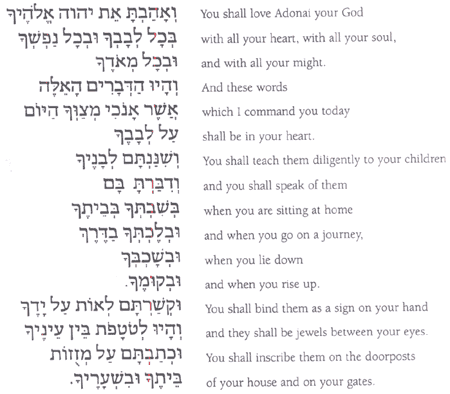
The Jewish Virtual Library declares the Shema is an affirmation of Judaism and a declaration of faith in one God.
The Shema is an affirmation of Judaism and a declaration of faith in one God. The obligation to recite the Shema is separate from the obligation to pray and a Jew is obligated to say Shema in the morning and at night (Deut. 6:7).8 
First & Main Paragraph of the Shema8


Fr. Richard Rohr, OFM, notes that Howard Thurman lovingly critiqued Christianity, which has often ignored the direct teaching and witness of Jesus in relationship with those who are oppressed. He shares an excerpt from one of Thurman’s most well-known books, “Jesus and the Disinherited”.
To those who need profound succor and strength to enable them to live in the present with dignity and creativity, Christianity often has been sterile and of little avail. The conventional Christian word is muffled, confused, and vague. Too often the price exacted by society for security and respectability is that the Christian movement in its formal expression must be on the side of the strong against the weak. This is a matter of tremendous significance, for it reveals to what extent a religion that was born of a people acquainted with persecution and suffering has become the cornerstone of a civilization and of nations whose very position in modern life has too often been secured by a ruthless use of power applied to weak and defenseless peoples.9 
Taking Providence for granted may harden our hearts and limit the fruit of our efforts as disciples of Jesus.

References

1
(n.d.). Exodus, chapter 16 - United States Conference of Catholic Bishops. Retrieved July 24, 2019, from http://www.usccb.org/bible/exodus/16 
2
(n.d.). Psalms, chapter 78 - United States Conference of Catholic Bishops. Retrieved July 24, 2019, from http://www.usccb.org/bible/psalms/78 
3
(n.d.). Matthew, chapter 13 - United States Conference of Catholic Bishops. Retrieved July 24, 2019, from http://www.usccb.org/bible/mt/13:3535 
4
(n.d.). Creighton U Daily Reflections - OnlineMinistries - Creighton University. Retrieved July 24, 2019, from http://onlineministries.creighton.edu/CollaborativeMinistry/daily.html 
5
(n.d.). Daily Scripture Readings and Meditations. Retrieved July 24, 2019, from https://dailyscripture.servantsoftheword.org/ 
6
(n.d.). Meditations - The Word Among Us. Retrieved July 24, 2019, from https://wau.org/meditations/2019/07/24/ 
7
(n.d.). Saint Sharbel Makhluf - Franciscan Media. Retrieved July 24, 2019, from https://www.franciscanmedia.org/saint-sharbel-makhluf/ 
8
(n.d.). The Shema - Jewish Virtual Library. Retrieved July 24, 2019, from https://www.jewishvirtuallibrary.org/the-shema 
9
(2019, July 24). A Subtle Peril — Center for Action and Contemplation. Retrieved July 24, 2019, from https://cac.org/a-subtle-peril-2019-07-24/