Showing posts with label Psalm 31. Show all posts

Tuesday, September 15, 2026

Paradox and Pain

 The texts from the Roman Catholic Lectionary today, Memorial of Our Lady of Sorrows, guide us to contemplate the sorrow and pain of our journey and how it informs our faith.
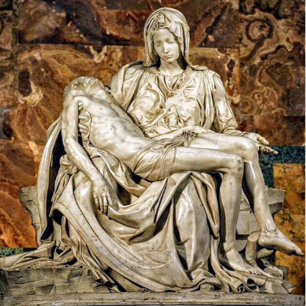
Michelangelo's Pietà is a famous Renaissance marble sculpture housed in St. Peter's Basilica, Vatican City, that shows the Virgin Mary holding the dead body of Jesus


The Reading from the Letter to the Hebrews reflects on our experience of the trials and weakness of human nature, especially fear of death.


* [5:6–8] The author of Hebrews is the only New Testament writer to cite Ps 110:4, here and in Heb 7:17, 21, to show that Jesus has been called by God to his role as priest. Heb 5:7–8 deal with his ability to sympathize with sinners, because of his own experience of the trials and weakness of human nature, especially fear of death. In his present exalted state, weakness is foreign to him, but he understands what we suffer because of his previous earthly experience.

* [5:7] He offered prayers…to the one who was able to save him from death: at Gethsemane (cf. Mk 14:35), though some see a broader reference (see note on Jn 12:27).

* [5:8] Son though he was: two different though not incompatible views of Jesus’ sonship coexist in Hebrews, one associating it with his exaltation, the other with his preexistence. The former view is the older one (cf. Rom 1:4). (Hebrews, CHAPTER 5 | USCCB, n.d.)


Psalm 31 presents a lament with a strong emphasis on trust.


* [Psalm 31] A lament (Ps 31:2–19) with a strong emphasis on trust (Ps 31:4, 6, 15–16), ending with an anticipatory thanksgiving (Ps 31:20–24). As is usual in laments, the affliction is couched in general terms. The psalmist feels overwhelmed by evil people but trusts in the “God of truth” (Ps 31:6).

* [31:6] Into your hands I commend my spirit: in Lk 23:46 Jesus breathes his last with this Psalm verse. Stephen in Acts 7:59 alludes to these words as he is attacked by enemies. The verse is used as an antiphon in the Divine Office at Compline, the last prayer of the day. (Psalms, PSALM 31 | USCCB, n.d.)


The Gospel of Luke presents Mary considering the various reactions to the role of Jesus.


* [2:35] (And you yourself a sword will pierce): Mary herself will not be untouched by the various reactions to the role of Jesus (Lk 2:34). Her blessedness as mother of the Lord will be challenged by her son who describes true blessedness as “hearing the word of God and observing it” (Lk 11:27–28 and Lk 8:20–21). (Luke, CHAPTER 2 | USCCB, n.d.)


 This scene in the Gospel of John has been interpreted literally and symbolically.


* [19:25] It is not clear whether four women are meant, or three (i.e., Mary the wife of Cl[e]opas [cf. Lk 24:18] is in apposition with his mother’s sister) or two (his mother and his mother’s sister, i.e., Mary of Cl[e]opas and Mary of Magdala). Only John mentions the mother of Jesus here. The synoptics have a group of women looking on from a distance at the cross (Mk 15:40).

* [19:26–27] This scene has been interpreted literally, of Jesus’ concern for his mother; and symbolically, e.g., in the light of the Cana story in Jn 2 (the presence of the mother of Jesus, the address woman, and the mention of the hour) and of the upper room in Jn 13 (the presence of the beloved disciple; the hour). Now that the hour has come (Jn 19:28), Mary (a symbol of the church?) is given a role as the mother of Christians (personified by the beloved disciple); or, as a representative of those seeking salvation, she is supported by the disciple who interprets Jesus’ revelation; or Jewish and Gentile Christianity (or Israel and the Christian community) are reconciled. (John, CHAPTER 19 | USCCB, n.d.)


Michele Bogard comments that today we celebrate the Memorial of Our Lady of Sorrows. Today’s Gospel from John is short but impactful. Jesus, despite his suffering, turns to his mother and plans for her future. A new family is formed as He asks the disciple to care for his mother post his death.


As I prayed with today’s readings, my mind wandered. How horrific would it be to have to bury your child and live beyond that day? What a human guttural reaction that is. My mind then wandered to a magnet on my refrigerator of Michelangelo’s Pieta, the sixth sorrow of Mary, as she prepares Jesus for burial. I bought that magnet years ago in the Vatican, as I was in Rome visiting our students studying abroad. There were so many feasts for the eye touring the Vatican, but this statue took my breath away. It’s a depiction of Mary’s grief but also her acceptance of God’s will. Some say her hand turned upward depicts hope as it is raised towards heaven. (Bogard, 2026)


Don Schwager quotes “Mary stood at the cross with her Son Jesus,” by Ambrose of Milan, 339-397 A.D.


"Mary, the mother of the Lord, stood by her Son's cross. No one has taught me this but the holy Evangelist John. Others have related how the earth was shaken at the Lord's passion, the sky was covered with darkness, the sun withdrew itself (Matthew 27:45) and how the thief was, after a faithful confession, received into paradise (Luke 23:43). John tells us what the others have not told, how the Lord while fixed on the cross called to his mother. He thought it was more important that, victorious over his sufferings, Jesus gave her the offices of piety than that he gave her a heavenly kingdom. For if it is the mark of religion to grant pardon to the thief, it is a mark of much greater piety that a mother is honored with such affection by her Son. 'Behold,' he says, 'your son.' ...'Behold your mother.' Christ testified from the cross and divided the offices of piety between the mother and the disciple...

"Nor was Mary below what was becoming the mother of Christ. When the apostles fled, she stood at the cross and with pious eyes beheld her Son's wounds. For she did not look to the death of her offspring but to the salvation of the world. Or perhaps, because that 'royal hall' [Mary as bearer of the divine King] knew that the redemption of the world would be through the death of her Son, she thought that by her death she also might add something to that universal gift. But Jesus did not need a helper for the redemption of all, who saved all without a helper. This is why he says, 'I am counted among those who go down to the pit. I am like those who have no help' (Psalm 88:4-5). He received indeed the affection of his mother but sought not anothers help. Imitate her, holy mothers, who in her only dearly beloved Son set forth so great an example of maternal virtue. For neither have you sweeter children, nor did the Virgin seek the consolation of being able to bear another son." (excerpt from LETTER 63.109-11) (Schwager, n.d.)


Friar Jude Winkler comments on the text from the First Letter to the Corinthians as Paul present that the Body of Christ functions with gifts that are different and at the end the gift of speaking in tongues, not as experienced bt the Apostles at Pentecost but in glossolia, an unintelligible audible expression of human words that are gifts which should respect religious services and avoid attraction to ourselves. Jesus on the cross addresses the beloved as son of Mary to take care of her on the personal level. The matrimonial symbolism connects to Jewish custom where the brother marries the widow and raises sons with his name. A figure with a title in the Gospel of John often has a symbolic role. We are the beloved to espouse the Church to produce children with Christ’s name who will be known as Christians. Jesus will become a crisis of acceptance or rejection. A Sword of Sorrow will pierce Mary’s heart, on one level. Friar Jude comments that the understanding in ancient times when the heart was thought to be the locale of thought and intelligence points to Mary’s understanding being pierced by the belief beyond possibility. Through accepting her role in the Birth and Resurrection of Jesus, Mary believed two things she could not understand as a Jewish woman.


The Word Among Us Meditation on John 19:25-27 comments that Mary can remind us that our heavenly Father is trustworthy. Her own life is a testament to that truth. In today’s Gospel, for instance, Jesus said to John from the cross, “Behold, your mother” (John 19:27). He made his mother, Mary, the mother of the whole Church. What an honor and a privilege this was for her—and what a grace for all of us!


Like any good mother, your heavenly mother, Mary, has compassion on you. Just as she stood by Jesus on the cross, she will stand by you as you carry your own crosses. So seek her comfort—and her prayers—every time your heart is sorrowful. Let her assure you, as Jesus did with his disciples, that one day your sorrow will turn to joy (John 16:20)!


“Our Lady of Sorrows, pray that I might always trust in my Father and his plan for my life.” (Meditation on John 19:25-27, n.d.)


Father Richard Rohr, OFM, considers how the apostle Paul identified within himself the many paradoxes that he taught.


It’s almost as if human consciousness was not ready to see this creative tension up to now. Churches have mostly quoted Paul’s letters on the side of structure, unwilling to see his clearly anti-structure opinions, many of which are quite dangerous to a religion that is primarily trying to create order in a disordered world. But neither Jesus nor Paul is especially concerned about order, niceness, or social control. They are concerned about transformation of persons and history and about using the very disorder of people’s lives to bring them to God. That is why both of them called it good news, and why it is a surprising and joyful discovery for any of us who are honest about our state.  


What we largely have in Western religion today is bad news, an attempt to superimpose an impossible order on a world that God allows to be disordered, and in which God even uses the disorder to bring us all to Love. How could we miss or avoid such utter good news? (Rohr, n.d.)


We seek understanding with the inspiration of the Spirit of the role of faith and trust in the plan of God as we navigate the paradox and pain of the sacrifice and sorrow we experience in our life.


References

Bogard, M. (2026, September 15). Daily Reflection September 15, 2026 | Creighton Online Ministries. Creighton Online Ministries. Retrieved September 15, 2026, from https://onlineministries.creighton.edu/daily-reflections/daily-reflection-september-15-2026 

Hebrews, CHAPTER 5 | USCCB. (n.d.). Daily Readings. Retrieved September 15, 2026, from https://bible.usccb.org/bible/hebrews/5? 

John, CHAPTER 19 | USCCB. (n.d.). Daily Bible Readings. Retrieved September 15, 2026, from https://bible.usccb.org/bible/john/19? 

Luke, CHAPTER 2 | USCCB. (n.d.). Daily Bible Readings. Retrieved September 15, 2026, from https://bible.usccb.org/bible/luke/2?33 

Meditation on John 19:25-27. (n.d.). Word Among Us. Retrieved September 15, 2026, from https://wau.org/meditations/2026/09/15/1669365/ 

Psalms, PSALM 31 | USCCB. (n.d.). Daily Readings. Retrieved September 15, 2026, from https://bible.usccb.org/bible/psalms/31? 

Rohr, R. (n.d.). A Man Who Lived and Loved Paradox. Center for Action and Contemplation. Retrieved September 15, 2026, from https://cac.org/daily-meditations/a-man-who-lived-and-loved-paradox/ 

Schwager, D. (n.d.). Standing by the Cross of Jesus. Daily Scripture Readings and Meditations – Daily Scripture Readings and Meditations. Retrieved September 15, 2026, from https://www.dailyscripture.net/daily-meditation/ 


Wednesday, June 17, 2026

A Mantle for Love

 The texts from the Roman Catholic Lectionary today challenge us to examine the practices in our journey that deepen our commitment to be agents of Jesus’ Love.


Food and Full Life


In the Reading from the Second Book of Kings, Elisha Succeeds Elijah.


* [2:9] Double portion of your spirit: as the firstborn son inherited a double portion of his father’s property (Dt 21:17), so Elisha asks to inherit from Elijah his spirit of prophecy in the degree befitting his principal disciple. In Nm 11:17–25, God bestows some of the spirit of Moses on others.

* [2:12] My father: a religious title accorded prophetic leaders; cf. 6:21; 8:9; and 13:14, where King Joash of Israel reacts to Elisha’s own impending death with the same words Elisha uses here.

* [2:14] The LORD, the God of Elijah—where is he now?: the words in Hebrew have an incantatory quality, as if Elisha is invoking both the divine name and the name of his departed master in an attempt to duplicate Elijah’s miracle. (2 Kings, CHAPTER 2 | USCCB, n.d.)


Psalm 31 presents an anticipatory thanksgiving.


* [Psalm 31] A lament (Ps 31:2–19) with a strong emphasis on trust (Ps 31:4, 6, 15–16), ending with an anticipatory thanksgiving (Ps 31:20–24). As is usual in laments, the affliction is couched in general terms. The psalmist feels overwhelmed by evil people but trusts in the “God of truth” (Ps 31:6). (Psalms, CHAPTER 31 | USCCB, n.d.)


The Sermon on the Mount from the Gospel of Matthew presents Jesus Teaching About Prayer, Fasting and Almsgiving.


* [6:1–18] The sermon continues with a warning against doing good in order to be seen and gives three examples, almsgiving (Mt 6:2–4), prayer (Mt 6:5–15), and fasting (Mt 6:16–18). In each, the conduct of the hypocrites (Mt 6:2) is contrasted with that demanded of the disciples. The sayings about reward found here and elsewhere (Mt 5:12, 46; 10:41–42) show that this is a genuine element of Christian moral exhortation. Possibly to underline the difference between the Christian idea of reward and that of the hypocrites, the evangelist uses two different Greek verbs to express the rewarding of the disciples and that of the hypocrites; in the latter case it is the verb apechō, a commercial term for giving a receipt for what has been paid in full (Mt 6:2, 5, 16).

* [6:2] The hypocrites: the scribes and Pharisees, see Mt 23:13, 15, 23, 25, 27, 29. The designation reflects an attitude resulting not only from the controversies at the time of Jesus’ ministry but from the opposition between Pharisaic Judaism and the church of Matthew. They have received their reward: they desire praise and have received what they were looking for.

* [6:16] The only fast prescribed in the Mosaic law was that of the Day of Atonement (Lv 16:31), but the practice of regular fasting was common in later Judaism; cf. Didache 9:1. (Matthew, CHAPTER 6 | USCCB, n.d.)


Greg Dyche thinks the main question is who are you asking to look, people or God?  Elisha is not a hypocrite. He’s not saying “look, look”. 


Jesus is instructing me about intent, “Take care not to perform … in order that people may see” me. I find it difficult to help and ignore the feeling of “look, look”. I used to avoid serving to avoid the temptation.  I have come to believe my own weakness is not a good enough reason to stay out of the game, to not help. I trust I am a work in progress. 


In closing, I’d like to invite you to look into the names of Elijah and Elisha, and how they tell a story of what is happening in the New Testament. Elijah translates as “God is Yahweh.” And Elisha roughly translates as “God is Salvation.” By Elisha asking for a double portion, it’s saying Salvation is the firstborn of Yahweh. (Dyche, n.d.)


Don Schwager quotes “Pray with the angels,” by John Chrysostom, 347-407 A.D.


"When you pray, it is as if you were entering into a palace - not a palace on earth, but far more awesome, a palace in heaven. When you enter there, you do so with complete attentiveness and fitting respect. For in the houses of kings all turmoil is set aside, and silence reigns. Yet here you are being joined by choirs of angels. You are in communion with archangels and singing with the seraphim, who sing with great awe their spiritual hymns and sacred songs to God, the Lord of all. So when you are praying, mingle with these voices, patterning yourself according to their mystical order. It is not to human beings that you are praying but to God, who is present everywhere, who hears even before you speak and who knows already the secrets of the heart. If you pray to this One, you shall receive a great reward. 'For your Father who sees in secret shall reward you openly.' He did not merely say he would give it to you but reward you, as if he himself had made a pledge to you and so honored you with a great honor. Because God himself is hidden, your prayer should be hidden." (excerpt from THE GOSPEL OF MATTHEW, HOMILY 19.3) (Schwager, n.d.)


The Word Among Us Meditation on Matthew 6:1-6, 16-18 comments that we know that fasting is good for us. It helps cleanse our mind of selfish thoughts, and it teaches us the virtue of self-denial. It’s also obvious that almsgiving is good for the poor and the hungry. But those are all “practical” rewards. There are even deeper rewards that God gives us when we practice them.


There’s nothing wrong with seeking the rewards that come from a life of holiness. After all, these rewards reach far more deeply into our hearts and are far more valuable than the rewards that come from selfish acts. In fact, they give us the greatest reward of all: they make us more like Jesus. Who wouldn’t want that?


“Father, I am so grateful that you see and reward me, even in my private acts of love and generosity!” (Meditation on Matthew 6:1-6, 16-18, n.d.)


Friar Jude Winkler comments that the reading from 2 Kings presents the story of Elijah taken up into heaven and how Elisha succeeds him. The guild prophets are told to stay but Elisha joins Elijah. Elisha asks for a double portion of Elijah’s gifts. He receives his request and can return by crossing the Jordan using Elijah’s mantle. The understanding at this time was that Heaven was not a place for people. The idea of heaven was very unusual. Three figures, Moses, Elijah and Enock who walked with God, are attributed to have had unusual deaths. Apocalyptic books are attributed to these figures who have special knowledge of heaven. The passage from the Gospel of Matthew is part of Jesus' Sermon On the Mount and it is in the context of the question of the Jewish people about how to be forgiven when the Temple is destroyed. Jesus' answer directs us to almsgiving, fasting and prayer. We are instructed to do it with the Spirit and hide it even from ourselves. Friar Jude reminds us to seek a turning of our hearts rather than a showing of pride. We seek poverty of spirit as opposed to arrogance and self righteousness.


Fr. Richard Rohr, OFM, introduces Church historian Diana Butler Bass who recounts how some early Christians lived their faith in the way of Jesus. Throughout the first five centuries people understood Christianity primarily as a way of life in the present, not as a doctrinal system, esoteric belief, or promise of eternal salvation. By followers enacting Jesus’s teachings, Christianity changed and improved the lives of its adherents and served as a practical spiritual pathway. This way—and earliest Christians were called “the People of the Way”—bettered existence for countless ancient believers.


Yet love is what Jesus preached—and what he embodied. In the early church, devout Christians tried to embody God’s love and to experience God in such a way that love reshaped their lives. “Love for God is ecstatic, making us go out from ourselves,” wrote Dionysios the Areopagite around 500; “it does not allow the lover to belong anymore to himself [or herself], but he [or she] belongs only to the Beloved.” Not all Christians achieved this; they too struggled with loving God. But Romans frequently criticized the Christian emphasis on love as somehow a little deluded and perhaps prurient, suggesting that followers of the Jesus Way made it known that theirs was a path of love. Early Christians insisted that love—not rationality or politics or even virtue—was the primary bond between God and human beings. Love was God’s symphony, the perfect beauty that human beings experienced through practices of faith—by imitating Christ and following his way. (Rohr, n.d.)


We invoke the Spirit to remind us that “they will know we are Christians by our love” that is energized by our almsgiving, fasting, and prayer.


References

Dyche, G. (n.d.). Daily Reflections. Creighton Online Ministries: Home. Retrieved June 17, 2026, from https://onlineministries.creighton.edu/daily-reflections/daily-reflection-june-17-2026 

Matthew, CHAPTER 6 | USCCB. (n.d.). Daily Readings. Retrieved June 17, 2026, from https://bible.usccb.org/bible/matthew/6? 

Meditation on Matthew 6:1-6, 16-18. (n.d.). Word Among Us. Retrieved June 17, 2026, from https://wau.org/meditations/2026/06/17/1593648/ 

Psalms, CHAPTER 31 | USCCB. (n.d.). Daily Bible Readings, Audio and Video Every Morning | USCCB. Retrieved June 17, 2026, from https://bible.usccb.org/bible/psalms/31?20 

Rohr, R. (n.d.). Christianity: A Love Song. Center for Action and Contemplation. Retrieved June 17, 2026, from https://cac.org/daily-meditations/christianity-a-love-song/ 

Schwager, D. (n.d.). When You Pray, Fast, and Give Alms. Daily Scripture Readings and Meditations – Daily Scripture Readings and Meditations. Retrieved June 17, 2026, from https://www.dailyscripture.net/daily-meditation/ 

2 Kings, CHAPTER 2 | USCCB. (n.d.). Daily Bible Readings, Audio and Video Every Morning | USCCB. Retrieved June 17, 2026, from https://bible.usccb.org/bible/2kings/2?1 


Tuesday, April 21, 2026

Signs of Love in Forgiveness

 The texts from the Roman Catholic Lectionary today present forgiveness as an essential sign of the love we strive to express as followers of Christ.


A Path of Love in Forgiveness


The Reading from the Acts of the Apostles concludes with Stephen’s Martyrdom.


* [7:55] He…saw…Jesus standing at the right hand of God: Stephen affirms to the Sanhedrin that the prophecy Jesus made before them has been fulfilled (Mk 14:62).

* [7:57] Covered their ears: Stephen’s declaration, like that of Jesus, is a scandal to the court, which regards it as blasphemy.

* [7:59] Compare Lk 23:34, 46. (Acts of the Apostles, CHAPTER 7 | USCCB, n.d.)


* [8:1] All were scattered…except the apostles: this observation leads some modern scholars to conclude that the persecution was limited to the Hellenist Christians and that the Hebrew Christians were not molested, perhaps because their attitude toward the law and temple was still more in line with that of their fellow Jews (see the charge leveled against the Hellenist Stephen in Acts 6:13–14). Whatever the facts, it appears that the Twelve took no public stand regarding Stephen’s position, choosing, instead, to await the development of events. (Acts of the Apostles, CHAPTER 8 | USCCB, n.d.)


Psalm 31 declares a strong emphasis on trust in God.


* [Psalm 31] A lament (Ps 31:2–19) with a strong emphasis on trust (Ps 31:4, 6, 15–16), ending with an anticipatory thanksgiving (Ps 31:20–24). As is usual in laments, the affliction is couched in general terms. The psalmist feels overwhelmed by evil people but trusts in the “God of truth” (Ps 31:6). (Psalms, PSALM 31 | USCCB, n.d.)


In the Gospel of John, Jesus presents Bread from heaven.


* [6:31] Bread from heaven: cf. Ex 16:4, 15, 32–34 and the notes there; Ps 78:24. The manna, thought to have been hidden by Jeremiah (2 Mc 2:5–8), was expected to reappear miraculously at Passover, in the last days. (John, CHAPTER 6 | USCCB, n.d.)


Colette O’Meara-McKinney comments that in today’s reading, Stephen the Martyr models something remarkable: he found peace in the middle of chaos. He spoke truth with confidence and accepted the consequences with courage.


I’ve been fortunate. Close family and trusted friends have challenged me at pivotal moments. I clearly remember a dear friend who called me out for lacking clear priorities and neglecting my responsibilities to the people I cared about. It was hard to hear. It was even harder not to respond defensively. But it was accurate — and it changed me.


This Lenten season, I’m challenging myself to cultivate an interior freedom — a quiet, centered place from which I can act with calm, clarity, and conviction. A place from which I can say the hard words, take meaningful action, and listen with genuine care.


That interior freedom — the freedom to choose courage — is an anchor. My prayer is that we each find our anchors in times of struggle and in seasons of abundance. May we find clarity in our convictions, and the will to live them out in honest, wholehearted action. (O'Meara-McKinney, n.d.)


Don Schwager quotes Trusting in the Lord, by Augustine of Hippo, 354-430 A.D.


"If you put your trust in money, you are paying futile regard to vain things; if you put your trust in high office or some exalted rank in human government, you are paying futile regard to vain things... When you put your trust in all these, either you expire and leave them all behind, or they will crumble while you are still alive, and what you trusted will have let you down... For my part, I do not put my trust in empty things as they do or pay futile regard to them; I have put my trust in the Lord." (excerpt from Exposition on the Psalms 31,12) (Schwager, n.d.)


The Word Among Us Meditation on Acts 7:51–8:1 comments that forgiveness is not optional for believers. God actually commands us to forgive those who have sinned against us. He expects us to forgive minor offenses, such as someone who snubs us, ignores us, or directs a sarcastic remark at us. Even though it can be very difficult and can take time, he also wants us to forgive family members or friends who have hurt us, betrayed us, or failed to help us when we most needed it.


If you are struggling to forgive someone, know that the grace of Jesus’ resurrection is available to you. If the offense is so serious that you don’t see how you could possibly forgive, just take the first step and ask God to forgive that person for you. Then, day by day, ask him to help you extend the same forgiveness. Ask your pastor or a close friend or counselor for help if you need to. It might be hard at first, but over time you will experience not only freedom from anger but also the joy of the risen Lord.


“Lord, help me to forgive anyone who has wronged me!” (Meditation on Acts 7:51–8:1, n.d.)


Friar Jude Winkler comments that, in the Acts passage, Stephen is arrested and suffers mob justice and recites a history of the rejection of God of the Jews and He sees Jesus standing at the right hand of God. As he is being stoned he forgives and implores God to receive his spirit. When someone is martyred Jesus is with them. Paul, who is Saul in Aramaic, is at their side. He is consenting to this action. Luke uses foreshadowing in his writing. Saul will become a main character. In the Gospel of John, Jesus accuses the people of ignoring signs. What are you going to perform after the loaves and fishes feed thousands. Jesus will satisfy as the true bread from heaven. Friar Jude presents the sign that He will satisfy the greatest hunger of their hearts.


Fr. Richard Rohr, OFM, comments that the healing focus of the gospel became corrupted when we made it about securing a “ticket” for the next world, rather than experiencing aliveness in this one. Many of us are tempted to seek an escape from this moment instead of trusting that God’s healing is possible for us now — that even this moment can be good. We have treated “repentance” as the price of our heavenly ticket, when it actually means “a change of mind” — a transformation for the better. Geri, a Daily Meditations reader, shares her own story of healing with us:


I had my world fractured last year after my husband passed away from cancer. I have been grieving his loss and at the same time grieving what’s been going on in our country. Sometimes the sadness and anger I feel are overwhelming. But every day, I pray for healing for myself and the world around me. I want to be an instrument of Christ’s peace, whatever that entails. Thank you, Father Richard Rohr, and staff of CAC, for helping me through these uncertain and painful times! (Rohr, n.d.)


We seek the inspiration of the Spirit to act in the realization that forgiveness is a gift to those we feel have wronged us that shines a light on our source of fullness of life in Jesus.


References

Acts of the Apostles, CHAPTER 7 | USCCB. (n.d.). Daily Readings. Retrieved April 21, 2026, from https://bible.usccb.org/bible/acts/7 

Acts of the Apostles, CHAPTER 8 | USCCB. (n.d.). Daily Readings. Retrieved April 21, 2026, from https://bible.usccb.org/bible/acts/8? 

John, CHAPTER 6 | USCCB. (n.d.). Daily Readings. Retrieved April 21, 2026, from https://bible.usccb.org/bible/john/6?22 

Meditation on Acts 7:51–8:1. (n.d.). Word Among Us. Retrieved April 21, 2026, from https://wau.org/meditations/2026/04/21/1547603/ 

O'Meara-McKinney, C. (n.d.). Daily Reflections. Creighton Online Ministries: Home. Retrieved April 21, 2026, from https://onlineministries.creighton.edu/daily-reflections/daily-reflection-april-21-2026 

Psalms, PSALM 31 | USCCB. (n.d.). Daily Readings. Retrieved April 21, 2026, from https://bible.usccb.org/bible/psalms/31? 

Rohr, R. (n.d.). Daily Meditations — Center for Action and Contemplation. Healing for a Hurting World. Retrieved April 21, 2026, from https://cac.org/daily-meditations/a-special-note-from-father-richard-healing-for-a-hurting-world/ 

Schwager, D. (n.d.). I Am the Bread of Life. Daily Scripture Readings and Meditations – Daily Scripture Readings and Meditations. Retrieved April 21, 2026, from https://www.dailyscripture.net/daily-meditation/