The texts from the Roman Catholic Lectionary today, Memorial of Our Lady of Sorrows, guide us to contemplate the sorrow and pain of our journey and how it informs our faith.
The Reading from the Letter to the Hebrews reflects on our experience of the trials and weakness of human nature, especially fear of death.
* [5:6–8] The author of Hebrews is the only New Testament writer to cite Ps 110:4, here and in Heb 7:17, 21, to show that Jesus has been called by God to his role as priest. Heb 5:7–8 deal with his ability to sympathize with sinners, because of his own experience of the trials and weakness of human nature, especially fear of death. In his present exalted state, weakness is foreign to him, but he understands what we suffer because of his previous earthly experience.
* [5:7] He offered prayers…to the one who was able to save him from death: at Gethsemane (cf. Mk 14:35), though some see a broader reference (see note on Jn 12:27).
* [5:8] Son though he was: two different though not incompatible views of Jesus’ sonship coexist in Hebrews, one associating it with his exaltation, the other with his preexistence. The former view is the older one (cf. Rom 1:4). (Hebrews, CHAPTER 5 | USCCB, n.d.)
Psalm 31 presents a lament with a strong emphasis on trust.
* [Psalm 31] A lament (Ps 31:2–19) with a strong emphasis on trust (Ps 31:4, 6, 15–16), ending with an anticipatory thanksgiving (Ps 31:20–24). As is usual in laments, the affliction is couched in general terms. The psalmist feels overwhelmed by evil people but trusts in the “God of truth” (Ps 31:6).
* [31:6] Into your hands I commend my spirit: in Lk 23:46 Jesus breathes his last with this Psalm verse. Stephen in Acts 7:59 alludes to these words as he is attacked by enemies. The verse is used as an antiphon in the Divine Office at Compline, the last prayer of the day. (Psalms, PSALM 31 | USCCB, n.d.)
The Gospel of Luke presents Mary considering the various reactions to the role of Jesus.
* [2:35] (And you yourself a sword will pierce): Mary herself will not be untouched by the various reactions to the role of Jesus (Lk 2:34). Her blessedness as mother of the Lord will be challenged by her son who describes true blessedness as “hearing the word of God and observing it” (Lk 11:27–28 and Lk 8:20–21). (Luke, CHAPTER 2 | USCCB, n.d.)
This scene in the Gospel of John has been interpreted literally and symbolically.
* [19:25] It is not clear whether four women are meant, or three (i.e., Mary the wife of Cl[e]opas [cf. Lk 24:18] is in apposition with his mother’s sister) or two (his mother and his mother’s sister, i.e., Mary of Cl[e]opas and Mary of Magdala). Only John mentions the mother of Jesus here. The synoptics have a group of women looking on from a distance at the cross (Mk 15:40).
* [19:26–27] This scene has been interpreted literally, of Jesus’ concern for his mother; and symbolically, e.g., in the light of the Cana story in Jn 2 (the presence of the mother of Jesus, the address woman, and the mention of the hour) and of the upper room in Jn 13 (the presence of the beloved disciple; the hour). Now that the hour has come (Jn 19:28), Mary (a symbol of the church?) is given a role as the mother of Christians (personified by the beloved disciple); or, as a representative of those seeking salvation, she is supported by the disciple who interprets Jesus’ revelation; or Jewish and Gentile Christianity (or Israel and the Christian community) are reconciled. (John, CHAPTER 19 | USCCB, n.d.)
Michele Bogard comments that today we celebrate the Memorial of Our Lady of Sorrows. Today’s Gospel from John is short but impactful. Jesus, despite his suffering, turns to his mother and plans for her future. A new family is formed as He asks the disciple to care for his mother post his death.
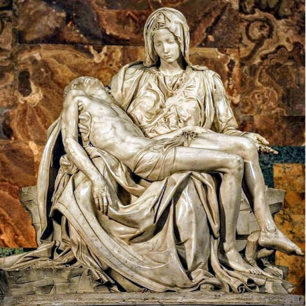
As I prayed with today’s readings, my mind wandered. How horrific would it be to have to bury your child and live beyond that day? What a human guttural reaction that is. My mind then wandered to a magnet on my refrigerator of Michelangelo’s Pieta, the sixth sorrow of Mary, as she prepares Jesus for burial. I bought that magnet years ago in the Vatican, as I was in Rome visiting our students studying abroad. There were so many feasts for the eye touring the Vatican, but this statue took my breath away. It’s a depiction of Mary’s grief but also her acceptance of God’s will. Some say her hand turned upward depicts hope as it is raised towards heaven. (Bogard, 2026)
Don Schwager quotes “Mary stood at the cross with her Son Jesus,” by Ambrose of Milan, 339-397 A.D.
"Mary, the mother of the Lord, stood by her Son's cross. No one has taught me this but the holy Evangelist John. Others have related how the earth was shaken at the Lord's passion, the sky was covered with darkness, the sun withdrew itself (Matthew 27:45) and how the thief was, after a faithful confession, received into paradise (Luke 23:43). John tells us what the others have not told, how the Lord while fixed on the cross called to his mother. He thought it was more important that, victorious over his sufferings, Jesus gave her the offices of piety than that he gave her a heavenly kingdom. For if it is the mark of religion to grant pardon to the thief, it is a mark of much greater piety that a mother is honored with such affection by her Son. 'Behold,' he says, 'your son.' ...'Behold your mother.' Christ testified from the cross and divided the offices of piety between the mother and the disciple...
"Nor was Mary below what was becoming the mother of Christ. When the apostles fled, she stood at the cross and with pious eyes beheld her Son's wounds. For she did not look to the death of her offspring but to the salvation of the world. Or perhaps, because that 'royal hall' [Mary as bearer of the divine King] knew that the redemption of the world would be through the death of her Son, she thought that by her death she also might add something to that universal gift. But Jesus did not need a helper for the redemption of all, who saved all without a helper. This is why he says, 'I am counted among those who go down to the pit. I am like those who have no help' (Psalm 88:4-5). He received indeed the affection of his mother but sought not anothers help. Imitate her, holy mothers, who in her only dearly beloved Son set forth so great an example of maternal virtue. For neither have you sweeter children, nor did the Virgin seek the consolation of being able to bear another son." (excerpt from LETTER 63.109-11) (Schwager, n.d.)
Friar Jude Winkler comments on the text from the First Letter to the Corinthians as Paul present that the Body of Christ functions with gifts that are different and at the end the gift of speaking in tongues, not as experienced bt the Apostles at Pentecost but in glossolia, an unintelligible audible expression of human words that are gifts which should respect religious services and avoid attraction to ourselves. Jesus on the cross addresses the beloved as son of Mary to take care of her on the personal level. The matrimonial symbolism connects to Jewish custom where the brother marries the widow and raises sons with his name. A figure with a title in the Gospel of John often has a symbolic role. We are the beloved to espouse the Church to produce children with Christ’s name who will be known as Christians. Jesus will become a crisis of acceptance or rejection. A Sword of Sorrow will pierce Mary’s heart, on one level. Friar Jude comments that the understanding in ancient times when the heart was thought to be the locale of thought and intelligence points to Mary’s understanding being pierced by the belief beyond possibility. Through accepting her role in the Birth and Resurrection of Jesus, Mary believed two things she could not understand as a Jewish woman.
The Word Among Us Meditation on John 19:25-27 comments that Mary can remind us that our heavenly Father is trustworthy. Her own life is a testament to that truth. In today’s Gospel, for instance, Jesus said to John from the cross, “Behold, your mother” (John 19:27). He made his mother, Mary, the mother of the whole Church. What an honor and a privilege this was for her—and what a grace for all of us!
Like any good mother, your heavenly mother, Mary, has compassion on you. Just as she stood by Jesus on the cross, she will stand by you as you carry your own crosses. So seek her comfort—and her prayers—every time your heart is sorrowful. Let her assure you, as Jesus did with his disciples, that one day your sorrow will turn to joy (John 16:20)!
“Our Lady of Sorrows, pray that I might always trust in my Father and his plan for my life.” (Meditation on John 19:25-27, n.d.)
Father Richard Rohr, OFM, considers how the apostle Paul identified within himself the many paradoxes that he taught.
It’s almost as if human consciousness was not ready to see this creative tension up to now. Churches have mostly quoted Paul’s letters on the side of structure, unwilling to see his clearly anti-structure opinions, many of which are quite dangerous to a religion that is primarily trying to create order in a disordered world. But neither Jesus nor Paul is especially concerned about order, niceness, or social control. They are concerned about transformation of persons and history and about using the very disorder of people’s lives to bring them to God. That is why both of them called it good news, and why it is a surprising and joyful discovery for any of us who are honest about our state.
What we largely have in Western religion today is bad news, an attempt to superimpose an impossible order on a world that God allows to be disordered, and in which God even uses the disorder to bring us all to Love. How could we miss or avoid such utter good news? (Rohr, n.d.)
We seek understanding with the inspiration of the Spirit of the role of faith and trust in the plan of God as we navigate the paradox and pain of the sacrifice and sorrow we experience in our life.
References
Bogard, M. (2026, September 15). Daily Reflection September 15, 2026 | Creighton Online Ministries. Creighton Online Ministries. Retrieved September 15, 2026, from https://onlineministries.creighton.edu/daily-reflections/daily-reflection-september-15-2026
Hebrews, CHAPTER 5 | USCCB. (n.d.). Daily Readings. Retrieved September 15, 2026, from https://bible.usccb.org/bible/hebrews/5?
John, CHAPTER 19 | USCCB. (n.d.). Daily Bible Readings. Retrieved September 15, 2026, from https://bible.usccb.org/bible/john/19?
Luke, CHAPTER 2 | USCCB. (n.d.). Daily Bible Readings. Retrieved September 15, 2026, from https://bible.usccb.org/bible/luke/2?33
Meditation on John 19:25-27. (n.d.). Word Among Us. Retrieved September 15, 2026, from https://wau.org/meditations/2026/09/15/1669365/
Psalms, PSALM 31 | USCCB. (n.d.). Daily Readings. Retrieved September 15, 2026, from https://bible.usccb.org/bible/psalms/31?
Rohr, R. (n.d.). A Man Who Lived and Loved Paradox. Center for Action and Contemplation. Retrieved September 15, 2026, from https://cac.org/daily-meditations/a-man-who-lived-and-loved-paradox/
Schwager, D. (n.d.). Standing by the Cross of Jesus. Daily Scripture Readings and Meditations – Daily Scripture Readings and Meditations. Retrieved September 15, 2026, from https://www.dailyscripture.net/daily-meditation/


