Friday, July 26, 2019

Blessed by our Parents

The texts from the Roman Catholic Lectionary invite us to contemplate the role of our parents and grandparents in forming our spiritual and moral lives.
Grandparent adventure

It is the Feast of Saints Joachim and Anne, parents of the Blessed Virgin Mary. The reading from the Book of Sirach offers praise of Israel’s great ancestors.
 * [44:1–15] The reader is here introduced to those people of Israel, later mentioned by name, who through various achievements and beneficial social activities have acquired great renown (vv. 1–8, 14–15); and also to those who, though forgotten, endure through the fruit of their virtues and through their families because of God’s covenant with them (vv. 9–15).1
Psalm 132 declares God’s promise of favor to the Davidic dynasty (Ps 132:11–12) and to Zion (Ps 132:13–17).
* [Psalm 132] A song for a liturgical ceremony in which the ark, the throne of Israel’s God, was carried in procession to the Temple. The singer asks that David’s care for the proper housing of the ark be regarded with favor (Ps 132:1–5), and tells how it was brought to Jerusalem (Ps 132:6–10). There follows God’s promise of favor to the Davidic dynasty (Ps 132:11–12) and to Zion (Ps 132:13–17). The transfer of the ark to the tent in Jerusalem is described in 2 Sm 6.2 
The Gospel from Matthew presents Jesus Word on the privilege of discipleship.

* [13:16–17] Unlike the unbelieving crowds, the disciples have seen that which the prophets and the righteous of the Old Testament longed to see without having their longing fulfilled.3 

Maureen McCann Waldron comments that being faithful isn’t about the grand gestures or the extraordinary. It is really about the smallest everyday moments in life. Getting children to daycare. Making sure an older parent gets to the doctor. Not getting annoyed at a tiresome co-worker. Making a meal with love. Doing laundry again. And again.
Yet in that hard life, Anne and Joachim were faithful.  They prayed and went to the synagogue together where they would have listened to the scripture.  And they taught Mary what it means to be faithful. To say Yes to a life of lugging water, gathering firewood and washing clothes.  There was no glamour about it, but she learned that God was always with her. She learned to rely on God’s support. She was prepared to say Yes.4 
Don Schwager quotes “God's word is like good seed sown in the heart,” by Saint Jerome (347-420 AD) and he applies it to the Gospel for the Liturgy celebrated when today is not a feast day. (Matthew 13:18-23).
"'And the one sown upon good ground is he who hears the word, understands it and bears fruit.' Even as on bad ground there were three diverse situations (by the path, upon rocky ground and among thorns), so too on good ground the diversity is of three types: fruit of one hundredfold, sixtyfold and thirtyfold. Both in one and the other there is a change that takes place in the will, not in the nature itself. In both the unbelievers and believers it is the heart that receives the seed. 'The wicked one comes,' he says, 'and snatches away what has been sown in his heart.' In the second and third cases, he says, 'That is he who hears the word.' In the explanation of the good ground, he is the one who hears the word. First we must listen, then understand; after understanding, we must bear the fruits of good teaching and yield fruit either one hundredfold, sixtyfold or thirtyfold." (excerpt from COMMENTARY ON MATTHEW 2.13.23)5 
A post by Franciscan Media reflects on Saints Joachim and Anne. The heroism and holiness of these people however, is inferred from the whole family atmosphere around Mary in the Scriptures. Whether we rely on the legends about Mary’s childhood or make guesses from the information in the Bible, we see in her a fulfillment of many generations of prayerful persons, herself steeped in the religious traditions of her people.
 This is the “feast of grandparents.” It reminds grandparents of their responsibility to establish a tone for generations to come: They must make the traditions live and offer them as a promise to little children. But the feast has a message for the younger generation as well. It reminds the young that older people’s greater perspective, depth of experience, and appreciation of life’s profound rhythms are all part of a wisdom not to be taken lightly or ignored.6
Emily Budden shares that to symbolize the Mi’kmaq people’s allegiance to the French and as a sign of good faith, Grand Chief Membertou and 21 of his family members were baptized in 1610. In 1628, the Mi’kmaq adopted St. Anne as their patron saint, but in doing so remained true to their Mi’kmaq ways by continuing to hold Mawio’mi (a traditional gathering; a time for reflection, joy, sharing, goodwill, and the opportunity to connect with the Great Spirit) in traditional gathering places.
Source: https://2eyedhealth.files.wordpress.com/2014/10/chapel-island-photo.jpg?w=300&h=225

A photo of Chapel Island with ribbons of Saint Anne’s cloth.
So next time you are caring for a patient of Mi’Kmaq decent, take note of their ribbon and treat it with pride and respect, for it may be their only source of strength during this difficult time.7
A Google search for “St Anne Parish in Nova Scotia” brings several parish locations Eglise Ste. Anne is the oldest Acadian parish on mainland Nova Scotia. Acadians returning from exile had settled the area in 1767 and built a small chapel for worship. In 1799, Father Jean Mandé Sigogne arrived and officially founded the parish of Ste-Anne. The Beaton Institute has a photo of my parish as a boy, St Anne’s Church in Glace Bay.

Beaton Institute: St Anne's Parish, Glace Bay
Friar Jude Winkler comments on the blessing of the Ten Commandments in freeing the people from living in terror about what God wanted of His people.


Fr. Richard Rohr, OFM invites us to read Howard Thurman’s thoughts on race and relationships.
On the other hand, if Christians practice brotherhood among Christians, this would be one limited step in the direction of a new order among men. Think of what this would mean. Wherever one Christian met or dealt with another Christian, there would be a socially redemptive encounter. They would be like the Gulf Stream or the Japanese Current tempering and softening the climate in all directions. Indeed the Christian would be a leaven at all levels of the community and in public and private living. Of course, such a situation may lend itself to all kinds of exploitation and betrayals—but the Christian would be one of the bulwarks of integrity in human relations in an immoral society.8 
If being Christian does not demand that all Christians love each other and thereby become deeply engaged in experiencing themselves as human beings, it would seem futile to expect that Christians as Christians would be concerned about the secular community in its gross practices of prejudice and discrimination.

References

1
(n.d.). Sirach, chapter 44 - United States Conference of Catholic Bishops. Retrieved July 26, 2019, from http://www.usccb.org/bible/sirach/44 
2
(n.d.). Psalms, chapter 132 - United States Conference of Catholic Bishops. Retrieved July 26, 2019, from http://www.usccb.org/bible/psalms/132 
3
(n.d.). Matthew, chapter 13 - United States Conference of Catholic Bishops. Retrieved July 26, 2019, from http://www.usccb.org/bible/matthew/13 
4
(n.d.). Creighton U Daily Reflections .... Retrieved July 26, 2019, from http://onlineministries.creighton.edu/CollaborativeMinistry/daily.html 
5
(n.d.). Daily Scripture Readings and Meditations. Retrieved July 26, 2019, from https://dailyscripture.servantsoftheword.org/ 
6
(n.d.). Saints Joachim and Anne - Franciscan Media. Retrieved July 26, 2019, from https://www.franciscanmedia.org/saints-joachim-and-anne/ 
7
(2014, October 29). Saint Anne – Grandmother of the Mi'kmaq | Two-Eyed Seeing for Health. Retrieved July 26, 2019, from https://2eyedhealth.wordpress.com/2014/10/29/saint-anne-grandmother-of-the-mikmaq/ 
8
(2019, July 26). Being Christian — Center for Action and Contemplation. Retrieved July 26, 2019, from https://cac.org/being-christian-2019-07-26/ 

Thursday, July 25, 2019

Living in tension of opposites

In the texts from the Roman Catholic Lectionary for the Feast of St James, opposite themes of life and death, weeping and rejoicing, right and left, and authority and service challenge our journey.
Winding road

The reading from the Second Letter of Paul to the Corinthians shares the paradox of Ministry.
* [4:10–11] Both the negative and the positive sides of the experience are grounded christologically. The logic is similar to that of 2 Cor 1:3–11. His sufferings are connected with Christ’s, and his deliverance is a sign that he is to share in Jesus’ resurrection.1 
In Psalm 126 the people rejoice that they are in Zion.
* [Psalm 126] A lament probably sung shortly after Israel’s return from exile. The people rejoice that they are in Zion (Ps 126:1–3) but mere presence in the holy city is not enough; they must pray for the prosperity and the fertility of the land (Ps 126:4). The last verses are probably an oracle of promise: the painful work of sowing will be crowned with life (Ps 126:5–6).2 
Jesus handles the request of James and John for authority in the Gospel from Matthew.
* [20:20–28] Cf. Mk 10:35–45. The request of the sons of Zebedee, made through their mother, for the highest places of honor in the kingdom, and the indignation of the other ten disciples at this request, show that neither the two brothers nor the others have understood that what makes for greatness in the kingdom is not lordly power but humble service. Jesus gives the example, and his ministry of service will reach its highest point when he gives his life for the deliverance of the human race from sin.3 
Larry Gillick, S.J. finds, in the Gospel, something very old, but may seem new. Jesus invites James and John to take their old selves and enter into Jesus’ being Servant. The human James and John, and their mother, would be more attracted to their being in positions of possessions. Here is what is really important now. Jesus invites these two not to being servants, serving God, but following Jesus in serving God’s people.
Jesus has come and continues His coming to be the Servant sent to care or, lead, find and unite God’s family, God’s creation. This is the “treasure” then, not to sit judging how others are serving or not, but accompanying Jesus and His sisters and brothers in caring, nourishing and healing. We serve within the context of earthiness which can grow old. What is new are the ways He invites us to live with the old and face the new opportunities to assist Jesus in the Creator’s constant re-creation.4 
Don Schwager quotes “Not to be served but to serve,” by John Chrysostom (344-407 AD).

   "[Jesus] says, 'The Son of man came not to be served but to serve and to give his life as a ransom for many.' It is as if he were saying, 'I willed not even to stop at death but even in death gave my life as a ransom. For whom? For enemies. For you. If you are abused, my life is given for you. It is for you. Me for you.' So you need not be too picky if you suffer the loss of your honor. No matter how much it is lowered, you will not be descending as far as your Lord descended. And yet the deep descent of one has become the ascent of all. His glory shines forth from these very depths. For before he was made man, he was known among the angels only. But after he was made man and was crucified, so far from lessening that glory, he acquired further glory besides, even that from his personal knowledge of the world."    "So fear not then, as though your honor were put down. Rather, be ready to abase yourself. For in this way your glory is exalted even more, and in this way it becomes greater. This is the door of the kingdom. Let us not then go the opposite way. Let us not war against ourselves. For if we desire to appear great, we shall not be great but even the most dishonored of all. Do you see how everywhere Jesus encourages them by turning things upside down? He gives them what they desire but in ways they did not expect.  (excerpt from THE GOSPEL OF MATTHEW, HOMILY 65.4.25)5 

The Word Among Us Meditation on Matthew 20:20-28 connects St James to Santiago de Compostela, a famous pilgrimage site that thousands of people visit every year to venerate the remains of the apostle James. Most of the pilgrims undertake an arduous journey through the mountains to reach this Spanish town. Many experience a deeper conversion even before they reach their final destination! What is the body of the apostle James doing in Spain?

the story tells that James’ body was transported by a mysterious unmanned ship. And when it arrived in Spain, the ship was secretly buried. “Lost” for centuries, in the Middle Ages his body was found because of a mysterious light illuminating the location. At first, the place was called Campus Stellae, the “Field of the Star.” But over time it was shortened to Compostela. Since, in Spanish, St. James’ name is “Santiago,” the site came to be called Santiago de Compostela.
The story can seem fantastical, but the down-to-earth reality is that ever since a shrine was built in Santiago de Compostela, millions of pilgrims have experienced God’s presence and work in their lives.6 

A post by Jack Wintz, OFM, comments on The Way in discussion with Martin Sheen and his son Emilio Estevez. They connect spirituality with the Camino de Santiago.

When I ask Sheen whether he considers The Way a Catholic film, he responds, “The guy [Tom] is a Catholic, but a non-practicing Catholic. Most of the people we met on the Camino [they filmed on location] were non-practicing Catholics—nondenominational folks—but what unites everyone is the spiritual. It’s a spiritual journey that doesn’t require you to be Catholic. It’s about being human, and about getting in touch with your spirituality.”
Near the end of the interview, I ask Sheen: “When Tom’s pilgrimage comes to an end at the Cathedral of St. James, does Tom return to his childhood faith, namely Catholicism?” Sheen’s response is, “I think he has become a true pilgrim. I think he got his faith back.”7 


Friar Jude Winkler comments on the physical dimension of being an apostle as described by Paul. St. James was one of the earliest martyrs. Friar Jude reminds us of the connection of Jesus to the Son of Man in the Book of Daniel and to the Suffering Servant of the Prophet Isaiah.


Fr. Richard Rohr, OFM, invites us to sit with a question at the end of the meditation, as Howard Thurman and his companion did for five hours—and not rush to a pat, tidy answer. It was at a meeting in Ceylon that the whole crucial issue was pointed up to Howard Thurman by a school principal, after reviewing the history of Christianity and slavery, in a way that he could never forget.
 “I am a Hindu. I do not understand. Here you are in my country, staying deep within the Christian faith and tradition. I do not wish to seem rude to you. But, sir, I think you are a traitor to all the darker peoples of the earth. I am wondering what you, an intelligent man, can say in defense of your position?”8
How are the many opposites of life reconciled in Christ? The faithful disciple journeys among the tensions in the hope of the triumph of Love.

References

1
(n.d.). 2 Corinthians, chapter 4 - United States Conference of Catholic Bishops. Retrieved July 25, 2019, from http://www.usccb.org/bible/2corinthians/4 
2
(n.d.). Psalms, chapter 126 - United States Conference of Catholic Bishops. Retrieved July 25, 2019, from http://www.usccb.org/bible/psalms/126 
3
(n.d.). Matthew, chapter 20 - United States Conference of Catholic Bishops. Retrieved July 25, 2019, from http://www.usccb.org/bible/matthew/20 
4
(n.d.). Creighton U Daily Reflections - OnlineMinistries - Creighton University. Retrieved July 25, 2019, from http://onlineministries.creighton.edu/CollaborativeMinistry/daily.html 
5
(n.d.). Daily Scripture Readings and Meditations. Retrieved July 25, 2019, from https://dailyscripture.servantsoftheword.org/ 
6
(n.d.). Saint James, Apostle (Feast) - Mass Readings and Catholic Daily .... Retrieved July 25, 2019, from https://wau.org/meditations/2019/07/25/ 
7
(n.d.). Martin Sheen and Emilio Estevez on The Way - Franciscan Media. Retrieved July 25, 2019, from https://www.franciscanmedia.org/martin-sheen-and-emilio-estevez-on-the-way/ 
8
(2019, July 25). Why Are You Here? — Center for Action and Contemplation. Retrieved July 25, 2019, from https://cac.org/why-are-you-here-2019-07-25/ 

Wednesday, July 24, 2019

Providing for growth

The texts from the Roman Catholic Lectionary on the Memorial of Lebanese Saint Sharbel Makhlūf connect us to ancient examples of Providence and modern neglect of the disinherited.
Source: https://www.franciscanmedia.org/wp-content/uploads/2016/07/SOD-0724-SaintSharbelMakhlouf-790x480.jpg

The passage from the Book of Exodus describes the complaints of the Israelites in the Wilderness of Sin and the response from God of Bread from heaven.
 * [16:4] Bread from heaven: as a gift from God, the manna is said to come down from the sky. Cf. Ps 78:24–25; Wis 16:20. Perhaps it was similar to a natural substance that is still found in small quantities on the Sinai peninsula—probably the honey-like resin from the tamarisk tree—but here it is, at least in part, clearly an extraordinary sign of God’s providence. With reference to Jn 6:32, 49–52, the Christian tradition has regarded the manna as a type of the Eucharist. Test: as the text stands, it seems to leave open the question whether the test concerns trusting in God to provide them with the daily gift of food or observing the sabbath instructions.1
Psalm 78 prays about the manna and the quail.
* [78:23–31] On the manna and the quail, see Ex 16 and Nm 11. Unlike Ex 16, here both manna and quail are instruments of punishment, showing that a divine gift can become deadly because of Israel’s apostasy.2 
In the text from the Gospel from Matthew, Jesus offers the Parable of the Sower.
* [13:3–8] Since in Palestine sowing often preceded plowing, much of the seed is scattered on ground that is unsuitable. Yet while much is wasted, the seed that falls on good ground bears fruit in extraordinarily large measure. The point of the parable is that, in spite of some failure because of opposition and indifference, the message of Jesus about the coming of the kingdom will have enormous success.3 
Tom Quinn comments that Jesus’ simple parable summarizes our own struggle to seek the best ground to nurture our faith.
 If we successfully avoid the weeds that we all live among, and spiritually dry and shallow places, we will thrive and produce fruit “a hundred-fold”.  Seek the good earth, grow in the spirit, and praise God. We surely will produce in many ways. Our daily lives, those whom we influence or influence us, and our service to others will, in fact, provide the good soil that faith must have in order to flourish.4
Don Schwager quotes “Shallow and rootless minds,” by Cyril of Alexandria (375-444 AD).
 "Let us look, as from a broader perspective, at what it means to be on the road. In a way, every road is hardened and foolish on account of the fact that it lies beneath everyone's feet. No kind of seed finds there enough depth of soil for a covering. Instead, it lies on the surface and is ready to be snatched up by the birds that come by. Therefore those who have in themselves a mind hardened and, as it were, packed tight do not receive the divine seed but become a well-trodden way for the unclean spirits. These are what is here meant by 'the birds of the heaven.' But 'heaven' we understand to mean this air, in which the spirits of wickedness move about, by whom, again, the good seed is snatched up and destroyed. Then what are those upon the rock? They are those people who do not take much care of the faith they have in themselves. They have not set their minds to understand the touchstone of the mystery [of communion with Christ]. The reverence these people have toward God is shallow and rootless. It is in times of ease and fair weather that they practice Christianity, when it involves none of the painful trials of winter. They will not preserve their faith in this way, if in times of tumultuous persecution their soul is not prepared for the struggle." (Excerpt from FRAGMENT 168)5
The Daily Meditation from the Word Among Us on Exodus 16:1-5, 9-15 suggests how easy it can be for us to lose sight of the gift that Jesus gives us in the Bread of Life. After all, we believe that at every Mass, no matter what else happens, ordinary bread and wine are transformed into Jesus’ sacred Body and Blood. Day in, day out, year after year, the same miracle happens on countless altars throughout the world.

On one level, it’s understandable that receiving the Eucharist can become routine for us. We might even begin to lose sight of how special it is. Don’t let that happen! Don’t ever lose faith in what Jesus can do for you through the Eucharist! Before God gave them the manna, the Israelites faced the very real threat of starving to death in the harsh wilderness of Sinai. Similarly, if we didn’t have Jesus’ Body and Blood to nourish and empower us, we too would be lost in the desert of this world. We too would have little hope of reaching the promised land of heaven.
So treasure this gift. At every Mass, be sure you call to mind what it is that you are receiving. Let the truths behind the Bread of Life bring you to the altar with a new openness to God’s power and grace.6 

In the Franciscan Media reflection on Saint Sharbel Makhluf John Paul II is cited as saying that the Church has two lungs—East and West—and it must learn to breathe using both of them. Remembering saints like Sharbel helps the Church to appreciate both the diversity and unity present in the Catholic Church. Like all the saints, Sharbel points us to God and invites us to cooperate generously with God’s grace, no matter what our situation in life may be. As our prayer life becomes deeper and more honest, we become more ready to make that generous response.
Following the example of the fifth-century Saint Maron, Sharbel lived as a hermit from 1875, until his death. His reputation for holiness prompted people to seek him to receive a blessing and to be remembered in his prayers. He followed a strict fast and was very devoted to the Blessed Sacrament. When his superiors occasionally asked him to administer the sacraments to nearby villages, Sharbel did so gladly.7
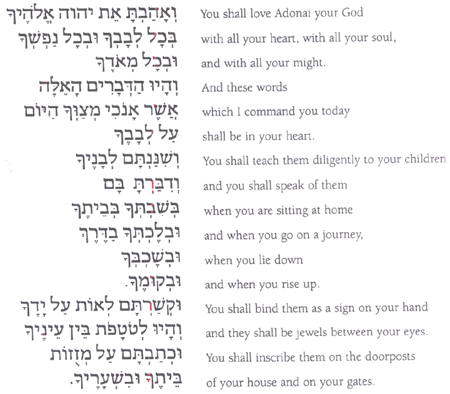
Friar Jude Winkler explains the seemingly continuous ingratitude of the Israelites in the desert. The parable of the sower connects to the ancient commandment to Love God. Friar Jude connects the parable to the commandment.


Parable of the sower
Shema Israel
Friar Jude associations
path
heart
intellect
Rocky ground
soul
Life in persecution
thorns
strength
Physical possessions


The Jewish Virtual Library declares the Shema is an affirmation of Judaism and a declaration of faith in one God.
The Shema is an affirmation of Judaism and a declaration of faith in one God. The obligation to recite the Shema is separate from the obligation to pray and a Jew is obligated to say Shema in the morning and at night (Deut. 6:7).8 
First & Main Paragraph of the Shema8


Fr. Richard Rohr, OFM, notes that Howard Thurman lovingly critiqued Christianity, which has often ignored the direct teaching and witness of Jesus in relationship with those who are oppressed. He shares an excerpt from one of Thurman’s most well-known books, “Jesus and the Disinherited”.
To those who need profound succor and strength to enable them to live in the present with dignity and creativity, Christianity often has been sterile and of little avail. The conventional Christian word is muffled, confused, and vague. Too often the price exacted by society for security and respectability is that the Christian movement in its formal expression must be on the side of the strong against the weak. This is a matter of tremendous significance, for it reveals to what extent a religion that was born of a people acquainted with persecution and suffering has become the cornerstone of a civilization and of nations whose very position in modern life has too often been secured by a ruthless use of power applied to weak and defenseless peoples.9 
Taking Providence for granted may harden our hearts and limit the fruit of our efforts as disciples of Jesus.

References

1
(n.d.). Exodus, chapter 16 - United States Conference of Catholic Bishops. Retrieved July 24, 2019, from http://www.usccb.org/bible/exodus/16 
2
(n.d.). Psalms, chapter 78 - United States Conference of Catholic Bishops. Retrieved July 24, 2019, from http://www.usccb.org/bible/psalms/78 
3
(n.d.). Matthew, chapter 13 - United States Conference of Catholic Bishops. Retrieved July 24, 2019, from http://www.usccb.org/bible/mt/13:3535 
4
(n.d.). Creighton U Daily Reflections - OnlineMinistries - Creighton University. Retrieved July 24, 2019, from http://onlineministries.creighton.edu/CollaborativeMinistry/daily.html 
5
(n.d.). Daily Scripture Readings and Meditations. Retrieved July 24, 2019, from https://dailyscripture.servantsoftheword.org/ 
6
(n.d.). Meditations - The Word Among Us. Retrieved July 24, 2019, from https://wau.org/meditations/2019/07/24/ 
7
(n.d.). Saint Sharbel Makhluf - Franciscan Media. Retrieved July 24, 2019, from https://www.franciscanmedia.org/saint-sharbel-makhluf/ 
8
(n.d.). The Shema - Jewish Virtual Library. Retrieved July 24, 2019, from https://www.jewishvirtuallibrary.org/the-shema 
9
(2019, July 24). A Subtle Peril — Center for Action and Contemplation. Retrieved July 24, 2019, from https://cac.org/a-subtle-peril-2019-07-24/ 

Tuesday, July 23, 2019

Alignment with the Father’s will

The texts from the Roman Catholic Lectionary today underline the benefit to our understanding of approaching our relationship with God as a journey through which we experience both Divine limitlessness and intimacy.
Journey in faith

The passage from the Book of Exodus describes the rout of the Egyptians who are pursuing the Israelites.
 Rout of the Egyptians1
In the response from Exodus 15, the ancient hymn celebrates God’s saving power.
* [15:1–21] This poem, regarded by many scholars as one of the oldest compositions in the Bible, was once an independent work. It has been inserted at this important juncture in the large narrative of Exodus to celebrate God’s saving power, having miraculously delivered the people from their enemies, and ultimately leading them to the promised land.2 
The true family of Jesus follows the will of the Father as proclaimed in the Gospel from Matthew.
* [12:46–50] See Mk 3:31–35. Matthew has omitted Mk 3:20–21 which is taken up in Mk 3:31 (see note on Mt 12:22–32), yet the point of the story is the same in both gospels: natural kinship with Jesus counts for nothing; only one who does the will of his heavenly Father belongs to his true family.3 
Mike Cherney comments that he may not always be on the same page with God. He sees a God who can be destructive in the passages from Exodus and who leads him to question family loyalty in the second.
I also take note of the difference in the way this message is presented in the Old vs. the New Testament. In the first reading from Exodus Moses leads his people out Egypt. God clears their path and subdues those who would stand in the way. In the Gospel, I think the message is far more subtle. Rather than leaving his family behind, Jesus shows the acceptance and degree of closeness He feels to those who believe. This is a closeness that extends beyond ethnicity or social status.4 
Don Schwager asks “What is the essence of being a Christian?”
 It is certainly more than doctrine, precepts, and commandments. It is first and foremost a relationship - a relationship of trust, affection, commitment, loyalty, faithfulness, kindness, thoughtfulness, compassion, mercy, helpfulness, encouragement, support, strength, protection, and so many other qualities that bind people together in mutual love and unity. God offers us the greatest of relationships - union of heart, mind, and spirit with himself, the very author and source of love (1 John 4:8,16).5 
He quotes “My mother through faith,” by Gregory the Great (540-604 AD).
"If someone can become the brother of the Lord by coming to faith, we must ask how one can become also his mother. We must realize that the one who is Christ’s brother and sister by believing becomes his mother by preaching. It is as though one brings forth the Lord and infuses him in the hearts of one's listeners. And that person becomes his mother if through one's voice the love of the Lord is generated in the mind of his neighbor. (excerpt from FORTY GOSPEL HOMILIES 3.2)5 
The Word Among Us Meditation on Exodus 14:21–15:1 notes the Exodus miracles seem beyond anything we can fathom. St. John Chrysostom, an early Church father who died in AD 407, taught that, as marvelous as it was, the Israelites’ exodus was just a foreshadowing of what God would accomplish through Baptism.
“Before yesterday you were captives, but now you are free and citizens of the Church; lately you lived in the shame of your sins, but now you live in freedom and justice. You are not only free, but also holy. You are not only holy, but also righteous. You are not only righteous, but also sons. You are not only sons, but also heirs. You are not only heirs, but also brothers of Christ. You are not only brothers of Christ, but also joint heirs. You are not only joint heirs, but also members. You are not only members, but also the temple. You are not only the temple, but also instruments of the Spirit.”6 
A post by Franciscan Media on Saint Bridget of Sweden is a reflection on her visions.
 … rather than isolating her from the affairs of the world, involved her in many contemporary issues, whether they be royal policy or the years that the legitimate Bishop of Rome lived in Avignon, France. She saw no contradiction between mystical experience and secular activity, and her life is a testimony to the possibility of a holy life in the marketplace.7
Friar Jude Winkler comments on the archaeological evidence of the “Reed Sea” defeat of the Egyptians. The hymn of Exodus 15 may date to the 13th Century BCE. Friar Jude reminds us of the sweep of Jesus family that includes “cousins” and Mary who is the model of following the will of God.


Fr. Richard Rohr, OFM, presents the work of Howard Thurman, who like many mystics, saw that humans need to relate to a God that is both beyond rational thought—what I might call a force field of love—and very relatable and personal.
Not only is faith a way of knowing, a form of knowledge, but it is also one of life’s great teachers. At no point is this fact more clearly demonstrated than in an individual’s growing knowledge of God. It is obvious that, in the last analysis, proof of the existence of God is quite impossible. A simple reason for this is the fact that, if there is that to which God may be finally reduced, then He is not ultimate. But let us not be led astray by this apparent abstraction. Faith teaches a man that God is. The human spirit has two fundamental demands that must be met relative to God. First, He must be vast, limitless, transcendent, all-comprehensive, so that there is no thing that is outside the wide reaches of His apprehension. The stars in the universe, the great galaxies of spatial groupings moving in endless rhythmic patterns in the trackless skies, as well as the tiny blade of grass by the roadside, are all within His grasp. The second demand is that He be personal and intimate. A man must have a sense of being cared for, of not being alone and stranded in the universe. All of us want the assurance of not being deserted by life nor deserted in life. Faith teaches us that God is—that He is the fact of life from which all other things take their meaning and reality. When Jesus prayed, he was conscious that, in his prayer, he met the Presence, and this consciousness was far more important and significant than the answering of his prayer. It is for this reason primarily that God was for Jesus the answer to all the issues and the problems of life. When I, with all my mind and heart, truly seek God and give myself in prayer, I, too, meet His Presence, and then I know for myself that Jesus was right.8 
In our relationship with God, we may comprehend miraculous changes in and around us like that of the Israelites. We are called to journey to the intimacy of Jesus family within which our alignment with the will of the Father becomes more possible.

References

1
(n.d.). Exodus, chapter 14. Retrieved July 23, 2019, from http://www.usccb.org/bible/exodus/14 
2
(n.d.). Exodus, chapter 15 - United States Conference of Catholic Bishops. Retrieved July 23, 2019, from http://www.usccb.org/bible/exodus/15 
3
(n.d.). Matthew, chapter 12 - United States Conference of Catholic Bishops. Retrieved July 23, 2019, from http://www.usccb.org/bible/matthew/12 
4
(n.d.). Creighton U Daily Reflections - OnlineMinistries - Creighton University. Retrieved July 23, 2019, from http://onlineministries.creighton.edu/CollaborativeMinistry/daily.html 
5
(n.d.). Daily Scripture Readings and Meditations. Retrieved July 23, 2019, from https://dailyscripture.servantsoftheword.org/ 
6
(n.d.). Saint Bridget, Religious (Optional Memorial) - Mass Readings and .... Retrieved July 23, 2019, from https://wau.org/meditations/2019/07/23/ 
7
(n.d.). Saint Bridget of Sweden - Franciscan Media. Retrieved July 23, 2019, from https://www.franciscanmedia.org/saint-bridget/ 
8
(2019, July 23). Faith Teaches — Center for Action and Contemplation. Retrieved July 23, 2019, from https://cac.org/faith-teaches-2019-07-23/