Showing posts with label Hasidism. Show all posts

Saturday, July 2, 2022

Restoration and Renewal

The texts from the Roman Catholic Lectionary today reassure us that our restoration to full life is the plan of God as the promptings of the Spirit lead us to relationship with the Bridegroom.


Restoration and Renewal


The reading from the Book of the Prophet Amos describes the restoration of David’s Kingdom.


* [9:1115] These verses are most likely an editorial supplement to Amos, added to bring the book into harmony with the positive thrust of the prophetic books in general, especially those written after the exile, when the final edition of Amos was probably completed. The editors would have seen the destruction of Samaria in 722/721 B.C. as the fulfillment of Amos’s prophecies, but in this epilogue they express the view that destruction was not the Lord’s final word for Israel. In Acts 15:1517, James interprets this passage in a messianic sense. The fallen hut of David: the Davidic kingdom, which included what later became the divided Northern and Southern Kingdoms. All nations claimed in my name: lit., “all nations over whom my name has been pronounced.” This idiom denotes ownership. (Amos, CHAPTER 9, n.d.)


Psalm 85 is a prayer for the restoration of God’s Favour.


* [Psalm 85] A national lament reminding God of past favors and forgiveness (Ps 85:24) and begging for forgiveness and grace now (Ps 85:58). A speaker represents the people who wait humbly with open hearts (Ps 85:910): God will be active on their behalf (Ps 85:1113). The situation suggests the conditions of Judea during the early postexilic period, the fifth century B.C.; the thoughts are similar to those of postexilic prophets (Hg 1:511; 2:69). (Psalms, PSALM 85, n.d.)


In the Gospel of Matthew, Jesus addresses a question about fasting.


* [9:1617] Each of these parables speaks of the unsuitability of attempting to combine the old and the new. Jesus’ teaching is not a patching up of Judaism, nor can the gospel be contained within the limits of Mosaic law. (Matthew, CHAPTER 9, n.d.)


Barbara Dilly (2018) asks how do God’s people learn to live in peace?  How do they learn to live in kindness and truth?  How do they learn to walk with justice?  She agrees with Pope Francis that it is when they learn to care for their common home and for others, to protect all the lands of the earth and their ability to provide for the needs of all people.  We certainly aren’t there yet.  We who claim to follow Jesus have a lot of work to do if we want to dwell in our own land in peace and justice with all that we need restored to us.  To achieve that, we should also help others to enjoy the same blessings.  Food and environmental justice, it seems to me, is a good focus for that work.


Jesus tells us we can’t get on with what it means to follow him by putting new wine into old wineskins.  I think that means that if we hear Jesus and follow him, are not just simply the same old people who got chosen to be special.  We are a transformed people.  If we follow Jesus, we see a very different relationship between ourselves and God, between ourselves and the earth, and ourselves and others.  Our relationship with God is not just about God being with us when we take what we need for ourselves.  When we are transformed, we find a way to be men and women with and for others. (Dilly, 2018)


Don Schwager quotes “No need to fast in the presence of the Bridegroom,” by Hilary of Poitiers (315-367 AD).


"The Pharisees and John's disciples were fasting, and the apostles were not. But Jesus answered them in a spiritual way and indicated to John's disciples that he was a bridegroom. John taught that all hope in life lay in Christ. While he was still preaching, however, his disciples could not be received by the Lord. Up until the time of John, the law and the prophets prevailed, and unless the law came to an end, none of them would subscribe to faith in the gospel. The fact that he said there was no need for his disciples to fast as long as the bridegroom is with them illustrates the joy of his presence and the sacrament of the holy food, which no one need be without while he is present, that is, bearing Christ in the light of the mind. But once he is gone, Jesus says that they will fast, for all those who do not believe that Christ has risen will not have the food of life. By faith in the resurrection, the sacrament of the heavenly bread is received. Whoever is without Christ will be forsaken, fasting from the food of life." (excerpt from the commentary ON MATTHEW 9.3) (Schwager, n.d.)


The Word Among Us Meditation on Amos 9:11-15 comments that restoration is a beautiful word filled with hope. It means that nothing and no one is too far gone for the Lord. Even when we are damaged by life’s trials or by patterns of sin, even when our relationships are broken and we see no hope, even when we have lost our loved ones, God promises restoration. Through Jesus, he will heal our wounds, heal our relationships, and eventually reunite us with our loved ones. That is, and has always been, his plan for us.


The people who heard Amos proclaim these words never saw them come to fruition in their lifetime. Perhaps we won’t see everything we yearn to be restored happen in our lifetime either. But God doesn’t make promises he doesn’t keep. One day, in his perfect timing, he will make all things new again (Revelation 21:5). “Father, bring about your restoration in me.” (Meditation on Amos 9:11-15, n.d.)


Friar Jude Winkler discusses the punishment and the subsequent restoration from God described in the Book of the Prophet Amos. Punishment has the purpose to bring us around to see  consequences and decide to choose the Lord again. Friar Jude notes the role of fasting as a ritual action to mourn for the death of a loved one. Friar Jude connects the new clothes of the wedding celebrating the Bridegroom with the New Wine of our relationship with Jesus.


Fr. Richard Rohr, OFM, shares the translation by Rabbis Or N. Rose and Ebn D. Leader of the eighteenth-century Hasidic Rabbi Hayim Heikel of Amdur, active in Lithuania, who counselled conscious remembrance of God first thing in the morning.


When you awake in the morning

immediately remember

that the blessed Creator has acted toward you with

goodness and kindness,

for He has returned the soul to you (Berakhot 2a);

the soul that fills your whole body. . . .

Before opening your eyes,

draw the Creator to you—

likewise with your ears, mouth, and mind.

If you follow this practice,

all your deeds will be holy that day,

as it is written, “I foretell the end from the beginning”

(Isaiah 46:10). [2] (Rohr, 2022)


We are reminded that renewal of fullness in our life begins with openness to the New Wine of relationship with Jesus.


References

Amos, CHAPTER 9. (n.d.). USCCB. Retrieved July 2, 2022, from https://bible.usccb.org/bible/amos/9?11 

Dilly, B. (2018, July 2). Daily Reflection Of Creighton University's Online Ministries. Creighton University's Online Ministries. Retrieved July 2, 2022, from https://onlineministries.creighton.edu/CollaborativeMinistry/070222.html 

Matthew, CHAPTER 9. (n.d.). USCCB. Retrieved July 2, 2022, from https://bible.usccb.org/bible/matthew/9?14 

Meditation on Amos 9:11-15. (n.d.). The Word Among Us: Homepage. Retrieved July 2, 2022, from https://wau.org/meditations/2022/07/02/429223/ 

Psalms, PSALM 85. (n.d.). USCCB. Retrieved July 2, 2022, from https://bible.usccb.org/bible/psalms/85?9 

Rohr, R. (2022, July 2). Judaism: Hasidic Mystics: Weekly Summary — Center for Action and Contemplation. Center for Action and Contemplation. Retrieved July 2, 2022, from https://cac.org/daily-meditations/judaism-hasidic-mystics-2022-07-02/ 

Schwager, D. (n.d.). Daily Scripture Readings and Meditations. Daily Scripture Readings and Meditations. Retrieved July 2, 2022, from https://www.dailyscripture.net/daily-meditation/?ds_year=2022&date=jul2 


Wednesday, June 29, 2022

Freedom to Declare Truth

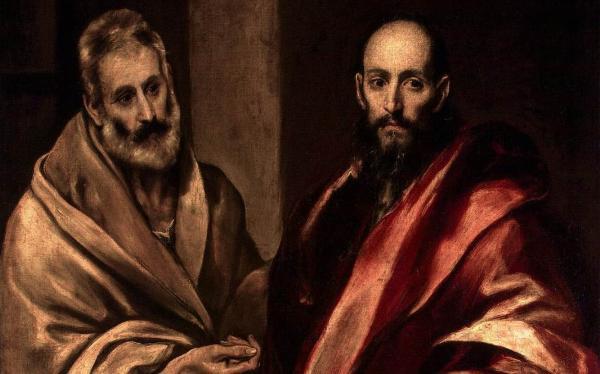
The texts from the Roman Catholic Lectionary today challenge us to ponder the paradox of the diversity in the missions of Peter and Paul as the guidance of the Spirit led them to live the truth of Jesus.


The reading from the Acts of the Apostles declares that James is killed and Peter imprisoned and then delivered from prison.


* [12:119] Herod Agrippa ruled Judea A.D. 41–44. While Luke does not assign a motive for his execution of James and his intended execution of Peter, the broad background lies in Herod’s support of Pharisaic Judaism. The Jewish Christians had lost the popularity they had had in Jerusalem (Acts 2:47), perhaps because of suspicions against them traceable to the teaching of Stephen. (Acts of the Apostles, CHAPTER 12, n.d.)


Psalm 34 gives praise for deliverance from trouble.


* [Psalm 34] A thanksgiving in acrostic form, each line beginning with a successive letter of the Hebrew alphabet. In this Psalm one letter is missing and two are in reverse order. The psalmist, fresh from the experience of being rescued (Ps 34:5, 7), can teach the “poor,” those who are defenseless, to trust in God alone (Ps 34:4, 12). God will make them powerful (Ps 34:511) and give them protection (Ps 34:1222). (Psalms, PSALM 34, n.d.)


The reading from the Second Letter of Timothy shares Paul’s reward for fidelity.


* [4:6] The apostle recognizes his death through martyrdom to be imminent. He regards it as an act of worship in which his blood will be poured out in sacrifice; cf. Ex 29:3840; Phil 2:17. (2 Timothy, CHAPTER 4, n.d.)


The Gospel of Matthew is Peter’s declaration about Jesus at Caesarea Philippi.


* [16:1320] The Marcan confession of Jesus as Messiah, made by Peter as spokesman for the other disciples (Mk 8:2729; cf. also Lk 9:1820), is modified significantly here. The confession is of Jesus both as Messiah and as Son of the living God (Mt 16:16). Jesus’ response, drawn principally from material peculiar to Matthew, attributes the confession to a divine revelation granted to Peter alone (Mt 16:17) and makes him the rock on which Jesus will build his church (Mt 16:18) and the disciple whose authority in the church on earth will be confirmed in heaven, i.e., by God (Mt 16:19). (Matthew, CHAPTER 16, n.d.)


Julie Kalkowski shares today's reading from St. Paul was the exact one used at her father’s funeral.


While my dad could be difficult at times, I believe he “competed well” and “kept the faith” as St. Paul wrote in today’s second reading. My dad’s strength came from God so he could often ‘be obedient to charity.’ May that be true for all of us. (Daily Reflection Of Creighton University's Online Ministries, n.d.)


Don Schwager quotes “Only by hope,” by Basil the Great, 329-379 A.D.


"'Turn, O my soul, into your rest: for the Lord has been bountiful to you' (Psalm 114:7). The brave contestant applies to himself the consoling words, very much like to Paul, when he says: 'I have fought the good fight, I have finished the course, I have kept the faith. For the rest, there is laid up for me a crown of justice.' These things the prophet also says to himself: Since you have fulfilled sufficiently the course of this life, turn then to your rest, 'for the Lord has been bountiful to you.' For, eternal rest lies before those who have struggled through the present life observant of the laws, a rest not given in payment for a debt owed for their works but provided as a grace of the munificent God for those who have hoped in him." (excerpt from HOMILIES 22) (Schwager, n.d.)


The Word Among Us Meditation on Acts 12:1-11 comments that Peter and Paul built up the Church in very different ways, but despite their differences, both men chose to obey Jesus’ call to “Follow me” (Acts 12:8). They didn’t become like each other or lose their personalities. Instead, through the Spirit, they became more like Jesus. Today, we honor them together because in the end, they followed Jesus unto death, both dying as martyrs in Rome.


Each of us is unique, but whatever our personalities, this one truth is the same: the same Spirit that empowered Peter and Paul lives in us. Do you feel unqualified to serve the Lord? Are you burdened by your past? Look to these two heroes of the faith. Their lives were changed by the power of the Spirit, just as yours can. Today, ask them to pray for you as you seek to yield to the Spirit and follow Jesus wherever he leads you. “Holy Spirit, help me to follow Jesus today.” (Meditation on Acts 12:1-11, n.d.)


Fr John Twist SJ, Chaplain to Stonyhurst College, comments that saints Peter and Paul were both men of great faith and influence, but they had very different understandings of the Messiah to whom they dedicated their lives.


It is believed that the two great apostles were both martyred in Rome: Paul executed with a sword as a Roman citizen; Peter crucified upside down in imitation of his friend, Jesus. There can be little doubt that Paul was the more influential figure, with his letters forming a major part of the New Testament; Paul was the great theoretician of Christianity. But it is Peter who is more warmly embraced. Here is a very human figure, with real defects but great generosity; a man all of us can not merely admire, but to a degree can hope to imitate. Paul’s thoughts have left their mark on Christianity, but it is Peter’s personality that has moved Christian hearts. (Twist, 2013)


Friar Jude Winkler uses the lives of Peter and Paul to remind us that God accompanies us in life and even to martyrdom. The readiness of Paul to accept life or death is expressed in his letter to the Philippians. Friar Jude notes that the date of Matthew’s Gospel is later than the death of Peter, indicating that the head of the Church is conferred on the descendants of Peter, the Pope.


Fr. Richard Rohr, OFM, introduces the Jewish philosopher Martin Buber (1878–1965) who helped introduce the non-Jewish world to the passionate spirituality of nineteenth-century Hasidism. As a young boy, Buber lived with his grandparents in Lemberg, present day Lviv, Ukraine. He was impacted by his grandfather’s Hasidic faith and went on to dedicate much of his scholarly life to sharing the legends, sayings, and stories of Hasidism. Much like the sayings of the Christian desert fathers and mothers, Hasidic short sayings contain wisdom beyond their words. We share several from Martin Buber’s work and encourage you to read them slowly, several times, to experience their prayerful wisdom. This saying reminds us that, while God’s presence is found in all reality, it takes an inner willingness to encounter it.


‘Where is the dwelling of God?’ 

This is the question with which the Rabbi of Kotzk surprised a number of learned men who happened to be visiting him. 

They laughed at him: ‘What a thing to ask! Is not the whole world full of [God’s] glory?’ 

Then he answered his own question:  

‘God dwells wherever man lets him in.’ [4] (Rohr, 2022)


Our gifts, received through the grace of God, are activated by the prompting of the Spirit to build the Freedom of the Kingdom of God.


References

Acts of the Apostles, CHAPTER 12. (n.d.). USCCB. Retrieved June 29, 2022, from https://bible.usccb.org/bible/acts/12?1 

Daily Reflection Of Creighton University's Online Ministries. (n.d.). Creighton University's Online Ministries. Retrieved June 29, 2022, from https://onlineministries.creighton.edu/CollaborativeMinistry/062922.html 

Matthew, CHAPTER 16. (n.d.). USCCB. Retrieved June 29, 2022, from https://bible.usccb.org/bible/matthew/16?13 

Meditation on Acts 12:1-11. (n.d.). The Word Among Us: Homepage. Retrieved June 29, 2022, from https://wau.org/meditations/2022/06/29/421721/ 

Psalms, PSALM 34. (n.d.). USCCB. Retrieved June 29, 2022, from https://bible.usccb.org/bible/psalms/34?2 

Rohr, R. (2022, June 29). Shining the Light of Divine Life — Center for Action and Contemplation. Center for Action and Contemplation. Retrieved June 29, 2022, from https://cac.org/daily-meditations/shining-the-light-of-divine-life-2022-06-29/ 

Schwager, D. (n.d.). Daily Scripture Readings and Meditations. Daily Scripture Readings and Meditations. Retrieved June 29, 2022, from https://www.dailyscripture.net/daily-meditation/?ds_year=2022&date=jun29a 

Twist, J. (2013, June 28). Saint Peter and Saint Paul. Thinking Faith. Retrieved June 29, 2022, from https://www.thinkingfaith.org/articles/20130628_1.htm 

2 Timothy, CHAPTER 4. (n.d.). USCCB. Retrieved June 29, 2022, from https://bible.usccb.org/bible/2timothy/4?6