Tuesday, November 26, 2019

Replaced in the end

The texts from the Roman Catholic Lectionary today remind us that the political regimes in our history have fallen in succession as we move as the Body of Christ in pursuit of truth, beauty, and goodness in achieving the common good.
Temporary Empires

The reading from the Book of Daniel tells of the interpretation of Nebuchadnezzar’s dream.
* [2:36–45] The four successive kingdoms in this apocalyptic perspective are the Babylonian (gold), the Median (silver), the Persian (bronze), and the Hellenistic (iron). The last, after Alexander’s death, was divided among his generals (vv. 41–42). Of the kingdoms which emerged from this partitioning, the two that most affected the Jews were the dynasties of the Ptolemies in Egypt and the Seleucids in Syria. They tried in vain, by war and through intermarriage, to restore the unity of Alexander’s empire (v. 43). The stone hewn from the mountain is the kingdom of God awaited by the Jews (vv. 44–45). Compare the image of the stone applied to Jesus in Luke 20:17–18.1
Another passage from the Book of Daniel is a response in the words of the prayer of Azariah in the fiery furnace.
* [3:24–90] These verses are additions to the Aramaic text of Daniel, translated from the Greek form of the book. They were probably first composed in Hebrew or Aramaic, but are no longer extant in the original language. The Roman Catholic Church has always regarded them as part of the canonical Scriptures.2 
In the Gospel of Luke, Jesus foretells the destruction of the Temple and describes signs and persecutions to come.
 * [21:8] The time has come: in Luke, the proclamation of the imminent end of the age has itself become a false teaching.3
Thomas Quinn observes we all have witnessed, if not in person, in the news media, the end of nations, plagues, wars, famine, and earthquakes.
 I believe that the most important phrase that Jesus tells us in today’s gospel is, “many will come in my name, saying ‘I am he’ and ‘the time has come.”  He implies by this that he, in fact, is the chosen one. The time had come. God would, and does, replace the temporal powers, and continues to fill the world with His power and majesty.4
Don Schwager quotes “First signs of the end times,” by Maximus of Turin (died between 408-423 AD).
"Perhaps you are anxious, brothers and sisters, at the fact that we hear constantly of the tumult of wars and the onsets of battles. Perhaps your love is still more anxious since these are taking place in our times. The reason is the closer we are to the destruction of the world, the closer we are to the kingdom of the Savior. The Lord himself says, 'In the last days nation will rise against nation and kingdom against kingdom. When you see wars, earthquakes and famines, know that the kingdom of God is at hand.'This nearness of wars shows us that Christ is near." (excerpt from SERMON 85.1)5 
The Word Among Us Meditation on Luke 21:5-11 notes as Jesus predicted, the Temple was destroyed. It happened in AD 70 when the Roman army moved in to put down a Jewish uprising. It was seen as a complete catastrophe—an undeniable triumph of the forces of evil over the will of God. But true to form, God was able to take this tragedy and bring great good out of it. With the Temple gone, the early Christians could grasp even more deeply the central truth that God now lived in them by the power of the Holy Spirit.

It’s just as true today as it was in AD 70: Christ dwells in you, always. He also dwells in a special way in every tabernacle around the world. And he dwells in every one of your brothers and sisters in Christ.
Are you struggling to understand a tragedy? It could be something deeply personal or something profoundly upsetting on the news. By all means, grieve and mourn the loss. Cry out to God for healing and strength. But at the same time, hold on to your faith. Believe, even against all hope, that God still has you in the palm of his hand. Believe, despite your fears and sadness, that he is already at work to bring good out of evil.6 
Friar Jude Winkler fleshes out the interpretation of Nebuchadnezzar’s dream. Is Jesus language about an apocalyptic event or our personal end? Friar Jude reminds us of the message to be ready.


Fr. Richard Rohr, OFM, comments that authors and scholars Peter Block, John McKnight, and Walter Brueggemann partnered to write “An Other Kingdom: Departing the Consumer Culture,” which describes the shifts in thinking that could create a post-consumer economy. It sounds a lot like the Gospel.

Luckily, the exodus from a consumer, globalized culture into a neighborly, localized communal and cooperative culture has begun. We join the chorus of other agents of the alternative economy: food hubs, cooperative and social enterprises, the climate change activists, health activists, [etc.]. . . .
Neighborliness means that our well-being and what really matters is close at hand and can be locally constructed or produced. In this modern time, neighborliness is considered quaint and nostalgic. To make neighborliness the center of our social order requires an act of imagination. It is counter-cultural. It is also a form of social interaction that is built on a covenant that serves the common good. . . .7 

Serving the common good is a theme discussed in the video series "Understanding Laudato Si," hosted by Fr. Daniel P. Horan, OFM who explores Chapter Four of Pope Francis encyclical “Laudato Si”, including the theme of the principle of the common good.
 The sum of those conditions of social life which allow social groups and their individual members relatively thorough and ready access to their own fulfillment (LS156/GS26)8


The long march of history has seen some human progress in dealing with persecution and inequity among the children of God.
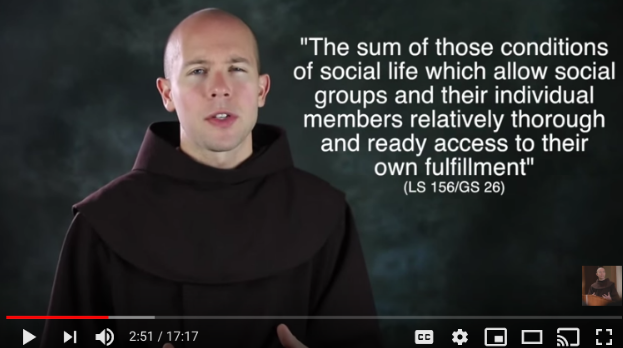
Understanding Laudato Si

We are called in this time to renew our mission to realize the common good.

References

1
(n.d.). Daniel, chapter 2 - United States Conference. Retrieved November 26, 2019, from http://www.usccb.org/bible/daniel/2 
2
(n.d.). Daniel, chapter 3. Retrieved November 26, 2019, from http://www.usccb.org/bible/daniel/3 
3
(n.d.). Luke, chapter 21 - United States Conference of Catholic Bishops. Retrieved November 26, 2019, from http://www.usccb.org/bible/luke/21 
4
(n.d.). Daily Reflections - OnlineMinistries .... Retrieved November 26, 2019, from https://onlineministries.creighton.edu/CollaborativeMinistry/daily.html 
5
(n.d.). Daily Scripture Readings and Meditations. Retrieved November 26, 2019, from https://dailyscripture.servantsoftheword.org/ 
6
(n.d.). Meditations - The Word Among Us. Retrieved November 26, 2019, from https://wau.org/meditations/2019/11/26/ 
7
(2019, November 26). Departing the Consumer Culture — Center for Action and .... Retrieved November 26, 2019, from https://cac.org/departing-the-consumer-culture-2019-11-26/ 
8
(2016, May 3). "Understanding Laudato Si" Series - YouTube. Retrieved November 26, 2019, from https://www.youtube.com/playlist?list=PLO2W1tFFtdJn9V9_DvEbz9Bygt7XsYXRj 

Monday, November 25, 2019

Extraordinary Effect

The texts from the Roman Catholic Lectionary today resonate with the sense that our efforts to seek truth, beauty, and goodness may have greater effect on events than we may consider.

Beautiful harbour
The reading from the Book of Daniel relates the effect of four young faithful Israelites at the Babylonian Court during a food test.
* [1:8] This defilement: the bread, meat, and wine of the Gentiles were unclean (Hos 9:3; Tb 1:12; Jdt 10:5; 12:1–2) because they might have been offered to idols; and the meat may not have been drained of blood, as Jewish dietary law requires. This test relates to the attempt of Antiochus to force Jews to eat forbidden foods in contempt of their religion (1 Mc 1:62–63; 2 Mc 6:18; 7:1).1 
The Book of Daniel provides the response today from the prayer of Azariah in the fiery furnace.
* [3:24–90] These verses are additions to the Aramaic text of Daniel, translated from the Greek form of the book. They were probably first composed in Hebrew or Aramaic, but are no longer extant in the original language. The Roman Catholic Church has always regarded them as part of the canonical Scriptures.2 
Jesus is moved by the Widow’s offering in the Gospel of Luke.
* [21:1–4] The widow is another example of the poor ones in this gospel whose detachment from material possessions and dependence on God leads to their blessedness (Lk 6:20). Her simple offering provides a striking contrast to the pride and pretentiousness of the scribes denounced in the preceding section (Lk 20:45–47). The story is taken from Mk 12:41–44.3 
Jeanne Schuler sees the youth who resisted and received wisdom more penetrating than the king’s gaudy soothsayers reflected today where, like prophets, steadfast youth shine a light into darkness.
Dreamers—migrants who arrived as children—claim this land that has become their home.  They are not in exile. The young fill the streets in many countries to call for justice.  Students read “the signs of the time” and, without endless calculation, take action. They push hard to protect the planet, our common home, from catastrophe.  We elders, like the magicians of Babylon, say what soothes the powerful. “Be patient. Change takes time. It is too costly. It’s too late already. We’ll ride out the storms.”   The abnormal gets christened as normal. How do the prudent make common cause with the prophets? When do I stop covering my ears and listen to the cry: “wake up”?4 
Don Schwager quotes “Mercy and compassion are never worthless,” by Leo the Great, 400-461 A.D.
"Although the spite of some people does not grow gentle with any kindness, nevertheless the works of mercy are not fruitless, and kindness never loses what is offered to the ungrateful. May no one, dearly beloved, make themselves strangers to good works. Let no one claim that his poverty scarcely sufficed for himself and could not help another. What is offered from a little is great, and in the scale of divine justice, the quantity of gifts is not measured but the steadfastness of souls. The "widow" in the Gospel put two coins into the "treasury," and this surpassed the gifts of all the rich. No mercy is worthless before God. No compassion is fruitless. He has given different resources to human beings, but he does not ask different affections." (excerpt from Sermon 20.3.1)5
The Word Among Us Meditation on Luke 21:1-4 comments that today’s reading is also a good reminder of the sacred obligation we all have to care for those who are lonely and widowed. May we always show them the love and care that they both need and deserve.
 Why did this widow catch Jesus’ attention? Perhaps because he was well aware of the plight of widows. In first-century Palestine, a woman who had lost her husband and had no sons to support her could end up defenseless and destitute. Jesus probably suspected that this widow had little to give, so he commended her for offering “her whole livelihood” (Luke 21:4).6
Friar Jude Winkler connects the stories in the Book of Daniel to the time of persecution of the Israelites by the Seleucid Empire. The standards for our generosity are subjective. Friar Jude reminds us that we need to do the best we can with what we have.


Fr. Richard Rohr, OFM, shares the writing of Charles Eisenstein, a fascinating public speaker, author, and advocate for gift economies.
 A world without weapons, without McMansions in sprawling suburbs, without mountains of unnecessary packaging, without giant mechanized monofarms, without energy-hogging big-box stores, without electronic billboards, without endless piles of throw-away junk, without the overconsumption of consumer goods no one really needs is not an impoverished world. I disagree with those environmentalists who say we are going to have to make do with less. In fact, we are going to make do with more: more beauty, more community, more fulfillment, more art, more music, and material objects that are fewer in number but superior in utility and aesthetics. . . .
Part of the healing that a sacred economy represents is the healing of the divide we have created between spirit and matter. In keeping with the sacredness of all things, I advocate an embrace, not an eschewing, of materialism. I think we will love our things more and not less. We will treasure our material possessions, honor where they came from and where they will go. . . . The cheapness of our things is part of their devaluation, casting us into a cheap world where everything is generic and expendable. . . .
Put succinctly, the essential need that goes unmet today, the fundamental need that takes a thousand forms, is the need for the sacred—the experience of uniqueness and connectedness. . . .7
Power pressures people to maintain the status quo. Our efforts to practice an alternate lifestyle may inspire greater change when we are aligned with the Will of God.

References

1
(n.d.). Daniel, chapter 1 - United States Conference. Retrieved November 25, 2019, from http://www.usccb.org/bible/daniel/1 
2
(n.d.). Daniel, chapter 3. Retrieved November 25, 2019, from http://www.usccb.org/bible/daniel/3 
3
(n.d.). Luke, chapter 21 - United States Conference of Catholic Bishops. Retrieved November 25, 2019, from http://www.usccb.org/bible/luke/21 
4
(n.d.). Daily Reflections - OnlineMinistries .... Retrieved November 25, 2019, from https://onlineministries.creighton.edu/CollaborativeMinistry/daily.html 
5
(n.d.). Daily Scripture Readings and Meditations. Retrieved November 25, 2019, from https://dailyscripture.servantsoftheword.org/ 
6
(n.d.). Meditations - The Word Among Us. Retrieved November 25, 2019, from https://wau.org/meditations/2019/11/25/ 
7
(2019, November 25). Making Do with More — Center for Action and Contemplation. Retrieved November 25, 2019, from https://cac.org/making-do-with-more-2019-11-25/ 

Sunday, November 24, 2019

Invited to join the King

The texts from the Roman Catholic Lectionary today invite contemplation of the systems of leadership in society in comparison to the Way of Christ the King.
Two paths of leadership

The reading from the Second Book of Samuel is the preamble to David anointed as King of all Israel.

In Psalm 122, a song of praise and prayer for Jerusalem, the singer anticipates joining the procession into Jerusalem.
* [Psalm 122] A song of Zion, sung by pilgrims obeying the law to visit Jerusalem three times on a journey. The singer anticipates joining the procession into the city (Ps 122:1–3). Jerusalem is a place of encounter, where the people praise God (Ps 122:4) and hear the divine justice mediated by the king (Ps 122:5). The very buildings bespeak God’s power (cf. Ps 48:13–15). May the grace of this place transform the people’s lives (Ps 122:6–9)!1
The passage from the Letter to the Colossians contains a hymn selected to proclaim the supremacy of Christ.
* [1:15–20] As the poetic arrangement indicates, these lines are probably an early Christian hymn, known to the Colossians and taken up into the letter from liturgical use (cf. Phil 2:6–11; 1 Tm 3:16). They present Christ as the mediator of creation (Col 1:15–18a) and of redemption (Col 1:18b–20). There is a parallelism between firstborn of all creation (Col 1:15) and firstborn from the dead (Col 1:18). While many of the phrases were at home in Greek philosophical use and even in gnosticism, the basic ideas also reflect Old Testament themes about Wisdom found in Prv 8:22–31; Wis 7:22–8:1; and Sir 1:4. See also notes on what is possibly a hymn in Jn 1:1–18.2 
The episode from the Gospel of Luke, recounted only in this gospel, shows the compassion and mercy of the Good Shepherd.
* [23:39–43] This episode is recounted only in this gospel. The penitent sinner receives salvation through the crucified Jesus. Jesus’ words to the penitent thief reveal Luke’s understanding that the destiny of the Christian is “to be with Jesus.”3 
Eileen Burke-Sullivan shares that we are invited to ponder one of the most poignant gospel passages – to enter deeply into the mystery of salvation and to recognize that Jesus’ Lordship or authority in our lives must first of all arise from gratitude.
To recognize and honor the Kingship of Christ is to know our humanity in all humility and gratitude.  It is to receive the gift of salvation from one like us in all things but sin, and it is to be drawn so close to Christ’s suffering in our lives that we can ask through suffering to be re- membered – placed with Christ in the Reign of perfect mercy and everlasting joy.4 
Don Schwager quotes “My kingdom is not of the world,” by Augustine of Hippo, 354-430 A.D.
 "Listen, everyone, Jews and Gentiles, circumcised and uncircumcised. Listen, all kings of the earth. I am no hindrance to your rule in this world, for 'my kingdom is not of this world.' Banish the groundless fear that filled Herod the Great on hearing that Christ was born. More cruel in his fear than in his anger, he put many children to death (Matthew 2:3,16), so that Christ would also die. But 'my kingdom is not of this world,' says Christ. What further reassurance do you seek? Come to the kingdom that is not of this world. Do not be enraged by fear, but come by faith. In a prophecy Christ also said, 'He,' that is, God the Father, 'has made me king on Zion his holy mountain' (Psalm 2:6). But that Zion and that mountain are not of this world.    "What in fact is Christ's kingdom? It is simply those who believe in him, those to whom he said, 'You are not of this world, even as I am not of this world.' He willed, nevertheless, that they should be in the world, which is why he prayed to the Father, 'I ask you not to take them out of the world but to protect them from the evil one' (John 17:15-16). So here also he did not say, 'My kingdom is not' in this world but 'is not of this world.' And when he went on to prove this by declaring, 'If my kingdom were of this world, my servants would have fought to save me from being handed over to the Jews,' he concluded by saying not 'my kingdom is not here' but 'my kingdom is not from here.'    "Indeed, his kingdom is here until the end of time, and until the harvest it will contain weeds. The harvest is the end of the world, when the reapers, who are the angels, will come and gather out of his kingdom all causes of sin (Matthew 13:48-41). And this could not happen if his kingdom were not here. But even so, it is not from here, for it is in exile in the world. Christ says to his kingdom, 'You are not of the world, but I have chosen you out of the world' (John 15:19). They were indeed of the world when they belonged to the prince of this world, before they became his kingdom. Though created by the true God, everyone born of the corrupt and accursed stock of Adam is of the world. [But] everyone who is reborn in Christ becomes the kingdom that is no longer of the world. For God has snatched us from the powers of darkness and brought us into the kingdom of his beloved Son (Colossians 1:13). This is that kingdom of which he said, 'My kingdom is not of this world; my kingly power does not come from here." (excerpt from TRACTATES ON THE GOSPEL OF JOHN 115.2)5
The Word Among Us Meditation on Luke 23:35-43 explains that when Pope Pius XI instituted this feast in 1925, he was responding to a culture he felt was rejecting Jesus and his ways. At a time when Hitler, Mussolini, and Stalin were rising to power, Pius XI wanted to draw the world’s attention back to Jesus, the only One who could bring lasting peace. It was not the “peace” of a totalitarian ruler exercising power to eliminate opposition. It was the peace of a king who chose not to save himself but instead offered himself for our sake to reconcile us to God. This is the peace that he won for us as he poured out his very life’s blood on Calvary (Colossians 1:20).

That’s why our Gospel today presents Jesus as a king who reigns from the cross. He freely emptied himself even though, as our second reading reminds us, “in him all the fullness was pleased to dwell” (Colossians 1:19). He refused to come down from the cross because his mission was to save us, not to conquer us. He did not rise to the bait of the soldiers who goaded him to save himself (Luke 23:37). He chose instead to focus his attention on the thief crucified beside him who pleaded for mercy (23:43).
Jesus turns our concept of kingship on its head. Power made strong by humility and self-emptying. Influence and authority exercised through self-sacrifice and mercy. Leadership displayed in service. Let’s embrace Jesus and his kingdom today. Let’s pray that it be more fully established in us and through us in our world.6 
Friar Jude Winkler connects the King of Israel to the concept of shepherd leading his flock for the Israelites. The Greeks in Colossae, understood Divine Wisdom and many mediators between people and God. Friar Jude reminds us of the realized eschatology of Luke shown in the Gospel today.


Brian Purfield, member of the Mount Street Jesuit Centre team, comments that when the Gospel is preached to the Colossians they are told that Jesus is their mediator before God – but they already had many mediators before God and life seemed to work very well. They therefore asked the question: ‘where does Jesus fit into our system?’ In other words, they were trying to take the Gospel and super-impose it upon their already-existing worldview.
In the letter to the Colossians, Paul in effect tells them that their first mistake is that they are trying to fit Jesus into a system. Jesus does not fit into a system; Jesus is the system… Paul says: ‘he is the image of the unseen God.’ The Greek word here is eikon. An icon is a likeness, a reflection. Paul is saying that Jesus Christ, in his humanity, is a reflection of the unseen God. Paul does not make any judgement on whether or not the thrones, ruling forces, sovereignties and powers that have been the subject of some of the teachings to the Colossians, exist. What Paul is saying to the Colossians is: if they exist, the only reason why they exist is for the sake of Jesus Christ. No one, no being, no thing has come into this world, except that which has been made by God our Father in relationship to Jesus Christ.7
Fr. Richard Rohr, OFM, suggests that the capitalist system of exchange seems reasonable to almost everybody today. And if we’re honest, it makes sense to us, too. It just seems fair. The only trouble is, Jesus doesn’t believe it at all, and he’s supposed to be our spiritual teacher. This might just be at the heart of what we mean by real conversion to the Gospel worldview, although few seem to have recognized this… if we call ourselves Christians, we have to deal with the actual Gospel. Now the only way we can do the great turnaround and understand this is if we’ve lived through at least one experience of being given to without earning. It’s called forgiveness, unconditional love, and mercy. If we’ve never experienced unearned, undeserved love, we will stay in the capitalist worldview.
Brothers and sisters, you and I don’t “deserve” anything, anything. It’s all a gift. But until we begin to live in the kingdom of God instead of the kingdoms of this world, we think, as most Christians do, exactly like the world. We like the world of seemingly logical equations. Basically, to understand the Gospel in its purity and in its transformative power, we have to stop counting, measuring, and weighing. We have to stop saying “I deserve” and deciding who does not deserve. None of us “deserve”! Can we do that? It’s pretty hard . . . unless we’ve experienced infinite mercy and realize that it’s all a gift.8 
The Solemnity of Our Lord Jesus Christ, King of the Universe is an opportunity to reflect on the conditions and roadblocks we create in our systems of relating to others. How can we move to act more like residents of Jesus Kingdom?

References

1
(n.d.). Psalms, chapter 122 - United States Conference. Retrieved November 24, 2019, from http://www.usccb.org/bible/psalms/122 
2
(n.d.). Colossians 1:15 - United States Conference. Retrieved November 24, 2019, from http://www.usccb.org/bible/colossians/1 
3
(n.d.). Luke, chapter 23 - United States Conference. Retrieved November 24, 2019, from http://www.usccb.org/bible/luke/23 
4
(n.d.). Daily Reflections - OnlineMinistries .... Retrieved November 24, 2019, from https://onlineministries.creighton.edu/CollaborativeMinistry/daily.html 
5
(2019, November 24). Daily Meditations - The Word Among Us. Retrieved November 24, 2019, from https://wau.org/meditations/2019/11/23/ 
6
(2019, November 24). Our Lord Jesus Christ, King of the Universe (Solemnity) - Mass .... Retrieved November 24, 2019, from https://wau.org/meditations/2019/11/24/ 
7
(2009, June 23). The Letter to the Colossians: Jesus and the Universe .... Retrieved November 24, 2019, from https://www.thinkingfaith.org/articles/20090623_1.htm 
8
(2019, November 24). The Gospel Economy — Center for Action and Contemplation. Retrieved November 24, 2019, from https://cac.org/the-gospel-economy-2019-11-24/ 

Saturday, November 23, 2019

Snared in our own trap

The texts from the Roman Catholic Lectionary today invite consideration of the irony wherein our efforts at self aggrandizement may become the source of our failure. From this pattern we may be able to become more aware of the possibilities of common ground with others.
Working for common ground

The reading from the First Book of Maccabees describes the last days of Antiochus Epiphanes.

The wicked are snared in the work of their own hands is a theme in Psalm 9.
* [Psalms 9–10] Ps 9 and Ps 10 in the Hebrew text have been transmitted as separate poems but they actually form a single acrostic poem and are so transmitted in the Greek and Latin tradition. Each verse of the two Psalms begins with a successive letter of the Hebrew alphabet (though several letters have no corresponding stanza). The Psalm states loosely connected themes: the rescue of the helpless poor from their enemies, God’s worldwide judgment and rule over the nations, the psalmist’s own concern for rescue (Ps 9:14–15).1
Jesus cleverly handles a question about the resurrection from the Sadducees in the Gospel of Luke.
* [20:28–33] The Sadducees’ question, based on the law of levirate marriage recorded in Dt 25:5–10, ridicules the idea of the resurrection. Jesus rejects their naive understanding of the resurrection (Lk 20:35–36) and then argues on behalf of the resurrection of the dead on the basis of the written law (Lk 20:37–38) that the Sadducees accept. See also notes on Mt 22:23–33.2 
Eileen Wirth observes Sadducees aren’t the only ones who have expected God to judge people’s adherence to their rules. She grew up in a Catholic culture that was almost as obsessed with legalistic trivia as they were.
 • If you were distracted during the priest’s communion (easy to do when his back was turned to you), had you missed Mass?
• Could you eat beans on Friday if a tiny piece of pork floated in the can even if you removed it?
• Would you spend time in purgatory for talking in church?
• If you were female was it sinful not to wear a hat in church?
This looks silly in retrospect but we took such questions pretty seriously in the 1950’s.
Today’s gospel teaches us that God is concerned about big issues like those in the two great commandments about loving him and our neighbor, not our own peculiar rules.  Probably God cares no more whether a Muslim eats a piece of bacon than he does if I have a hamburger on a Friday in Lent.3
Don Schwager quotes “Jesus cites Moses to affirm the resurrection,” by Cyril of Alexandria (376-444 AD).
"The Savior also demonstrated the great ignorance of the Sadducees by bringing forward their own leader Moses, who was clearly acquainted with the resurrection of the dead. He set God before us saying in the bush, 'I am the God of Abraham, and the God of Isaac and the God of Jacob' (Exodus 3:6). Of whom is he God, if, according to their argument, these have ceased to live? He is the God of the living. They certainly will rise when his almighty right hand brings them and all that are on the earth there. For people not to believe that this will happen is worthy perhaps of the ignorance of the Sadducees, but it is altogether unworthy of those who love Christ. We believe in him who says, 'I am the resurrection and the life' (John 11:25). He will raise the dead suddenly, in the twinkling of an eye, and at the last trumpet. It shall sound, the dead in Christ shall rise incorruptible, and we shall be changed (1 Corinthians 15:52). For Christ our common Savior will transfer us into incorruption, glory and to an incorruptible life." (excerpt from COMMENTARY ON LUKE, HOMILY 136)4 
The Word Among Us Meditation on Luke 20:27-40 comments that trying to relate to people who are different from us can be scary. Whether we disagree about sports, politics, sexual morality, or religion, chances are that we would rather not get into an uncomfortable conversation. But Jesus’ dialogue with the Sadducees gives us a three-part model that we can follow.
First, be peaceful. Try to approach people who are different from you with peace in your heart... Second, find common ground. Always begin by looking for something that you agree on… Finally, make positive connections. Look for the ways in which a person’s outlook aligns with Scripture and Catholic teaching. Help them see that they are closer to the Lord than they might think—and that God is closer to them as well. Reach out in love, and you will make a difference.5 
Friar Jude Winkler explores the possibility of propaganda in the story of the last days of Antiochus Epiphanes. Jesus finds common ground with the Sadducees in the Book of Genesis. Friar Jude reminds us of Jesus clever argument to confirm the resurrection of the dead.


Fr. Richard Rohr, OFM, observes while sound teaching can enlighten the mind and powerful preaching can move the heart, song has a unique power to move our bodies, pulling us into the river that flowed before us and will continue long after we are gone.
 Listen to a recording of this song, “Stay on the Battlefield,” sung by Sweet Honey in the Rock and woven with a poem by Sonia Sanchez at https://www.youtube.com/watch?v=tRe5aACNx50. 6
Our patterns of behaviour may lead to separation from others or to peaceful relationships around common ground.

References

1
(n.d.). Psalms, chapter 9. Retrieved November 23, 2019, from http://www.usccb.org/bible/psalms/9 
2
(n.d.). Luke, chapter 20 - United States Conference of Catholic Bishops. Retrieved November 23, 2019, from http://www.usccb.org/bible/luke/20 
3
(n.d.). Daily Reflections - OnlineMinistries .... Retrieved November 23, 2019, from https://onlineministries.creighton.edu/CollaborativeMinistry/daily.html 
4
(n.d.). Daily Scripture Readings and Meditations. Retrieved November 23, 2019, from https://dailyscripture.servantsoftheword.org/ 
5
(n.d.). Meditations - The Word Among Us. Retrieved November 23, 2019, from https://wau.org/meditations/2019/11/23/ 
6
(n.d.). Politics: Old and New: Weekly Summary — Center for Action .... Retrieved November 23, 2019, from https://cac.org/politics-old-and-new-weekly-summary-2019-11-23/