Showing posts with label consumerism. Show all posts

Friday, September 24, 2021

The Temple and Trouble

The texts from the Roman Catholic Lectionary today challenge us to pray to discern the Will of God for our journey.
Time for the Temple


The reading from the Prophet Haggai exhorts the people to trust Providence to restore the future glory of the Temple.

* [2:69] These verses emphasize that the total fulfillment of God’s promises to Israel is on the horizon. Such an eschatological event, which will shake the nations (v. 6; cf. v. 21), finds an echo not only in the political revolts in the Persian empire in 521 but also in the formative events of Israel’s history (Ex 19:18; Jgs 5:4; Ps 68:89) when God intervened on behalf of the Israelites. The bringing of treasures of all the nations (v. 7) to Jerusalem recalls the visionary passages of Isaiah of the pilgrimage of all nations to Jerusalem (Is 2:24; 60:69).1 

Psalm 43 is a prayer to God in times of trouble.

* [43:3] Your light and your fidelity: a pair of divine attributes personified as guides for the pilgrimage. As in Ps 42:9 the psalmist prays that these divine attributes lead him back to Jerusalem and ultimately to God’s presence in the Temple.2 

The Gospel of Luke proclaims Peter’s Declaration about Jesus  and how Jesus foretells His Death and Resurrection.

* [9:20] The Messiah of God: on the meaning of this title in first-century Palestinian Judaism, see notes on Lk 2:11 and on Mt 16:1320 and Mk 8:2730. * [9:23] Daily: this is a Lucan addition to a saying of Jesus, removing the saying from a context that envisioned the imminent suffering and death of the disciple of Jesus (as does the saying in Mk 8:3435) to one that focuses on the demands of daily Christian existence.3 

Eileen Wirth comments that Jesus sets a powerful example of how we must confront our own moral challenges.

Like Jesus, Mother questioned authority when she thought it was merited and that also had an indelible impact on her children. As a reporter, I did a lot of stories about people who had suffered injustices and to this day, I instinctively feel a duty to help underdogs, if possible. Still, standing up can be difficult. Even those of us who take pride in being mavericks like to do what people in our social circles approve of, such as getting vaccinated or refusing to do so. People in my milieu tend to shun anti-vaxxers (if they know any) but I keep reading that the opposite is true in other groups. We’re all sensitive to criticism such as Jesus faced. So let’s examine our lives and try to find ways to exhibit moral courage in the ordinary things we do. Blessings to all who find it within themselves to do so.4 

Don Schwager quotes “Peter confesses that Jesus is God's Anointed Son and Savior of all,” by Cyril of Alexandria (376-444 AD).

"You see the skillfulness of the question. He [Jesus] did not at once say, 'Who do you say that I am?' He refers to the rumor of those that were outside their company. Then, having rejected it and shown it unsound, he might bring them back to the true opinion. It happened that way. When the disciples had said, 'Some, John the Baptist, and others, Elijah, and others, that some prophet of those in old time has risen up,' he said to them, 'But you, who do you say that I am?' Oh! how full of meaning is that word you! He separates them from all others, that they may also avoid the opinions of others. In this way, they will not conceive an unworthy idea about him or entertain confused and wavering thoughts. Then they will not also imagine that John had risen again, or one of the prophets. 'You,' he says, 'who have been chosen,' who by my decree have been called to the apostleship, who are the witnesses of my miracles. Who do you say that I am?'"(excerpt from COMMENTARY ON LUKE, HOMILY 49)5 

The Word Among Us Meditation on Haggai 2:1-9 comments that the Temple was ultimately restored, and it stood for several hundred years afterward. Certainly, the Jewish people experienced God’s glory there. But Haggai’s prophecy also hinted at something greater than God dwelling in a physical building. It was foreshadowing the promise that God would fill us with his glory. Together, as “living stones,” we make up the Church (1 Peter 2:5). God’s presence dwells in each of us, and the clearer it shines forth from each of us, the brighter the glory of the Church becomes.

When you go to Confession, you are doing your part to restore God’s temple, the Church. After you make your confession, stay in church for a while and thank God that he has cleared away everything that blocks you from him. Rejoice that you carry his presence within you. Resolve that you will share that presence with the people you encounter. And remember that you are an essential part of the glory of God shining through the Church. “Lord, may your light shine in me today!”6 

Friar Jude Winkler comments that the people imagined the Temple of Solomon as Haggai encouraged them to do their best and let God do the rest. Jesus frequently prays to discern the Will of the Father in Luke’s Gospel. Friar Jude reminds us of Jesus' self reference as the Son of Man resonating with The Book of Daniel and the Suffering Servant of Isaiah.


Fr. Richard Rohr, OFM, introduces  Sallie McFague (1933–2019), a renowned scholar in the theological disciplines of ecology, economics, and feminist Christianity. In her book Blessed Are the Consumers, she calls consumerism “the most successful religion on the planet” with catastrophic results for humanity and our planet. However, she also suggests a way forward.

I have been struck by . . . the rather shocking practice of self-emptying, of what the Christian tradition has called “kenosis” [see Philippians 2:5–8]. . . . I believe it suggests an ethic for our time, a time that is characterized by climate change and financial chaos. These two related crises are the result of excess, our insatiable appetites that are literally consuming the world. . . . We are living way beyond our means at all levels: our personal credit cards, the practices of the financial lending institutions, and the planet’s resources that support all of us.7 

We are challenged to look to Jesus and the Cross when we discern that efforts today are too often in support of the success of ourselves in our consumerism culture.


References

1

(n.d.). Haggai, CHAPTER 2 | USCCB. Retrieved September 24, 2021, from https://bible.usccb.org/bible/haggai/2 


2

(n.d.). Psalms, PSALM 43 | USCCB. Retrieved September 24, 2021, from https://bible.usccb.org/bible/psalms/43 


3

(n.d.). Luke, CHAPTER 9 | USCCB. Retrieved September 24, 2021, from https://bible.usccb.org/bible/luke/9 


4

(n.d.). Creighton U Daily Reflections - Online Ministries. Retrieved September 24, 2021, from https://onlineministries.creighton.edu/CollaborativeMinistry/092421.html 


5

(n.d.). Daily Scripture Readings and Meditations. Retrieved September 24, 2021, from https://www.dailyscripture.net/daily-meditation/?ds_year=2021&date=sep24 


6

(2021, September 23). Meditation: Haggai 2:1-9 - The Word Among Us. Retrieved September 24, 2021, from https://wau.org/meditations/2021/09/24/202646/ 


7

(n.d.). Daily Meditations Archive: 2021 - Center for Action and Contemplation. Retrieved September 24, 2021, from https://cac.org/curbing-our-appetites-2021-09-24/ 


Tuesday, November 26, 2019

Replaced in the end

The texts from the Roman Catholic Lectionary today remind us that the political regimes in our history have fallen in succession as we move as the Body of Christ in pursuit of truth, beauty, and goodness in achieving the common good.
Temporary Empires

The reading from the Book of Daniel tells of the interpretation of Nebuchadnezzar’s dream.
* [2:36–45] The four successive kingdoms in this apocalyptic perspective are the Babylonian (gold), the Median (silver), the Persian (bronze), and the Hellenistic (iron). The last, after Alexander’s death, was divided among his generals (vv. 41–42). Of the kingdoms which emerged from this partitioning, the two that most affected the Jews were the dynasties of the Ptolemies in Egypt and the Seleucids in Syria. They tried in vain, by war and through intermarriage, to restore the unity of Alexander’s empire (v. 43). The stone hewn from the mountain is the kingdom of God awaited by the Jews (vv. 44–45). Compare the image of the stone applied to Jesus in Luke 20:17–18.1
Another passage from the Book of Daniel is a response in the words of the prayer of Azariah in the fiery furnace.
* [3:24–90] These verses are additions to the Aramaic text of Daniel, translated from the Greek form of the book. They were probably first composed in Hebrew or Aramaic, but are no longer extant in the original language. The Roman Catholic Church has always regarded them as part of the canonical Scriptures.2 
In the Gospel of Luke, Jesus foretells the destruction of the Temple and describes signs and persecutions to come.
 * [21:8] The time has come: in Luke, the proclamation of the imminent end of the age has itself become a false teaching.3
Thomas Quinn observes we all have witnessed, if not in person, in the news media, the end of nations, plagues, wars, famine, and earthquakes.
 I believe that the most important phrase that Jesus tells us in today’s gospel is, “many will come in my name, saying ‘I am he’ and ‘the time has come.”  He implies by this that he, in fact, is the chosen one. The time had come. God would, and does, replace the temporal powers, and continues to fill the world with His power and majesty.4
Don Schwager quotes “First signs of the end times,” by Maximus of Turin (died between 408-423 AD).
"Perhaps you are anxious, brothers and sisters, at the fact that we hear constantly of the tumult of wars and the onsets of battles. Perhaps your love is still more anxious since these are taking place in our times. The reason is the closer we are to the destruction of the world, the closer we are to the kingdom of the Savior. The Lord himself says, 'In the last days nation will rise against nation and kingdom against kingdom. When you see wars, earthquakes and famines, know that the kingdom of God is at hand.'This nearness of wars shows us that Christ is near." (excerpt from SERMON 85.1)5 
The Word Among Us Meditation on Luke 21:5-11 notes as Jesus predicted, the Temple was destroyed. It happened in AD 70 when the Roman army moved in to put down a Jewish uprising. It was seen as a complete catastrophe—an undeniable triumph of the forces of evil over the will of God. But true to form, God was able to take this tragedy and bring great good out of it. With the Temple gone, the early Christians could grasp even more deeply the central truth that God now lived in them by the power of the Holy Spirit.

It’s just as true today as it was in AD 70: Christ dwells in you, always. He also dwells in a special way in every tabernacle around the world. And he dwells in every one of your brothers and sisters in Christ.
Are you struggling to understand a tragedy? It could be something deeply personal or something profoundly upsetting on the news. By all means, grieve and mourn the loss. Cry out to God for healing and strength. But at the same time, hold on to your faith. Believe, even against all hope, that God still has you in the palm of his hand. Believe, despite your fears and sadness, that he is already at work to bring good out of evil.6 
Friar Jude Winkler fleshes out the interpretation of Nebuchadnezzar’s dream. Is Jesus language about an apocalyptic event or our personal end? Friar Jude reminds us of the message to be ready.


Fr. Richard Rohr, OFM, comments that authors and scholars Peter Block, John McKnight, and Walter Brueggemann partnered to write “An Other Kingdom: Departing the Consumer Culture,” which describes the shifts in thinking that could create a post-consumer economy. It sounds a lot like the Gospel.

Luckily, the exodus from a consumer, globalized culture into a neighborly, localized communal and cooperative culture has begun. We join the chorus of other agents of the alternative economy: food hubs, cooperative and social enterprises, the climate change activists, health activists, [etc.]. . . .
Neighborliness means that our well-being and what really matters is close at hand and can be locally constructed or produced. In this modern time, neighborliness is considered quaint and nostalgic. To make neighborliness the center of our social order requires an act of imagination. It is counter-cultural. It is also a form of social interaction that is built on a covenant that serves the common good. . . .7 

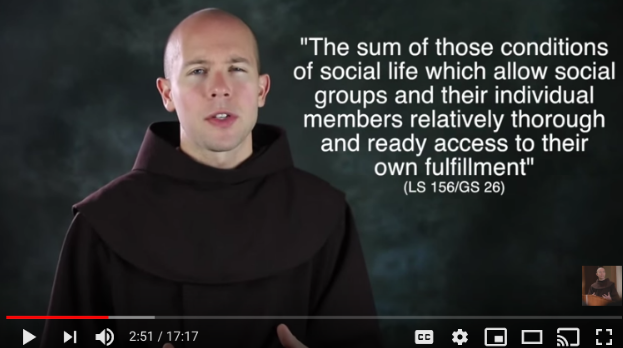
Serving the common good is a theme discussed in the video series "Understanding Laudato Si," hosted by Fr. Daniel P. Horan, OFM who explores Chapter Four of Pope Francis encyclical “Laudato Si”, including the theme of the principle of the common good.
 The sum of those conditions of social life which allow social groups and their individual members relatively thorough and ready access to their own fulfillment (LS156/GS26)8


The long march of history has seen some human progress in dealing with persecution and inequity among the children of God.
Understanding Laudato Si

We are called in this time to renew our mission to realize the common good.

References

1
(n.d.). Daniel, chapter 2 - United States Conference. Retrieved November 26, 2019, from http://www.usccb.org/bible/daniel/2 
2
(n.d.). Daniel, chapter 3. Retrieved November 26, 2019, from http://www.usccb.org/bible/daniel/3 
3
(n.d.). Luke, chapter 21 - United States Conference of Catholic Bishops. Retrieved November 26, 2019, from http://www.usccb.org/bible/luke/21 
4
(n.d.). Daily Reflections - OnlineMinistries .... Retrieved November 26, 2019, from https://onlineministries.creighton.edu/CollaborativeMinistry/daily.html 
5
(n.d.). Daily Scripture Readings and Meditations. Retrieved November 26, 2019, from https://dailyscripture.servantsoftheword.org/ 
6
(n.d.). Meditations - The Word Among Us. Retrieved November 26, 2019, from https://wau.org/meditations/2019/11/26/ 
7
(2019, November 26). Departing the Consumer Culture — Center for Action and .... Retrieved November 26, 2019, from https://cac.org/departing-the-consumer-culture-2019-11-26/ 
8
(2016, May 3). "Understanding Laudato Si" Series - YouTube. Retrieved November 26, 2019, from https://www.youtube.com/playlist?list=PLO2W1tFFtdJn9V9_DvEbz9Bygt7XsYXRj