Monday, April 11, 2022

Family Service and Celebration

The texts from the Roman Catholic Lectionary today challenge us to expand our practice of service and respect of others we encounter on our journey.
Family and Service


The reading from the Book of the Prophet Isaiah identifies the Servant as a Light to the Nations.

* [42:1–4] Servant: three other passages have been popularly called “servant of the Lord” poems: 49:1–7; 50:4–11; 52:13–53:12. Whether the servant is an individual or a collectivity is not clear (e.g., contrast 49:3 with 49:5). More important is the description of the mission of the servant. In the early Church and throughout Christian tradition, these poems have been applied to Christ; cf. Mt 12:18–21.1
 

Psalm 27 is a triumphant song of confidence.

* [Psalm 27] Tradition has handed down the two sections of the Psalm (Ps 27:1–6; 7–14) as one Psalm, though each part could be understood as complete in itself. Asserting boundless hope that God will bring rescue (Ps 27:1–3), the psalmist longs for the presence of God in the Temple, protection from all enemies (Ps 27:4–6). In part B there is a clear shift in tone (Ps 27:7–12); the climax of the poem comes with “I believe” (Ps 27:13), echoing “I trust” (Ps 27:3).2
 

In the Gospel of John, Mary anoints Jesus and the Pharisees plot to kill Lazarus.

* [12:1–8] This is probably the same scene of anointing found in Mk 14:3–9 (see note there) and Mt 26:6–13. The anointing by a penitent woman in Lk 7:36–38 is different. Details from these various episodes have become interchanged. * [12:3] The feet of Jesus: so Mk 14:3; but in Mt 26:6, Mary anoints Jesus’ head as a sign of regal, messianic anointing.3
 

John Shea S.J. wishes to focus on our response to the poor in this reflection.

In a broad sense, the poor are those who are in need. So yes, the poor will always be with us so long as someone is in need. Considering that we live limited lives with many needs, how could it be otherwise? The real question is, “how do we respond to the poor?” Our first reading shows God’s response to the poor, for those in need. God speaks of one who will “open the eyes of the blind, to bring out prisoners from confinement, and from the dungeon, those who live in darkness.” With the insight of our Christian faith, we realize that this reading is about Jesus. And as Christians we also recognize our call to follow Jesus, bringing forth justice, alleviating poverty, and sharing the Good News with all.4
 

Don Schwager quotes “God first loved us,” by Augustine of Hippo, 354-430 A.D.

"Fulfill the commandments out of love. Could anyone refuse to love our God, so abounding in mercy, so just in all His ways? Could anyone deny love to Him Who first loved us despite all our injustice and all our pride? Could anyone refuse to love God Who so loved us as to send His only Son not only to live among human beings but also to be put to death for their sake and at their own hands?." (excerpt from Catechetical Instructions 39)5
 

The Word Among Us Meditation on John 12:1-11 relates a story about Sandra, who was a dedicated, active Catholic mom. Her to-do list was endless, and she used every spare moment to cross off another item on that list. Every morning during Lent, Sandra read the Gospel stories about Jesus’ passion, death, and resurrection. And the results were amazing. She began to see how much Jesus loved her. She saw his mercy in a whole new light. And what she saw made her love him more and more.

Sandra found it hard at first. But each time she put aside her plans so that she could help someone out, she felt a deep sense of accomplishment. She also discovered that she was usually able to take care of the most important items on her list. Like the woman in today’s Gospel reading, Sandra learned that loving and serving Jesus was the most important thing she could ever do. Let’s imitate these two women by pouring ourselves out for the Lord. “Jesus, thank you for giving your life for me. Help me to give my life back to you.”6
 

Friar Jude Winkler outlines the four songs of the Suffering Servant from Deutero-Isaiah that date from the Babylonian exile and show a sense of universalism in the texts. Our desire to do charity may need to extend to love and respect for those we serve. Friar Jude suggests that diakonia references in the Gospel are indications that women have served as deacons in the history of the Church.


Fr. Richard Rohr, OFM, comments that Jesus asks us to imitate him in his own journey of full incarnation. To do so, he gives us the two great commandments: (1) Love God with your whole heart, soul, mind, and strength and (2) Love your neighbour as yourself (Mark 12:28–31; Luke 10:25–28). In the parable of the Good Samaritan (Luke 10:29–37), Jesus shows us that our “neighbour” even includes our “enemy.”

Most of us were given the impression that we had to be totally selfless, and when we couldn’t achieve that, many of us gave up altogether. One of John Duns Scotus’ (c. 1266–1308) most helpful teachings is that Christian morality at its best seeks “a harmony of goodness.” We harmonise and balance necessary self-care with a constant expansion beyond ourselves to loving others. This for me is brilliant! It is both simple and elegant, showing us how to love our neighbour as our self. Imagining and working toward this harmony keeps us from seeking impossible, private, and heroic ideals. Now the possibility of love is potentially right in front of us and always concrete; love is no longer a theory, a heroic ideal, or a mere textbook answer. Love is seeking the good of as many subjects as possible.7 

The Spirit may inspire extravagant actions in love as a response to encounters with the Divine Lover.


References

1

(n.d.). Isaiah, CHAPTER 42 | USCCB. Retrieved April 11, 2022, from https://bible.usccb.org/bible/isaiah/42 

2

(n.d.). Psalms, PSALM 27 | USCCB. Retrieved April 11, 2022, from https://bible.usccb.org/bible/psalms/27 

3

(n.d.). John, CHAPTER 12 | USCCB. Retrieved April 11, 2022, from https://bible.usccb.org/bible/john/12 

4

(n.d.). Creighton U Daily Reflections - Online Ministries. Retrieved April 11, 2022, from https://onlineministries.creighton.edu/CollaborativeMinistry/041122.html 

5

(n.d.). Daily Scripture Readings and Meditations. Retrieved April 11, 2022, from https://www.dailyscripture.net/daily-meditation/?ds_year=2022&date=apr11 

6

(n.d.). The Word Among Us: Homepage. Retrieved April 11, 2022, from https://wau.org/meditations/2022/04/11/350508/ 

7

(n.d.). Daily Meditations Archive: 2022 - Center for Action and Contemplation. Retrieved April 11, 2022, from https://cac.org/expanding-circles-of-love-2022-04-11/ 


Sunday, April 10, 2022

Self Emptying Passion

The texts from the Roman Catholic Lectionary today initiate our observance of Holy Week with the account of Jesus' Passion as portrayed by Luke.


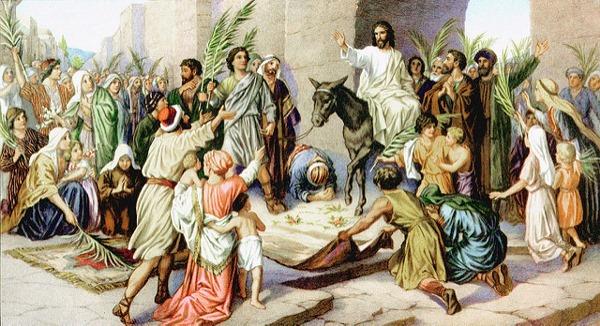
The Gospel Passage for Blessing the palms describes Jesus’ triumphal entry into Jerusalem.

* [19:28–21:38] With the royal entry of Jesus into Jerusalem, a new section of Luke’s gospel begins, the ministry of Jesus in Jerusalem before his death and resurrection. Luke suggests that this was a lengthy ministry in Jerusalem (Lk 19:47; 20:1; 21:37–38; 22:53) and it is characterized by Jesus’ daily teaching in the temple (Lk 21:37–38). For the story of the entry of Jesus into Jerusalem, see also Mt 21:1–11; Mk 11:1–10; Jn 12:12–19 and the notes there.1
 

The reading from the Book of the Prophet Isaiah is the humiliation and vindication of the Suffering Servant.

* [50:4–11] The third of the four “servant of the Lord” oracles (cf. note on 42:1–4); in vv. 4–9 the servant speaks; in vv. 10–11 God addresses the people directly. * [50:5] The servant, like a well-trained disciple, does not refuse the divine vocation. * [50:6] He willingly submits to insults and beatings. Tore out my beard: a grave and painful insult.2
 

Psalm 22 is a plea for deliverance from suffering and hostility.

* [Psalm 22] A lament unusual in structure and in intensity of feeling. The psalmist’s present distress is contrasted with God’s past mercy in Ps 22:2–12. In Ps 22:13–22 enemies surround the psalmist. The last third is an invitation to praise God (Ps 22:23–27), becoming a universal chorus of praise (Ps 22:28–31). The Psalm is important in the New Testament. Its opening words occur on the lips of the crucified Jesus (Mk 15:34; Mt 27:46), and several other verses are quoted, or at least alluded to, in the accounts of Jesus’ passion (Mt 27:35, 43; Jn 19:24).3
 

The reading from the Letter of Paul to the Phillippians is a plea for unity and humility.

* [2:6–11] Perhaps an early Christian hymn quoted here by Paul. The short rhythmic lines fall into two parts, Phil 2:6–8 where the subject of every verb is Christ, and Phil 2:9–11 where the subject is God. The general pattern is thus of Christ’s humiliation and then exaltation. More precise analyses propose a division into six three-line stanzas (Phil 2:6; 7abc, 7d–8, 9, 10, 11) or into three stanzas (Phil 2:6–7ab, 7cd–8, 9–11). Phrases such as even death on a cross (Phil 2:8c) are considered by some to be additions (by Paul) to the hymn, as are Phil 2:10c, 11c.4
 

The Passion account in the Gospel of Luke shares the Lord’s Supper to the Burial of Jesus.

* [22:1–23:56a] The passion narrative. Luke is still dependent upon Mark for the composition of the passion narrative but has incorporated much of his own special tradition into the narrative. Among the distinctive sections in Luke are: (1) the tradition of the institution of the Eucharist (Lk 22:15–20); (2) Jesus’ farewell discourse (Lk 22:21–38); (3) the mistreatment and interrogation of Jesus (Lk 22:63–71); (4) Jesus before Herod and his second appearance before Pilate (Lk 23:6–16); (5) words addressed to the women followers on the way to the crucifixion (Lk 23:27–32); (6) words to the penitent thief (Lk 23:39–41); (7) the death of Jesus (Lk 23:46, 47b–49). Luke stresses the innocence of Jesus (Lk 23:4, 14–15, 22) who is the victim of the powers of evil (Lk 22:3, 31, 53) and who goes to his death in fulfillment of his Father’s will (Lk 22:42, 46). Throughout the narrative Luke emphasizes the mercy, compassion, and healing power of Jesus (Lk 22:51; 23:43) who does not go to death lonely and deserted, but is accompanied by others who follow him on the way of the cross (Lk 23:26–31, 49).5 

Susan Naatz reflects that our readings today invite us to experience both exuberant joy and profound sorrow.

Several days ago, during the Angelus prayer at the Vatican, Pope Francis said, “Those who wage war forget humanity. They do not start from the people; they do not look at the real life of people but place partisan interests and power before all else. They trust in the diabolical and perverse logic of weapons, which is the furthest from the logic of God…put down your weapons! God is with the peacemakers, not with those who use violence.” [source] The words of Pope Francis will continue to echo throughout this holiest of weeks when we face the violence of the crucifixion and death of Jesus. Holy Week is upon us with its messages of hope and despair; joy and grief—intermingled with the promise of salvation. There is a call here to invite Jesus to become a deeper part of our lives. May he be the lens with which we act, serve, and see. And as the world experiences our peaceful actions of love, compassion, and prayer, perhaps they too will declare: “That is Jesus!”6 

Don Schwager quotes “The following of Christ,” by Augustine of Hippo, 354-430 A.D.

"Come, follow Me, says the Lord. Do you love? He has hastened on, He has flown on ahead. Look and see where. O Christian, don't you know where your Lord has gone? I ask you: Don't you wish to follow Him there? Through trials, insults, the cross, and death. Why do you hesitate? Look, the way has been shown you." (excerpt from Sermon 64,5)7
 

The Word Among Us Meditation on Luke 22:14–23:56 reminds us that today is the beginning of Holy Week. It’s the beginning of our own sacred time. For the next seven days, Jesus will appear before us as the suffering Servant of the Lord. Each day we will hear another story that reveals the depth of his love for us. Each day we will see another facet of what it means that he is the Lamb of God who has come to take away our sins.

The hour has come. Jesus is about to offer himself for you. Don’t miss out on the grace of this sacred time. Try to carve out a few extra minutes for prayer each day. Or spend a little more time with the word of God. Or just gaze at the cross a little longer. Let the love that Jesus has for you fill your heart and heal your soul. “Holy Spirit, let the grace of this Holy Week change my heart.”8
 

Jack Mahoney SJ, Emeritus Professor of Moral and Social Theology in the University of London, looks at the picture that Luke paints for us of Jesus’s arrest, trial and crucifixion. How can this narrative help us to understand that Jesus ‘loved me and gave himself for me’?

As mentioned previously, Luke’s Gospel was written to commend faith in Jesus to Gentile and Roman readers and it is understandable that it gives considerable attention to the Roman trial of Jesus by Pilate – in contrast with Mark, Matthew and even John – showing that the Roman procurator tried on no fewer than three occasions to resist the Jewish religious establishment and acquit the accused. Jesus’s innocence is highlighted repeatedly by Luke, and the political charges laid against him by the whole assembly before Pilate are obviously contrived, including the charge that he claimed to be a king (23:1-2). We may recall, however, that in Luke the crowds on Palm Sunday did change the psalm to acclaim Jesus as ‘the king who comes in the name of the Lord’, to the political scandal of the Pharisees (19:38-39). Perhaps this gave some credibility to the charge, for it was this allegation that Pilate picked up in asking Jesus if he was the king of the Jews (23:3). Hearing also that Jesus had started his prophetic activities in Galilee, Pilate sent him off to be dealt with by Herod, the ruler of Galilee (3:1), for whom Jesus had little time, referring to him as ‘that fox’ (13:32). In fact, Herod and his thugs could get nothing out of Jesus, and he was returned to Pilate in ridicule (23:6-13). The Roman governor next attempted to release Jesus by declaring him innocent against the popular swell of rejection (23:13-16) and by offering to extend to him the traditional pardon that was given at Passover time to a convicted criminal; but ‘the chief priests, the leaders and the people’ demanded that Pilate release another criminal, called Barabbas, instead, and have Jesus crucified (23:13-21).  Yet once more Pilate protested he could find no basis for the sentence of death and he now proposed to have the accused flogged and released, a common Roman procedure of acquittal. Yet again, however, he could not prevail and he ultimately surrendered to popular pressure: he gave his verdict ‘that their demand should be granted . . . and he handed Jesus over as they wished’ (23:22-25).9
 

Friar Jude Winkler relates the texts to Jesus' humility and His response to violence. The unique features of the treatment of the Romans, Luke as philosopher and physician, and special attention to women are discussed. Friar Jude reminds us of the realized eschatology in the Passion Account of Luke.


The CAC Daily Meditations for Sunday, April 10, 2022 were unavailable at publication time.


Meditation on the Passion today is an opportunity for the Spirit to shape our spiritual growth in Holy Week.


References

1

(n.d.). Luke, CHAPTER 19 | USCCB. Retrieved April 10, 2022, from https://bible.usccb.org/bible/luke/19 

2

(n.d.). Isaiah, CHAPTER 50 | USCCB. Retrieved April 10, 2022, from https://bible.usccb.org/bible/isaiah/50 

3

(n.d.). Psalms, PSALM 22 | USCCB - United States Conference of Catholic .... Retrieved April 10, 2022, from https://bible.usccb.org/bible/psalms/22 

4

(n.d.). Philippians, CHAPTER 2 | USCCB. Retrieved April 10, 2022, from https://bible.usccb.org/bible/philippians/2 

5

(n.d.). Luke, CHAPTER 22 | USCCB. Retrieved April 10, 2022, from https://bible.usccb.org/bible/luke/22 

6

(n.d.). Creighton U Daily Reflections - Online Ministries. Retrieved April 10, 2022, from https://onlineministries.creighton.edu/CollaborativeMinistry/041022.html 

7

(n.d.). Daily Scripture Readings and Meditations. Retrieved April 10, 2022, from https://www.dailyscripture.net/daily-meditation/?ds_year=2022&date=apr10 

8

(n.d.). Mass Readings and Catholic Daily Meditations for April 10, 2022. Retrieved April 10, 2022, from https://wau.org/meditations/2022/04/10/348018/ 

9

(2010, March 24). The Passion According to Saint Luke | Thinking Faith. Retrieved April 10, 2022, from https://www.thinkingfaith.org/articles/20100324_1.htm