Showing posts with label Pope Frances. Show all posts

Sunday, April 10, 2022

Self Emptying Passion

The texts from the Roman Catholic Lectionary today initiate our observance of Holy Week with the account of Jesus' Passion as portrayed by Luke.
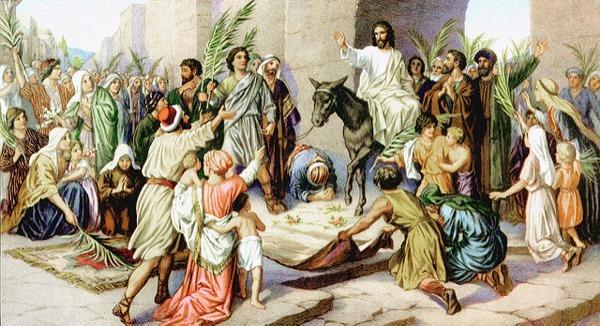


The Gospel Passage for Blessing the palms describes Jesus’ triumphal entry into Jerusalem.

* [19:2821:38] With the royal entry of Jesus into Jerusalem, a new section of Luke’s gospel begins, the ministry of Jesus in Jerusalem before his death and resurrection. Luke suggests that this was a lengthy ministry in Jerusalem (Lk 19:47; 20:1; 21:3738; 22:53) and it is characterized by Jesus’ daily teaching in the temple (Lk 21:3738). For the story of the entry of Jesus into Jerusalem, see also Mt 21:111; Mk 11:110; Jn 12:1219 and the notes there.1
 

The reading from the Book of the Prophet Isaiah is the humiliation and vindication of the Suffering Servant.

* [50:411] The third of the four “servant of the Lord” oracles (cf. note on 42:14); in vv. 49 the servant speaks; in vv. 1011 God addresses the people directly. * [50:5] The servant, like a well-trained disciple, does not refuse the divine vocation. * [50:6] He willingly submits to insults and beatings. Tore out my beard: a grave and painful insult.2
 

Psalm 22 is a plea for deliverance from suffering and hostility.

* [Psalm 22] A lament unusual in structure and in intensity of feeling. The psalmist’s present distress is contrasted with God’s past mercy in Ps 22:212. In Ps 22:1322 enemies surround the psalmist. The last third is an invitation to praise God (Ps 22:2327), becoming a universal chorus of praise (Ps 22:2831). The Psalm is important in the New Testament. Its opening words occur on the lips of the crucified Jesus (Mk 15:34; Mt 27:46), and several other verses are quoted, or at least alluded to, in the accounts of Jesus’ passion (Mt 27:35, 43; Jn 19:24).3
 

The reading from the Letter of Paul to the Phillippians is a plea for unity and humility.

* [2:611] Perhaps an early Christian hymn quoted here by Paul. The short rhythmic lines fall into two parts, Phil 2:68 where the subject of every verb is Christ, and Phil 2:911 where the subject is God. The general pattern is thus of Christ’s humiliation and then exaltation. More precise analyses propose a division into six three-line stanzas (Phil 2:6; 7abc, 7d8, 9, 10, 11) or into three stanzas (Phil 2:67ab, 7cd8, 911). Phrases such as even death on a cross (Phil 2:8c) are considered by some to be additions (by Paul) to the hymn, as are Phil 2:10c, 11c.4
 

The Passion account in the Gospel of Luke shares the Lord’s Supper to the Burial of Jesus.

* [22:123:56a] The passion narrative. Luke is still dependent upon Mark for the composition of the passion narrative but has incorporated much of his own special tradition into the narrative. Among the distinctive sections in Luke are: (1) the tradition of the institution of the Eucharist (Lk 22:1520); (2) Jesus’ farewell discourse (Lk 22:2138); (3) the mistreatment and interrogation of Jesus (Lk 22:6371); (4) Jesus before Herod and his second appearance before Pilate (Lk 23:616); (5) words addressed to the women followers on the way to the crucifixion (Lk 23:2732); (6) words to the penitent thief (Lk 23:3941); (7) the death of Jesus (Lk 23:46, 47b49). Luke stresses the innocence of Jesus (Lk 23:4, 1415, 22) who is the victim of the powers of evil (Lk 22:3, 31, 53) and who goes to his death in fulfillment of his Father’s will (Lk 22:42, 46). Throughout the narrative Luke emphasizes the mercy, compassion, and healing power of Jesus (Lk 22:51; 23:43) who does not go to death lonely and deserted, but is accompanied by others who follow him on the way of the cross (Lk 23:2631, 49).5 

Susan Naatz reflects that our readings today invite us to experience both exuberant joy and profound sorrow.

Several days ago, during the Angelus prayer at the Vatican, Pope Francis said, “Those who wage war forget humanity. They do not start from the people; they do not look at the real life of people but place partisan interests and power before all else. They trust in the diabolical and perverse logic of weapons, which is the furthest from the logic of God…put down your weapons! God is with the peacemakers, not with those who use violence.” [source] The words of Pope Francis will continue to echo throughout this holiest of weeks when we face the violence of the crucifixion and death of Jesus. Holy Week is upon us with its messages of hope and despair; joy and grief—intermingled with the promise of salvation. There is a call here to invite Jesus to become a deeper part of our lives. May he be the lens with which we act, serve, and see. And as the world experiences our peaceful actions of love, compassion, and prayer, perhaps they too will declare: “That is Jesus!”6 

Don Schwager quotes “The following of Christ,” by Augustine of Hippo, 354-430 A.D.

"Come, follow Me, says the Lord. Do you love? He has hastened on, He has flown on ahead. Look and see where. O Christian, don't you know where your Lord has gone? I ask you: Don't you wish to follow Him there? Through trials, insults, the cross, and death. Why do you hesitate? Look, the way has been shown you." (excerpt from Sermon 64,5)7
 

The Word Among Us Meditation on Luke 22:14–23:56 reminds us that today is the beginning of Holy Week. It’s the beginning of our own sacred time. For the next seven days, Jesus will appear before us as the suffering Servant of the Lord. Each day we will hear another story that reveals the depth of his love for us. Each day we will see another facet of what it means that he is the Lamb of God who has come to take away our sins.

The hour has come. Jesus is about to offer himself for you. Don’t miss out on the grace of this sacred time. Try to carve out a few extra minutes for prayer each day. Or spend a little more time with the word of God. Or just gaze at the cross a little longer. Let the love that Jesus has for you fill your heart and heal your soul. “Holy Spirit, let the grace of this Holy Week change my heart.”8
 

Jack Mahoney SJ, Emeritus Professor of Moral and Social Theology in the University of London, looks at the picture that Luke paints for us of Jesus’s arrest, trial and crucifixion. How can this narrative help us to understand that Jesus ‘loved me and gave himself for me’?

As mentioned previously, Luke’s Gospel was written to commend faith in Jesus to Gentile and Roman readers and it is understandable that it gives considerable attention to the Roman trial of Jesus by Pilate – in contrast with Mark, Matthew and even John – showing that the Roman procurator tried on no fewer than three occasions to resist the Jewish religious establishment and acquit the accused. Jesus’s innocence is highlighted repeatedly by Luke, and the political charges laid against him by the whole assembly before Pilate are obviously contrived, including the charge that he claimed to be a king (23:1-2). We may recall, however, that in Luke the crowds on Palm Sunday did change the psalm to acclaim Jesus as ‘the king who comes in the name of the Lord’, to the political scandal of the Pharisees (19:38-39). Perhaps this gave some credibility to the charge, for it was this allegation that Pilate picked up in asking Jesus if he was the king of the Jews (23:3). Hearing also that Jesus had started his prophetic activities in Galilee, Pilate sent him off to be dealt with by Herod, the ruler of Galilee (3:1), for whom Jesus had little time, referring to him as ‘that fox’ (13:32). In fact, Herod and his thugs could get nothing out of Jesus, and he was returned to Pilate in ridicule (23:6-13). The Roman governor next attempted to release Jesus by declaring him innocent against the popular swell of rejection (23:13-16) and by offering to extend to him the traditional pardon that was given at Passover time to a convicted criminal; but ‘the chief priests, the leaders and the people’ demanded that Pilate release another criminal, called Barabbas, instead, and have Jesus crucified (23:13-21).  Yet once more Pilate protested he could find no basis for the sentence of death and he now proposed to have the accused flogged and released, a common Roman procedure of acquittal. Yet again, however, he could not prevail and he ultimately surrendered to popular pressure: he gave his verdict ‘that their demand should be granted . . . and he handed Jesus over as they wished’ (23:22-25).9
 

Friar Jude Winkler relates the texts to Jesus' humility and His response to violence. The unique features of the treatment of the Romans, Luke as philosopher and physician, and special attention to women are discussed. Friar Jude reminds us of the realized eschatology in the Passion Account of Luke.


The CAC Daily Meditations for Sunday, April 10, 2022 were unavailable at publication time.


Meditation on the Passion today is an opportunity for the Spirit to shape our spiritual growth in Holy Week.


References

1

(n.d.). Luke, CHAPTER 19 | USCCB. Retrieved April 10, 2022, from https://bible.usccb.org/bible/luke/19 

2

(n.d.). Isaiah, CHAPTER 50 | USCCB. Retrieved April 10, 2022, from https://bible.usccb.org/bible/isaiah/50 

3

(n.d.). Psalms, PSALM 22 | USCCB - United States Conference of Catholic .... Retrieved April 10, 2022, from https://bible.usccb.org/bible/psalms/22 

4

(n.d.). Philippians, CHAPTER 2 | USCCB. Retrieved April 10, 2022, from https://bible.usccb.org/bible/philippians/2 

5

(n.d.). Luke, CHAPTER 22 | USCCB. Retrieved April 10, 2022, from https://bible.usccb.org/bible/luke/22 

6

(n.d.). Creighton U Daily Reflections - Online Ministries. Retrieved April 10, 2022, from https://onlineministries.creighton.edu/CollaborativeMinistry/041022.html 

7

(n.d.). Daily Scripture Readings and Meditations. Retrieved April 10, 2022, from https://www.dailyscripture.net/daily-meditation/?ds_year=2022&date=apr10 

8

(n.d.). Mass Readings and Catholic Daily Meditations for April 10, 2022. Retrieved April 10, 2022, from https://wau.org/meditations/2022/04/10/348018/ 

9

(2010, March 24). The Passion According to Saint Luke | Thinking Faith. Retrieved April 10, 2022, from https://www.thinkingfaith.org/articles/20100324_1.htm 


Sunday, December 8, 2019

Expecting the King

The texts from the Roman Catholic Lectionary today invite us to contemplate the peaceful relationship we expect in the Kingdom of the Messiah as we ponder the contrast to our daily experience.
Relationships in Advent

The reading from the Prophet Isaiah expresses a longing and expectation of a peaceful Kingdom associated with the return of the remnant of Israel and Judah after the Exile.
* [11:2–3] The source of the traditional names of the gifts of the Holy Spirit. The Septuagint and the Vulgate read “piety” for “fear of the Lord” in its first occurrence, thus listing seven gifts.1
Psalm 72 is a prayer for guidance and support for the King.
* [Psalm 72] A royal Psalm in which the Israelite king, as the representative of God, is the instrument of divine justice (Ps 72:1–4, 12–14) and blessing (Ps 72:5–7, 15–17) for the whole world. The king is human, giving only what he has received from God. Hence intercession must be made for him. The extravagant language is typical of oriental royal courts.2 
In the Letter to the Romans, Paul exhorts patience and self-denial as he proclaims the Gospel is for Jews and Gentiles alike.
* [15:5] Think in harmony: a Greco-Roman ideal. Not rigid uniformity of thought and expression but thoughtful consideration of other people’s views finds expression here.3 
The Gospel of Matthew is the Proclamation of John the Baptist concerning Jesus arrival.
* [3:11] Baptize you with the holy Spirit and fire: the water baptism of John will be followed by an “immersion” of the repentant in the cleansing power of the Spirit of God, and of the unrepentant in the destroying power of God’s judgment. However, some see the holy Spirit and fire as synonymous, and the effect of this “baptism” as either purification or destruction. See note on USCCB Bible Luke 3:16.4 
Carol Zuegner concludes that our time of hope in Advent can be a time of making straight the paths to our own hearts.
 We are waiting for the birth of Jesus, but the birth of what he means in our lives can bloom and flourish every day. It takes work and mindfulness to show that spirit of wisdom and understanding, but the God of endurance and encouragement will work with us.5
Frances Murphy, Editor of Thinking Faith, quotes Pope Francis encyclical Laudato Si, as he summarizes the call in the texts today to contemplate our relationships and pray for the grace of a more open heart in a world where everything is interconnected.
The human person grows more, matures more and is sanctified more to the extent that he or she enters into relationships, going out from themselves to live in communion with God, with others and with all creatures. … Everything is interconnected, and this invites us to develop a spirituality of that global solidarity which flows from the mystery of the Trinity.[3]6 
Don Schwager quotes “The voice of the one crying in the wilderness,” by Theodoret of Cyr 393-466 A.D.
"The true consolation, the genuine comfort and the real deliverance from the iniquities of humankind is the incarnation of our God and Savior. Now the first who acted as herald of this event was the inspired John the Baptist. Accordingly, the prophetic text proclaims the realities that relate to him in advance, for that is what the three blessed Evangelists have taught us and that the most divine Mark has even made the prologue of his work. As for the inspired John, whom the Pharisees asked whether he himself was the Christ, he declared on his part: 'I am the voice of one crying in the wilderness, Make straight the way of the Lord' as the prophet Isaiah said (John 1:23; Isaiah 40:30); I am not God the Word but a voice, for it is as a herald that I am announcing God the Word, who is incarnate. Moreover, he refers to the Gentiles as the 'untrodden [land]' because they have not yet received the prophetic stamp." (excerpt from COMMENTARY ON ISAIAH 12.40.3)7 
The Word Among Us Meditation on Isaiah 11:1-10 notes that during Advent, it’s traditional to review stories from the Old Testament that promise the coming of the Messiah. Stories of these ancestors of Jesus illustrate God’s commitment to his plan to save us. It’s a commitment that stretched from the very beginning, through thousands of years, right up to Christmas Day. It’s a commitment that reaches even to the present.

Jesus’ birth has brought about something new and wonderful, and the Jesse Tree illustrates it: a salvation that is far more wide-reaching than we ever could have imagined.
“Heavenly Father, thank you for your faithfulness to your promises! Thank you for making me a part of your family.”8 

Friar Jude Winkler relates the hope of Isaiah to how the line of Davidic Kings had messed up. Paul in concluding his Letter to the Romans is witness to many Jews and Gentiles who have turned to Jesus. Friar Jude detects some residual anger in the Evangelist Matthew over the expulsion of Jewish Christians from the Temple.


Fr. Richard Rohr, OFM, cites Living School alumnus Tim King who attributes the United States’ epidemic of addiction to “the failures of religion and of an anemic spirituality.” [2] Fr Richard believes the Twelve-Step programs are a movement of the Spirit in our time. In creating Alcoholics Anonymous in 1935, Bill Wilson and Dr. Bob Smith, with typical American pragmatism, designed a truly practical program that really worked to change lives. Twelve-Step spirituality rediscovered the real transformative power that is the core of the Gospel. It is the spirituality of imperfection that Jesus taught, Paul clarified, Francis and Clare of Assisi lived, and Thérèse of Lisieux brought to light for the modern world. Transformation has little to do with intelligence, willpower, or perfection. It has everything to do with honest humility, willingness, and surrender. Fr Richard shares four assumptions that he makes about addiction.
We are all addicts. Human beings are addictive by nature. King writes: “The question for each of us is not whether we are addicted but how we are addicted, and to what. Denial of the existence of addiction in your life is not a mark of moral accomplishment but a sign of blindness.” [3] ...
“Stinking thinking” is the universal addiction. Substance addictions like alcohol and drugs are merely the most visible form of addiction, but actually we are all addicted to our own habitual way of thinking and doing... 
All societies are addicted to themselves and create deep codependency… we have all agreed to be compulsive about the same things and blind to the same problems. In the United States we’re addicted to oil, war, and empire. The church is addicted to its own exceptionalism. The white person is addicted to superiority. The wealthy person is addicted to entitlement and power.
Some form of alternative consciousness is the only freedom from this self and from cultural lies… Prayer is a form of non-dual resting in “what is”; this contemplative practice eventually changes our whole operating system! 9 
The King we expect is inviting us to contemplate the stare of our relationships with others, Nature, and God. We are subject to being addicted to patterns that divert us from experiencing the fullness of life to which Jesus calls us.

References

1
(n.d.). Isaiah, chapter 11 - United States Conference. Retrieved December 8, 2019, from http://www.usccb.org/bible/isaiah/11 
2
(n.d.). Psalms, chapter 72 - United States Conference. Retrieved December 8, 2019, from http://www.usccb.org/bible/psalms/72 
3
(n.d.). Romans, chapter 15 - United States Conference. Retrieved December 8, 2019, from http://www.usccb.org/bible/romans/15 
4
(n.d.). Matthew, chapter 3 - United States Conference. Retrieved December 8, 2019, from http://www.usccb.org/bible/matthew3:29 
5
(n.d.). Daily Reflections - OnlineMinistries .... Retrieved December 8, 2019, from https://onlineministries.creighton.edu/CollaborativeMinistry/daily.html 
6
(2019, December 4). The Word was with God | Thinking Faith: The online journal of .... Retrieved December 8, 2019, from https://www.thinkingfaith.org/articles/word-was-god 
7
(n.d.). Daily Scripture Readings and Meditations. Retrieved December 8, 2019, from https://dailyscripture.servantsoftheword.org/ 
8
(n.d.). 2nd Sunday of Advent - Mass Readings and Catholic Daily .... Retrieved December 8, 2019, from https://wau.org/meditations/2019/12/08/ 
9
(2019, December 8). A Universal Addiction — Center for Action and Contemplation. Retrieved December 8, 2019, from https://cac.org/a-universal-addiction-2019-12-08/