Showing posts with label the Christ. Show all posts

Sunday, January 16, 2022

Manifesting Good

The texts from the Roman Catholic Lectionary today resonate with our ideas about covenant and marriage and the direction for our lives in these relationships.
Consider the Covenant


The reading from the Book of the Prophet Isaiah proclaims the vindication and salvation of Zion.

* [62:112] As in chap. 60, the prophet addresses Zion, announcing the reversal of her fortune. Several motifs reappear: light and glory (60:13, 1920), tribute of nations (60:11), and especially the marriage (61:10; cf. also 54:58).1 

Psalm 96 praises God Who comes in judgment.

* [Psalm 96] A hymn inviting all humanity to praise the glories of Israel’s God (Ps 96:13), who is the sole God (Ps 96:46). To the just ruler of all belongs worship (Ps 96:710); even inanimate creation is to offer praise (Ps 96:1113). This Psalm has numerous verbal and thematic contacts with Is 4055, as does Ps 98. Another version of the Psalm is 1 Chr 16:2333.2 

The reading from the First Letter of Paul to the Corinthians asserts the manifestation of the Spirit for the common good.

* [12:46] There are some features common to all charisms, despite their diversity: all are gifts (charismata), grace from outside ourselves; all are forms of service (diakoniai), an expression of their purpose and effect; and all are workings (energÄ“mata), in which God is at work. Paul associates each of these aspects with what later theology will call one of the persons of the Trinity, an early example of “appropriation.”3 

In the Gospel of John, Jesus uses the Wedding at Cana to present signs of His mission.

* [2:111] The first sign. This story of replacement of Jewish ceremonial washings (Jn 2:6) presents the initial revelation about Jesus at the outset of his ministry. He manifests his glory; the disciples believe. There is no synoptic parallel.4
 

Mike Cherney finds himself drawn to St. Paul’s comment on the diversity of gifts. He thinks about how we are called to respond as recipients of God’s gifts. He considers the current labor market and the historically large number of people who are rethinking their role in the workplace. He and his wife are finding themselves among the disproportionate number of people later in their lives who are reassessing how they can best serve in their remaining years.

Dear Lord,

As I age, I have the chance to reflect on what might be called a full life. I think back to how meeting my wife gave me the first real sense of what unconditional love could mean. This was insightful both in terms of human and spiritual relationships. I think about the excessive amount time and effort that I devoted to my career. I realize that by the time I was in my early-forties, I had accomplished the goals that I had set out for myself as young academic. Distracted by the tasks at hand, it took me that long to start to realize the full importance of relationships. Now in my early retirement I find that my wife is my joy, and my grandchildren are my purpose. Still, I feel undeserving of the many gifts that I have received. My wife and I find ourselves considering the direction of our relationship with the larger community.

Heavenly Father, I acknowledge Your benevolence throughout my life.

Divine Son, I recognize Your continuing call to service.

Holy Spirit, I ask for Your gift of wisdom in using what I have been given to sustain old and to develop new relationships.5


Don Schwager quotes “The touch of the Lord,” by Ephrem the Syrian (306-373 AD).

"Why did our Lord change nature at the beginning of his signs, if it was not to show that the divinity that changed nature in the interior of the jars was the same that changed nature in the womb of the virgin? And at the conclusion of the signs, he opened the tomb to show that the insatiable nature of death would not keep hold of him; he confirmed and ratified these two uncertainties of his birth and of his death. As to their nature, these waters were turned into the [fruit of] the vine; their stone vessels were not changed within their own nature. They were a symbol of his body, which was wonderfully conceived in a woman, and in a marvelous way by [the intervention of] no man within the virgin. He thus made wine out of water to teach about the manner of his conception and birth. He called upon the six jars as witness to the one virgin who gave birth to him; for the jars conceived in a unique way that was not customary for them, and they brought forth wine, and then they did not continue to produce [it]. Thus did the virgin conceive and give birth to Immanuel, and then she ceased and did not continue [to give birth]. The offspring of the jars was from smallness to grandeur, and from vileness to excellence, for from water came good wine. In this case [the birth from the virgin], however, it was from grandeur to weakness and from glory to contempt. Yet in the case of these jars, they were for the purification of the Jews, and our Lord poured his instruction into them, to teach that he came in the way [found in] the Law and the Prophets, and he transformed everything by his teaching, just as wine [was made] from water." (excerpt fromCommentary on Tatian's DIATESSARON 5.6-7)6 

The Word Among Us Meditation on John 2:1-11 comments that we ask Jesus to come into a specific situation, as Mary did at the wedding at Cana. And when we see him acting—whether that’s through answering our prayer or reassuring us of his presence—he reveals something about himself. That he loves us. That he cares for us. That he has come to save us. That he will be with us always.

Is there some situation in your life that you want the Lord to enter into? As you pray, remember that he wants to do more than just resolve the immediate problem you are facing. He wants you to know who he is and why he came. He wants to reveal his glory to you. “Jesus, open my eyes to your glory in my life!”7
 

Friar Jude Winkler shares how God renewed the Covenant with the people of Israel after they had turned away at the time of the Exile. Paul expresses difficulty with the proto Gnostic attitudes of Corinthians who over emphasized speaking in tongues among the gifts of the Spirit. Friar Jude makes many connections in the symbols at the wedding in Cana to Jesus' “hour of glory” on the Cross.


Fr. Richard Rohr, OFM, comments that there were clear statements in the New Testament about the cosmic meaning to Christ [1], and the communities taught by Paul and John were initially overwhelmed by this message. In the early Christian era, only some few Eastern Fathers (such as Origen of Alexandria and Maximus the Confessor) cared to notice that the Christ was clearly something older, larger, and different than Jesus himself. They mystically saw that Jesus is the union of human and divine in space and time, and the Christ is the eternal union of matter and Spirit beyond time. But the later centuries tended to lose this mystical element in favor of dualistic Christianity. We lost our foundational paradigm for connecting all opposites.

Since we could not overcome the split between the spiritual and the material within ourselves, how could we then possibly overcome it for the rest of creation? The polluted earth, extinct and endangered species, tortured animals, nonstop wars, and constant religious conflicts have been the result. Yet Jesus the Christ has still planted within creation a cosmic hope, and we cannot help but see it in so many unexplainable and wonderful events and people. For some Christians, the split is overcome in the person of Jesus. But for more and more people, union with the divine is first experienced through “the Universal Christ”—in nature, in moments of pure love, silence, inner or outer music, with animals, or a primal sense of awe. Why? Because creation itself is the first incarnation of Christ, the primary and foundational “Bible” that reveals the path to God. Our encounter with the eternal Christ mystery started about 13.8 billion years ago in an event we now call the “Big Bang.” God has overflowed into visible Reality and revealed God’s self in trilobites, giant flightless birds, jellyfish, pterodactyls, and thousands of species that humans have never once seen. But God did.  And that was already more than enough meaning and glory.8 

The image of God and Jesus as bridegroom to the people of God is a rich paradigm in which to examine our keeping of the Covenant.


References

1

(n.d.). Isaiah, CHAPTER 62 | USCCB. Retrieved January 16, 2022, from https://bible.usccb.org/bible/isaiah/62 

2

(n.d.). Psalms, PSALM 96 | USCCB. Retrieved January 16, 2022, from https://bible.usccb.org/bible/psalms/96 

3

(n.d.). 1 Corinthians, CHAPTER 12 | USCCB. Retrieved January 16, 2022, from https://bible.usccb.org/bible/1corinthians/12 

4

(n.d.). John, CHAPTER 2 | USCCB. Retrieved January 16, 2022, from https://bible.usccb.org/bible/john/2 

5

(n.d.). Creighton U Daily Reflections - Online Ministries. Retrieved January 16, 2022, fromhttps://onlineministries.creighton.edu/CollaborativeMinistry/011622.html 

6

(n.d.). Daily Scripture Readings and Meditations. Retrieved January 16, 2022, from https://www.dailyscripture.net/daily-meditation/?ds_year=2022&date=jan16 

7

(n.d.). Mass Readings and Catholic Daily Meditations for January 16, 2022. Retrieved January 16, 2022, from https://wau.org/meditations/2022/01/16/293595/ 

8

(n.d.). Daily Meditations Archive - Center for Action and Contemplation. Retrieved January 16, 2022, from https://cac.org/a-dynamic-unity-2022-01-16/ 


Monday, December 3, 2018

Diversity and common concern for life

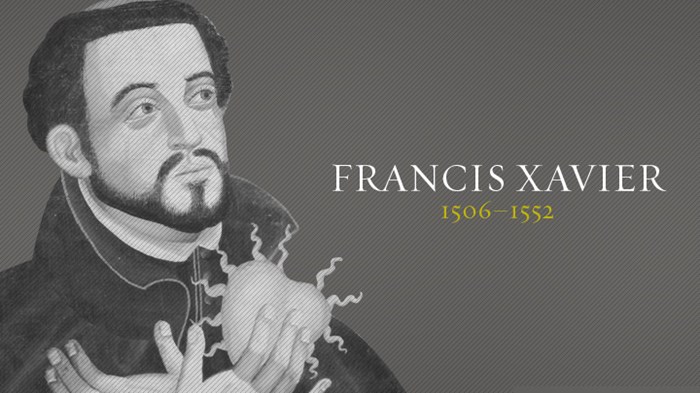
The texts from the Roman Catholic Lectionary on the Memorial of St Francis Xavier share a theme of peace and being gracious and offering dignity to those who may be thought as outsiders.
https://www-images.christianitytoday.com/images/67403.jpg?w=700

The Book of the Prophet Isaiah celebrates the movement of all peoples seeking peace to the Lord in Jerusalem.
* [2:4] Once the nations acknowledge God as sovereign, they go up to Jerusalem to settle their disputes, rather than having recourse to war.
Psalm 122 declares our joy as we move toward the House of the Lord.

In the Gospel from Matthew, Jesus encounters deep faith in a Roman centurion.
* [8:8–9] Acquainted by his position with the force of a command, the centurion expresses faith in the power of Jesus’ mere word.
Kyle Lierk reflects on the life of Francis Xavier and our readings today, and is struck by a powerful “golden thread” through it all:  the beauty of finding God through diversity, not in spite of it.
Our Campus Ministry Department took a group of seven undergraduate students who identify as Buddhist, Catholic, Muslim, Lutheran, Apache, and Sikh to the Parliament of the World’s Religions in Toronto, Canada three weeks ago.  They reported that the experience was one of “warmth” where they felt “seen” and “fed” by authentic interactions with the more than 10,000 people from around the world who attended. This is what heaven on earth is like. We don’t bemoan the fact that we must tolerate each other, but, as the Psalmist says today, we “rejoice” in the gift of being able to actually celebrate each other.
Bert Ghezzi outlines the gift of ministry of Saint Francis Xavier, 1506-1552.
In his passion for spreading the gospel, in his simple obedience, in his humble disregard for himself, the saint was a near perfect imitation of Christ.
Don Schwager quotes “Welcoming the Lord Jesus with expectant faith and humility,”  by Augustine of Hippo, 354-430 A.D.
"When the Lord promised to go to the centurion's house to heal his servant, the centurion answered, 'Lord, I am not worthy to have you come under my roof; but only say the word, and my servant will be healed.' By viewing himself as unworthy, he showed himself worthy for Christ to come not merely into his house but also into his heart. He would not have said this with such great faith and humility if he had not already welcomed in his heart the One who came into his house. It would have been no great joy for the Lord Jesus to enter into his house and not to enter his heart. For the Master of humility both by word and example sat down also in the house of a certain proud Pharisee, Simon, and though he sat down in his house, there was no place in his heart. For in his heart the Son of Man could not lay his head" (Matthew 8:20). (excerpt from SERMON 62.1)
The Word Among Us Meditation on Isaiah 2:1-5. notes that today, the gospel goes out through missionaries laboring in foreign lands or sharing the love of Christ in homeless shelters just down the road from us. And people are streaming in as a result.
You don’t have to be a prophet like Isaiah or a missionary for the good news of Christ to ring out from your life. You can offer everyday acts of love and kindness to the people around you. You can visit a neighbor who is sick and offer to pray for them—or even with them! You can include that lonely coworker in your plans for the holidays. You can help teach a catechism class or set up at your parish’s “Welcome Sunday” social.
Friar Jude Winkler expands on the theme of shalom that comes from Oneness in the Lord. The encounter of Jesus with the centurion is an example of graciousness and offering dignity. Friar Jude comments that the Gospel of Matthew, written to Jewish Christians, highlights the faith of a pagan soldier of an occupying army.

Fr. Richard Rohr, OFM, teaches the Risen Christ is the only Jesus that Paul ever knew! This makes Paul a fitting mediator for the rest of us, since the Omnipresent Risen Christ is the only Jesus we will ever know as well (see 2 Corinthians 5:16-17). Jesus’ historical transformation (“resurrected flesh”) allows us to more easily experience the Presence that has always been available since the beginning of time, a Presence unlimited by space or time, the promise and “guarantee” of our own transformation (see 1 Corinthians 15:1-58).
Whenever the material and the spiritual coincide, there is the Christ. Jesus fully accepted that human-divine identity and walked it into history. Henceforth, the Christ “comes again” whenever we are able to see the spiritual and the material coexisting, in any moment, in any event, and in any person. All matter reveals Spirit, and Spirit needs matter to “show itself”! I believe “the Second Coming of Christ” happens whenever and wherever we allow this to be utterly true for us. This is how God continually breaks into history—even before the first homo sapiens stood in awe and wonder, gazing at the stars
Our experience of the Presence resonates across time with the Spirit working in the actions of Francis Xavier and the prophecy of Isaiah concerning shalom in the Presence.

References

(n.d.). Isaiah chapter 2 - United States Conference of Catholic Bishops. Retrieved December 3, 2018, from http://www.usccb.org/bible/isaiah/2
(n.d.). Matthew chapter 8 - United States Conference of Catholic Bishops. Retrieved December 3, 2018, from http://www.usccb.org/bible/matthew/8
(n.d.). Creighton U Daily Reflections .... Retrieved December 3, 2018, from http://onlineministries.creighton.edu/CollaborativeMinistry/daily.html
(2017, December 3). Saint Francis Xavier, 1506-1552 - Loyola Press. Retrieved December 3, 2018, from https://www.loyolapress.com/our-catholic-faith/saints/saints-stories-for-all-ages/saint-francis-xavier-1506-1552
(n.d.). Daily Scripture Readings and Meditations. Retrieved December 3, 2018, from https://dailyscripture.servantsoftheword.org/
(n.d.). Saint Francis Xavier, Priest (Memorial) - Mass Readings and Catholic .... Retrieved December 3, 2018, from https://wau.org/meditations/
(2017, December 30). 2018 Daily Meditations - Center for Action and Contemplation. Retrieved December 3, 2018, from https://cac.org/2018-daily-meditations/