Showing posts with label systemic sin. Show all posts

Wednesday, October 20, 2021

Dealing with Division

The texts from the Roman Catholic Lectionary today resonate with our sense of separation that comes from encountering situations that deplete our sense of fullness in life.


Choices in Life
 

The Letter of Paul to the Romans shares our faith in the gift of Eternal Life. Psalm 1 declares the Two Ways we have to choose in life.  The Gospel of Luke expresses how Jesus becomes the Cause of Division1 Sr. Candice Tucci, OSF comments that to follow Jesus, to do the right thing, to live in right relationships, to basically do good and avoid evil is the mission of Jesus. Jesus challenged the Law and introduced a new one, to Love God, your neighbor as yourself. If we follow this new law of Love, and Life, it seems divisions happen.

So, Jesus, there you are creating the healing serum, giving the vaccinations, receiving the vaccinations, voting in Congress for life-giving choices, challenging bad laws, at the bedside of those dying of diseases, speaking out against injustices, building the city’s infrastructure, and mailing in a ballot! There you are promoting life, life everlasting and others just don’t get it!2 

Don Schwager quotes “The fire of the Gospel and being baptized in the Holy Spirit, “ by Cyril of Alexandria (376-444 AD).

"We affirm that the fire that Christ sent out is for humanity's salvation and profit. May God grant that all our hearts be full of this. The fire is the saving message of the Gospel and the power of its commandments. We were cold and dead because of sin and in ignorance of him who by nature is truly God. The gospel ignites all of us on earth to a life of piety and makes us fervent in spirit, according to the expression of blessed Paul (Romans 12:11). Besides this, we are also made partakers of the Holy Spirit, who is like fire within us. We have been baptized with fire and the Holy Spirit. We have learned the way from what Christ says to us. Listen to his words: 'Truly I say to you, that except a man be born of water and spirit, he cannot see the kingdom of God' (John 3:5). It is the divinely inspired Scripture's custom to give the name of fire sometimes to the divine and sacred words and to the efficacy and power which is by the Holy Spirit by which we are made fervent in spirit." (excerpt from COMMENTARY ON LUKE, HOMILY 94)3
 

The Word Among Us Meditation on Romans 6:19-23 comments that Paul is trying to help the Romans understand the difference between being bound by our sinful tendencies and being children of God wholly belonging to him. He wants them, and us, to understand that “the wages of sin is death, but the gift of God is eternal life in Christ Jesus our Lord” (Romans 6:23).

In the end, it’s a beautiful paradox: we find our greatest freedom when we surrender ourselves to God. The more we submit to his reign, the more free we become. May we never go back to living as a “slave” to sin! “Thank you, Lord, for setting me free! I want to belong completely to you and lovingly obey you.”4 

Friar Jude Winkler shares insight about the readings today. Richard Rohr, OFM, comments on the systemic evils in our culture. We experience division among those we love as we struggle to choose the path of life.


References


1

(n.d.). Thursday of the Twenty-ninth Week in Ordinary Time | USCCB. Retrieved October 21, 2021, from https://bible.usccb.org/bible/readings/102121.cfm 

2

(n.d.). Creighton U Daily Reflections - Online Ministries. Retrieved October 21, 2021, from https://onlineministries.creighton.edu/CollaborativeMinistry/daily.html 

3

(n.d.). Daily Scripture Readings and Meditations. Retrieved October 21, 2021, from https://www.dailyscripture.net/daily-meditation/?ds_year=2021&date=oct21 

4

(2021, October 21). Mass Readings and Catholic Daily Meditations for October 21, 2021. Retrieved October 21, 2021, from https://wau.org/meditations/2021/10/21/228352/ 

Tuesday, September 21, 2021

Build the Body with Mercy

The texts from the Roman Catholic Lectionary today challenge us to contemplate the power of mercy in our interactions with others to transform lives.
Mercy needed in our systems


The reading from the Letter to the Ephesians describes the faith that builds unity in the Body of Christ.

* [4:1–16] A general plea for unity in the church. Christians have been fashioned through the Spirit into a single harmonious religious community (one body, Eph 4:4, 12; cf. Eph 4:16), belonging to a single Lord (in contrast to the many gods of the pagan world), and by one way of salvation through faith, brought out especially by the significance of baptism (Eph 4:1–6; cf. Rom 6:1–11). But Christian unity is more than adherence to a common belief. It is manifested in the exalted Christ’s gifts to individuals to serve so as to make the community more Christlike (Eph 4:11–16). This teaching on Christ as the source of the gifts is introduced in Eph 4:8 by a citation of Ps 68:18, which depicts Yahweh triumphantly leading Israel to salvation in Jerusalem. It is here understood of Christ, ascending above all the heavens, the head of the church; through his redemptive death, resurrection, and ascension he has become the source of the church’s spiritual gifts. The “descent” of Christ (Eph 4:9–10) refers more probably to the incarnation (cf. Phil 2:6–8) than to Christ’s presence after his death in the world of the dead (cf. 1 Pt 3:19).1
 

Psalm 19 praises God’s Glory in Creation and the Law.

* [19:4] No speech, no words: the regular functioning of the heavens and the alternation of day and night inform human beings without words of the creator’s power and wisdom.2
 

The Gospel of Matthew describes the Calling of Matthew.

* [9:13] Go and learn…not sacrifice: Matthew adds the prophetic statement of Hos 6:6 to the Marcan account (see also Mt 12:7). If mercy is superior to the temple sacrifices, how much more to the laws of ritual impurity.3
 

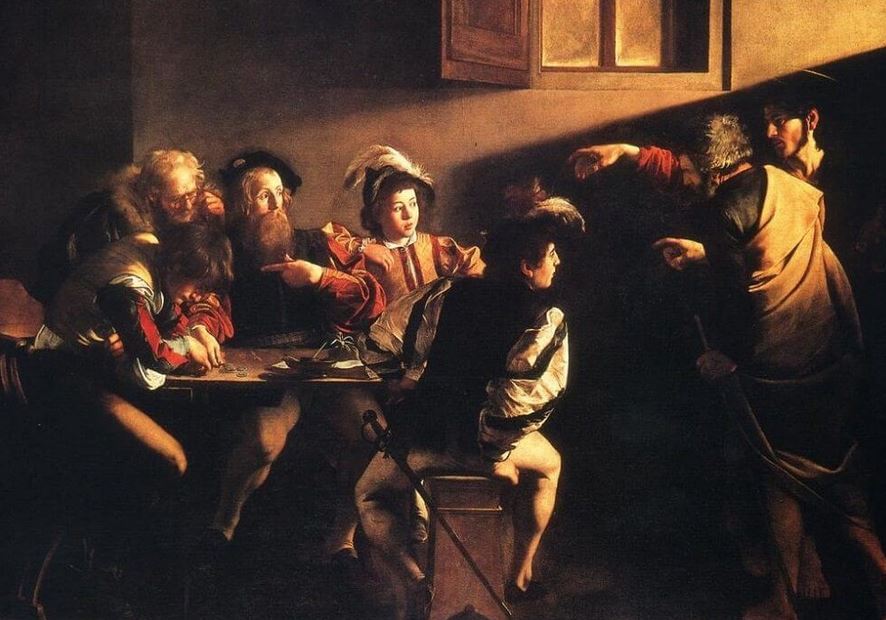
Dennis Hamm, S.J. comments that Pope Francis speaks frequently of contemplating Caravaggio’s painting, of the call of Matthew, with himself in Matthew’s place, targeted by Jesus’ finger inviting him to a continuing conversion, to a joyful surrender to a new way of belonging — really a new creation.
the call of Matthew


He concludes with a prayer of his own.

Thank you, Lord, for creating the occasion for me to pause, listen, and re-enter my Church’s prayer, this Feast’s Collect. Thank you also for Caravaggio’s artistry and Pope Francis’ application of it to his own experience of the call of Jesus to ongoing conversion. I am amazed to find myself praying for the grace of being sustained by Matthew’s example. As Francis has learned to see, Matthew realized that Jesus so loved him that he understood that he (Matthew) was caught in a way of life, a self-centered way seeking love, from which he needed rescue, a new way of belonging and being loved and loving and a new way of belonging to human community. It is not all about me; it is about all of us who identify as following Jesus and wanting to do it better. Now is the worst of times and the best of times. Creator God, I know that others have used that phrase about their day. But your chosen leader for your church, Francis, has helped us recognize that we live during a moment when human beings have sinned more egregiously than ever against your creation; and yet we also experience a new call to hear both the cry of the Earth and the cry of Earth’s poorest. On this feast of Saint Matthew, help us recognize your finger beckoning us to collaborate with you in mitigating the harm we have done to our common home. And help us walk with those who have suffered most from the harm we, the so-called powerful and privileged, have helped to bring about. You have created all out of love. Help us hear your invitation to embrace all of our fellow creatures in a sharing of that self-giving love in the company of Jesus.4 

Don Schwager quotes “Matthew did not delay when called by Jesus,” by Chromatius (died 406 AD).

"The Lord, about to give salvation to all sinners believing in him, willingly chose Matthew the former publican. The gift of his esteem for Matthew stands as an example for our salvation. Every sinner must be chosen by God and can receive the grace of eternal salvation if one is not without a religious mind and a devout heart. So Matthew was chosen willingly by God. And though he is immersed in worldly affairs, because of his sincere religious devotion he is judged worthy to be called forth by the Lord ("Follow me"), who by virtue of his divine nature knows the hidden recesses of the heart. From what follows, we know that Matthew was accepted by the Lord not by reason of his status but of his faith and devotion. As soon as the Lord says to him, "Follow me," he does not linger or delay, but thereupon "he arose and followed him." (excerpt from TRACTATE ON MATTHEW 45.1)5 

The Word Among Us Meditation on Matthew 9:9-13 comments that Jesus’ invitation sparked hope in Matthew. Maybe he could find his way back to God after all! Other men of God had shunned Matthew because of his corrupt profession and worldly lifestyle, but this “Man of Mercy” was different. Jesus reached out to him as a physician reaches out to his patients. He wasn’t intimidated by Matthew’s job. On the contrary, he seemed emboldened by it.

Matthew didn’t let human wisdom or self-preservation control him. He kept holding on to Jesus instead. And as a result, millions upon millions of lives have been changed by his words and his witness. Take a moment now to recall some of the things Jesus has done in you and for you. What if you shared your life in Christ with the same kind of freedom that Matthew had? Imagine how many lives could be changed. You don’t have to do it all at once, either. Just take a couple of small steps in faith and watch where the Lord leads you. “Jesus, help me to reach out today to someone who is far from you.”6 

Peter Edmonds SJ, a tutor in biblical studies at Campion Hall, University of Oxford, comments on the final words of Matthew’s Gospel. Through these words, Jesus continues to speak to the church of today and reminds her of her mission.

On this feast day of Matthew, we can be grateful for this gospel, which is truly the work of one who was a scribe trained for the kingdom of heaven who brought out of his treasure what is new and what is old (13:52). And having read the end of the gospel, it is now time to read it from the beginning. It could be a fruitful experience. ‘This is the one who hears the word and understands it, who indeed bears fruit and yields, in one case a hundredfold, in another sixty, and in another thirty’ (13:23).7 

Friar Jude Winkler comments on the dignified lifestyle and the charisms mentioned in the Letter to the Ephesians. The Pharisees considered contact with sinners may be a contagion to fall into sin. Friar Jude reminds us that Jesus shares a table with sinners to heal their sickness with mercy and love.


Fr. Richard Rohr, OFM, wrote a short book entitled What Do We Do with Evil? In it, he explored the apostle Paul’s teachings on “the world, the flesh, and the devil,” to clarify the often invisible, systemic, and hidden nature of evil, including systems of money.

As regards money and evil, money’s meaning and use is highly obfuscated by small print and obscure vocabularies which only highly-trained economists can understand: annuities, interest (“usury” used to be a major sin!), non-fiduciary, reverse mortgages, and more. Yes, the devil is in the details! The ordinary person is left at the mercy of these new clerics who alone understand how we can be “saved” by the “infallible laws of the market” and the “bottom line” of everything. They use the language of religion and transcendence to speak with a kind of assumed objectivity that we once only allowed in the realm of theology and from the pulpit. Letting the domination systems of “the world” off the hook, we put almost all our moral concern on greedy or ambitious individuals. We tried to change them without recognizing that each isolated individual was on bended knee before the powers and principalities of the market and more. In most nations today, our moral compass has been thrown off its foundations.8 

The environment of our culture often does not encourage mercy and love toward those who work in areas we find objectionable. Jesus' example calls us to reach out with love and mercy to enable transformation of lives.


References

1

(n.d.). Ephesians, CHAPTER 4 | USCCB. Retrieved September 21, 2021, from https://bible.usccb.org/bible/ephesians/4 


2

(n.d.). Psalm 19 - USCCB. Retrieved September 21, 2021, from https://bible.usccb.org/bible/psalms/19 


3

(n.d.). Matthew, CHAPTER 9 | USCCB. Retrieved September 21, 2021, from https://bible.usccb.org/bible/matthew/9 


4

(n.d.). Creighton U Daily Reflections - Online Ministries. Retrieved September 21, 2021, from https://onlineministries.creighton.edu/CollaborativeMinistry/092121.html 


5

(n.d.). Daily Scripture Readings and Meditations. Retrieved September 21, 2021, from https://www.dailyscripture.net/daily-meditation/?ds_year=2021&date=sep21a 


6

(n.d.). Meditation: Matthew 9:9-13 - The Word Among Us. Retrieved September 21, 2021, from https://wau.org/meditations/2020/ 


7

(2009, September 22). Matthew: a saint for today | Thinking Faith: The online journal of the .... Retrieved September 21, 2021, from https://www.thinkingfaith.org/articles/20090922_1.htm 


8

(n.d.). Daily Meditations Archive: 2021 - Center for Action and Contemplation. Retrieved September 21, 2021, from https://cac.org/the-power-of-money-2021-09-21/ 


Saturday, February 20, 2021

Transformed to Heal


The texts from the Roman Catholic Lectionary today invite us to contemplate how our attention to the situation of those around us can help heal some of the despair and loneliness they may experience.
Listening and healing


The reading from the Book of the Prophet Isaiah offers the promise that our light shall rise in the darkness when we care for others.


* [58:6–12] Fasting is not genuine without reforming one’s way of life. A true social morality will ensure prosperity.* [58:13–14] Sabbath observance becomes a cornerstone of postexilic piety; cf. 56:2, 4, 6.1

Psalm 86 is a supplication for help against enemies.


* [Psalm 86] An individual lament. The psalmist, “poor and oppressed” (Ps 86:1), “devoted” (Ps 86:2), “your servant” (Ps 86:2, 4, 16), “rescued…from the depths of Sheol” (Ps 86:13), attacked by the ruthless (Ps 86:14), desires only God’s protection (Ps 86:1–7, 11–17).2

In the Gospel of Luke, Jesus calls Levi and heals the loneliness of the rejected.


* [5:28] Leaving everything behind: see note on Lk 5:11.3

Andy Alexander, S.J. comments that it isn't easy to turn that desire by God for us into a Lenten practice, without some careful reflection. We aren't accustomed to reflecting upon acting justly as part of our Lenten journey. It isn't often part of our practice to do an examination of the systemic patterns of injustice of which we are a part.


Imagine if every family were to agree that this Lent we will begin by being kind to each other, in ways beyond our normal patterns. Imagine if we got together and talked about how we would intentionally try to listen to each other more, respond to each other with compassion and affirmation, and look for ways to surrender "my way" to make life easier for someone in my family. And imagine - I know I'm sounding crazy now - that we might agree to spend some time each week in a conversation about ways we recognize and feel sadness about the injustices around us and share our feelings of compassion and reinforce them in each other.4

Don Schwager quotes “Our All-powerful Physician,” by Saint Augustine of Hippo, 354-430 AD.

 "Our wound is serious, but the Physician is all-powerful. Does it seem to you so small a mercy that, while you were living in evil and sinning, he did not take away your life, but brought you to belief and forgave your sins? What I suffer is serious, but I trust the Almighty. I would despair of my mortal wound if I had not found so great a Physician." (excerpt from Sermon 352, 3)5

The Word Among Us Meditation on Isaiah 58:9-14 comments that we make no mistake; God is calling us to serve him by caring for the people around us. But he is not asking us to do it alone, and he certainly is not expecting that we go unrewarded. As we put his love into action, he promises to pour his blessings into us. As the Prayer of St. Francis says, “It is in giving that we receive.” So let’s take a look at some of the ways God may be calling us today.


Help the “oppressed,” “hungry,” and “afflicted” (Isaiah 58:10). You can be God’s eyes, ears, and hands for his beloved poor. The work may be challenging. It may take you out of your comfort zone. But know that each time you reach out like this, you are doing more than just offering food or money. You are bringing God’s own love to someone in desperate need. As you do, God will reach out to you and give you a deeper empathy for people who may not be like you. He will expand your ability to love as Jesus does.6

Friar Jude Winkler notes the text from Trito-Isaiah is a continuation from yesterday and it presents the horizontal and vertical dimensions of our action toward others and God. Like the Pharisees, we sometimes fear the contagion of sin. Friar Jude underlines the loneliness of sin that Jesus takes action to heal.


Fr. Richard Rohr, OFM, comments that the natural world has so much to teach us about God, ourselves, and our connection to one another. Scholar and artist Alexis Pauline Gumbs shares wisdom from South Asian river dolphins who look with their voices.


What I want to say to you . . . requires me to reshape my forehead, my lungs. It requires me to redistribute my dependence on visual information. So I will close my eyes and say it: Here. Here I am. Here I am with you. Here is all of me. And here we are. Here. Inside this blinding presence. Here. A constant call in a moving world. Here. All of it. Here. Here. Humbly listening towards home. And here. And here. Right here. My poem for you. My offered presence. This turbid life. Yes. Here you go.7

As the Spirit prompts us to listen to the needs of those we encounter on our journey, may we be moved to action to heal loneliness and division.


References

1

(n.d.). Isaiah, CHAPTER 58 | USCCB. Retrieved February 20, 2021, from https://bible.usccb.org/bible/isaiah/58 

2

(n.d.). Psalms, PSALM 86 | USCCB. Retrieved February 20, 2021, from https://bible.usccb.org/bible/psalms/86 

3

(n.d.). Luke, CHAPTER 5 | USCCB. Retrieved February 20, 2021, from https://bible.usccb.org/bible/luke/5 

4

(n.d.). Creighton U Daily Reflections - Online .... Retrieved February 20, 2021, from https://onlineministries.creighton.edu/CollaborativeMinistry/022021.html 

5

(n.d.). Daily Scripture Readings and Meditations. Retrieved February 20, 2021, from https://www.dailyscripture.net/daily-meditation/?ds_year=2021&date=feb20 

6

(n.d.). The Word Among Us: Homepage. Retrieved February 20, 2021, from https://wau.org/meditations/2021/02/20/180915/ 

7

(2021, February 14). Nature, Cosmos, and Connection Archives — Center for Action and .... Retrieved February 20, 2021, from https://cac.org/themes/nature-cosmos-and-connection/