Showing posts with label Caravaggio. Show all posts

Tuesday, September 21, 2021

Build the Body with Mercy

The texts from the Roman Catholic Lectionary today challenge us to contemplate the power of mercy in our interactions with others to transform lives.
Mercy needed in our systems


The reading from the Letter to the Ephesians describes the faith that builds unity in the Body of Christ.

* [4:116] A general plea for unity in the church. Christians have been fashioned through the Spirit into a single harmonious religious community (one body, Eph 4:4, 12; cf. Eph 4:16), belonging to a single Lord (in contrast to the many gods of the pagan world), and by one way of salvation through faith, brought out especially by the significance of baptism (Eph 4:16; cf. Rom 6:111). But Christian unity is more than adherence to a common belief. It is manifested in the exalted Christ’s gifts to individuals to serve so as to make the community more Christlike (Eph 4:1116). This teaching on Christ as the source of the gifts is introduced in Eph 4:8 by a citation of Ps 68:18, which depicts Yahweh triumphantly leading Israel to salvation in Jerusalem. It is here understood of Christ, ascending above all the heavens, the head of the church; through his redemptive death, resurrection, and ascension he has become the source of the church’s spiritual gifts. The “descent” of Christ (Eph 4:910) refers more probably to the incarnation (cf. Phil 2:68) than to Christ’s presence after his death in the world of the dead (cf. 1 Pt 3:19).1
 

Psalm 19 praises God’s Glory in Creation and the Law.

* [19:4] No speech, no words: the regular functioning of the heavens and the alternation of day and night inform human beings without words of the creator’s power and wisdom.2
 

The Gospel of Matthew describes the Calling of Matthew.

* [9:13] Go and learn…not sacrifice: Matthew adds the prophetic statement of Hos 6:6 to the Marcan account (see also Mt 12:7). If mercy is superior to the temple sacrifices, how much more to the laws of ritual impurity.3
 

Dennis Hamm, S.J. comments that Pope Francis speaks frequently of contemplating Caravaggio’s painting, of the call of Matthew, with himself in Matthew’s place, targeted by Jesus’ finger inviting him to a continuing conversion, to a joyful surrender to a new way of belonging — really a new creation.

the call of Matthew


He concludes with a prayer of his own.

Thank you, Lord, for creating the occasion for me to pause, listen, and re-enter my Church’s prayer, this Feast’s Collect. Thank you also for Caravaggio’s artistry and Pope Francis’ application of it to his own experience of the call of Jesus to ongoing conversion. I am amazed to find myself praying for the grace of being sustained by Matthew’s example. As Francis has learned to see, Matthew realized that Jesus so loved him that he understood that he (Matthew) was caught in a way of life, a self-centered way seeking love, from which he needed rescue, a new way of belonging and being loved and loving and a new way of belonging to human community. It is not all about me; it is about all of us who identify as following Jesus and wanting to do it better. Now is the worst of times and the best of times. Creator God, I know that others have used that phrase about their day. But your chosen leader for your church, Francis, has helped us recognize that we live during a moment when human beings have sinned more egregiously than ever against your creation; and yet we also experience a new call to hear both the cry of the Earth and the cry of Earth’s poorest. On this feast of Saint Matthew, help us recognize your finger beckoning us to collaborate with you in mitigating the harm we have done to our common home. And help us walk with those who have suffered most from the harm we, the so-called powerful and privileged, have helped to bring about. You have created all out of love. Help us hear your invitation to embrace all of our fellow creatures in a sharing of that self-giving love in the company of Jesus.4 

Don Schwager quotes “Matthew did not delay when called by Jesus,” by Chromatius (died 406 AD).

"The Lord, about to give salvation to all sinners believing in him, willingly chose Matthew the former publican. The gift of his esteem for Matthew stands as an example for our salvation. Every sinner must be chosen by God and can receive the grace of eternal salvation if one is not without a religious mind and a devout heart. So Matthew was chosen willingly by God. And though he is immersed in worldly affairs, because of his sincere religious devotion he is judged worthy to be called forth by the Lord ("Follow me"), who by virtue of his divine nature knows the hidden recesses of the heart. From what follows, we know that Matthew was accepted by the Lord not by reason of his status but of his faith and devotion. As soon as the Lord says to him, "Follow me," he does not linger or delay, but thereupon "he arose and followed him." (excerpt from TRACTATE ON MATTHEW 45.1)5 

The Word Among Us Meditation on Matthew 9:9-13 comments that Jesus’ invitation sparked hope in Matthew. Maybe he could find his way back to God after all! Other men of God had shunned Matthew because of his corrupt profession and worldly lifestyle, but this “Man of Mercy” was different. Jesus reached out to him as a physician reaches out to his patients. He wasn’t intimidated by Matthew’s job. On the contrary, he seemed emboldened by it.

Matthew didn’t let human wisdom or self-preservation control him. He kept holding on to Jesus instead. And as a result, millions upon millions of lives have been changed by his words and his witness. Take a moment now to recall some of the things Jesus has done in you and for you. What if you shared your life in Christ with the same kind of freedom that Matthew had? Imagine how many lives could be changed. You don’t have to do it all at once, either. Just take a couple of small steps in faith and watch where the Lord leads you. “Jesus, help me to reach out today to someone who is far from you.”6 

Peter Edmonds SJ, a tutor in biblical studies at Campion Hall, University of Oxford, comments on the final words of Matthew’s Gospel. Through these words, Jesus continues to speak to the church of today and reminds her of her mission.

On this feast day of Matthew, we can be grateful for this gospel, which is truly the work of one who was a scribe trained for the kingdom of heaven who brought out of his treasure what is new and what is old (13:52). And having read the end of the gospel, it is now time to read it from the beginning. It could be a fruitful experience. ‘This is the one who hears the word and understands it, who indeed bears fruit and yields, in one case a hundredfold, in another sixty, and in another thirty’ (13:23).7 

Friar Jude Winkler comments on the dignified lifestyle and the charisms mentioned in the Letter to the Ephesians. The Pharisees considered contact with sinners may be a contagion to fall into sin. Friar Jude reminds us that Jesus shares a table with sinners to heal their sickness with mercy and love.


Fr. Richard Rohr, OFM, wrote a short book entitled What Do We Do with Evil? In it, he explored the apostle Paul’s teachings on “the world, the flesh, and the devil,” to clarify the often invisible, systemic, and hidden nature of evil, including systems of money.

As regards money and evil, money’s meaning and use is highly obfuscated by small print and obscure vocabularies which only highly-trained economists can understand: annuities, interest (“usury” used to be a major sin!), non-fiduciary, reverse mortgages, and more. Yes, the devil is in the details! The ordinary person is left at the mercy of these new clerics who alone understand how we can be “saved” by the “infallible laws of the market” and the “bottom line” of everything. They use the language of religion and transcendence to speak with a kind of assumed objectivity that we once only allowed in the realm of theology and from the pulpit. Letting the domination systems of “the world” off the hook, we put almost all our moral concern on greedy or ambitious individuals. We tried to change them without recognizing that each isolated individual was on bended knee before the powers and principalities of the market and more. In most nations today, our moral compass has been thrown off its foundations.8 

The environment of our culture often does not encourage mercy and love toward those who work in areas we find objectionable. Jesus' example calls us to reach out with love and mercy to enable transformation of lives.


References

1

(n.d.). Ephesians, CHAPTER 4 | USCCB. Retrieved September 21, 2021, from https://bible.usccb.org/bible/ephesians/4 


2

(n.d.). Psalm 19 - USCCB. Retrieved September 21, 2021, from https://bible.usccb.org/bible/psalms/19 


3

(n.d.). Matthew, CHAPTER 9 | USCCB. Retrieved September 21, 2021, from https://bible.usccb.org/bible/matthew/9 


4

(n.d.). Creighton U Daily Reflections - Online Ministries. Retrieved September 21, 2021, from https://onlineministries.creighton.edu/CollaborativeMinistry/092121.html 


5

(n.d.). Daily Scripture Readings and Meditations. Retrieved September 21, 2021, from https://www.dailyscripture.net/daily-meditation/?ds_year=2021&date=sep21a 


6

(n.d.). Meditation: Matthew 9:9-13 - The Word Among Us. Retrieved September 21, 2021, from https://wau.org/meditations/2020/ 


7

(2009, September 22). Matthew: a saint for today | Thinking Faith: The online journal of the .... Retrieved September 21, 2021, from https://www.thinkingfaith.org/articles/20090922_1.htm 


8

(n.d.). Daily Meditations Archive: 2021 - Center for Action and Contemplation. Retrieved September 21, 2021, from https://cac.org/the-power-of-money-2021-09-21/ 


Wednesday, April 17, 2019

Zeal and motivation

The texts from the Roman Catholic Lectionary today inspire a consideration of the nature of zeal and the motivation that may have been behind Judas decision to betray Jesus.
https://www.thinkingfaith.org/sites/default/files/styles/article_full_687/public/field/image/20140417_2TheBetrayal.jpg?itok=-XWi1O8m

The passage from the Book of the Prophet Isaiah reveals the zeal for the plan of salvation through the Lord’s Suffering Servant.
 * [50:4–11] The third of the four “servant of the Lord” oracles (cf. note on 42:1–4); in vv. 4–9 the servant speaks; in vv. 10–11 God addresses the people directly.1
Psalm 69 depicts the suffering of the innocent, just person vividly. It is cited often by the New Testament especially in the passion accounts.
 * [Psalm 69] A lament complaining of suffering in language both metaphorical (Ps 69:2–3, 15–16, the waters of chaos) and literal (Ps 69:4, 5, 9, 11–13, exhaustion, alienation from family and community, false accusation). In the second part the psalmist prays with special emphasis that the enemies be punished for all to see (Ps 69:23–29). Despite the pain, the psalmist does not lose hope that all be set right, and promises public praise (Ps 69:30–36). The Psalm, which depicts the suffering of the innocent just person vividly, is cited often by the New Testament especially in the passion accounts, e.g., Ps 69:5 in Jn 15:25; Ps 69:22 in Mk 15:23, 36 and parallels and in Jn 19:29. The Psalm prays not so much for personal vengeance as for public vindication of God’s justice. There was, at this time, no belief in an afterlife where such vindication could take place. Redress had to take place now, in the sight of all.2
The Gospel from Matthew describes the identification of Judas as the Betrayer of Jesus.
 * [26:21] Given Matthew’s interest in the fulfillment of the Old Testament, it is curious that he omits the Marcan designation of Jesus’ betrayer as “one who is eating with me” (Mk 14:18), since that is probably an allusion to Ps 41:10. However, the shocking fact that the betrayer is one who shares table fellowship with Jesus is emphasized in Mt 26:23.3
Mariana Miller reflects that we come to Lent in different circumstances with different hopes and struggles every year and God’s invitation is always the same: “I love you no matter what, love one another as I love you.”
 I reflecting on today’s gospel, it struck me how easily I blamed Judas for Jesus’ death and how fast I was to judge him. Then I remembered his circumstances. He wanted the liberation of Israel, he really thought that Jesus was the Messiah, he had followed him for a while, but he did not know him that well. Judas probably wanted for the kingdom of God to come in order to be liberated from Roman power, he interpreted God’s promise only as political, he did not understand that Jesus’s power was not of this world, although it was also meant to transform this world. Judas wanted for this political liberation to happen fast and he lost his patience in Jesus. He probably thought that giving him up would accelerate the process, he misunderstood his call. Jesus wanted the conversion of hearts, Jesus showed us with his life how to love our enemies, to feed the hungry, to visit the incarcerated, to heal the sick, to console those grieving, to walk with one another in friendship and love. Jesus’ life was not about efficiency, but about love in service, trust and patience. Unfortunately, Judas missed the point and regretted it later.4
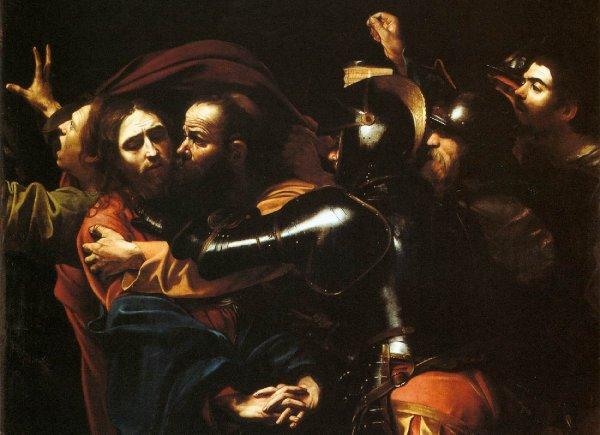
Teresa White FCJ, a member of the European Province of the Sisters of Faithful Companions of Jesus, contemplates the motives of Judas as portrayed in The Taking of Christ, one of Caravaggio’s most celebrated works. It is arguably the most famous depiction of the arrest of Jesus.
 Judas does not look cruel and spiteful. Rather, he looks worried and uncertain, as if he is ill at ease in the role of traitor. It is thought by some that Judas agreed to betray Jesus because he was sure that Jesus, when pushed to the limit, would reveal his power and free himself from his captors. It is possible that Caravaggio took this view, for in the painting, there is a kind of grim determination on Judas’s face. ‘If I do this,’ he seems to be telling himself, ‘Jesus will show what he’s made of. He won’t let the authorities take hold of him. He’ll show them that he is the Messiah, the King of the Jews, and he’ll deliver all of us from Roman domination.’5  
Don Schwager quotes Origen (185-254 AD), a bible scholar and early church father, who comments on Judas' betrayal.
 "Let us consider what Judas said to the Jewish priests: What will you give me if I hand him over to you? He was willing to take money in exchange for handing over the Word of God. They do the same thing who accept sensual or worldly goods in exchange for handing over and casting out from their souls the Savior and Word of truth who came to dwell with them. Indeed, it would be fitting to apply Judas's example to all who show contempt for the Word of God and betray him, as it were, by committing sin for the sake of money or for any selfish motive. People who behave in this way appear openly to be calling out to the powers of the enemy who offer worldly gain in return for the sin of betraying God's Word, saying, What will you give me if I hand him over to you? And they gave him thirty pieces of silver.The number of coins they gave Judas was equivalent to the number of years the Savior had sojourned in this world. For at the age of thirty, he was baptized and began to preach the gospel, like Joseph was thirty years old when he began to gather grain for his brothers (Genesis 41:46). Just as at that time the grain was prepared by God for the sons of Israel but given also to the Egyptians, so also the gospel was prepared for the saints but preached also to the unfaithful and wicked." (Commentary on Matthew 78.)6
The Word Among Us Meditation on Isaiah 50:4-9 recalls “I gave my back to those who beat me, my cheeks to those who plucked my beard.” (Isaiah 50:6) The humility and generosity of the servant in this verse beautifully captures Jesus’ heart as he endured his entire arrest, trial, and crucifixion.
 Being human, Jesus naturally experienced great distress about what was awaiting him. But then in his divinity, he could pray with complete confidence: “The Lord God is my help, therefore I am not disgraced” (Isaiah 50:7). So while he certainly felt great apprehension over what lay ahead of him, he also found strength knowing that his Father would never abandon him.
There’s a parallel here to our lives. We can’t see into the future, but we do know that we all have our own share of hardships to deal with. It could be major, like the death of a loved one, or minor, like being stuck in a traffic jam for three hours. The magnitude of the challenge is not as important as how we deal with it. We can either fret about it or try our best to place it in the Father’s hands as Jesus did.7
Friar Jude Winkler reviews the background of the 3rd Song of the Suffering Servant, written during Babylonian Exile. Saint John Paul II cautioned that we should not assume Judas is in hell. Friar Jude offers a few responses to the question of “Why did Judas betray Jesus?”


The consequences of betrayal are often very grave. Our relationship with Jesus affirms that even Judas is welcomed to return to intimacy with Christ.

References

1
(n.d.). Isaiah, chapter 50 - usccb. Retrieved April 17, 2019, from http://www.usccb.org/bible/isaiah/50
2
Psalms, chapter 69 - usccb. Retrieved April 17, 2019, from http://www.usccb.org/bible/psalms/69
3
(n.d.). Matthew, chapter 26 - usccb. Retrieved April 17, 2019, from http://www.usccb.org/bible/matthew/26
4
(n.d.). Creighton U Daily Reflections - OnlineMinistries - Creighton University. Retrieved April 17, 2019, from http://onlineministries.creighton.edu/CollaborativeMinistry/daily.html
5
(2014, April 17). The Betrayal | Thinking Faith: The online journal of the Jesuits in Britain. Retrieved April 17, 2019, from https://www.thinkingfaith.org/articles/betrayal
6
(n.d.). Daily Scripture Readings and Meditations. Retrieved April 17, 2019, from https://dailyscripture.servantsoftheword.org/
7
(n.d.). Wednesday of Holy Week - Mass Readings and Catholic Daily .... Retrieved April 17, 2019, from https://wau.org/meditations/2019/04/17/