Showing posts with label generational wounds. Show all posts

Friday, February 27, 2026

Extending our Care and Concern

The texts from the Roman Catholic Lectionary today challenge us to examine the role of our individual responsibility to be examples of faith, hope, and love in our community and ambassadors of Christ.


Responsibility and Faith


The Reading from the Prophet Ezekiel examines Personal Responsibility across Generations.


* [18:25] The LORD’s way is not fair: this chapter rejects the idea that punishment is transferred from one generation to the next and emphasizes individual responsibility and accountability. (Ezekiel, CHAPTER 18 | USCCB, n.d.)


Psalm 130 cries to God asking for mercy.


* [Psalm 130] This lament, a Penitential Psalm, is the De profundis used in liturgical prayers for the faithful departed. In deep sorrow the psalmist cries to God (Ps 130:12), asking for mercy (Ps 130:34). The psalmist’s trust (Ps 130:56) becomes a model for the people (Ps 130:78). (Psalms, PSALM 130 | USCCB, n.d.)


In the Gospel of Matthew, Jesus extends the Teaching About Anger.


* [5:2226] Reconciliation with an offended brother is urged in the admonition of Mt 5:2324 and the parable of Mt 5:2526 (//Lk 12:5859). The severity of the judge in the parable is a warning of the fate of unrepentant sinners in the coming judgment by God.

* [5:22] Anger is the motive behind murder, as the insulting epithets are steps that may lead to it. They, as well as the deed, are all forbidden. Raqa: an Aramaic word rēqā’ or rēqâ probably meaning “imbecile,” “blockhead,” a term of abuse. The ascending order of punishment, judgment (by a local council?), trial before the Sanhedrin, condemnation to Gehenna, points to a higher degree of seriousness in each of the offenses. Sanhedrin: the highest judicial body of Judaism. Gehenna: in Hebrew gê-hinnōm, “Valley of Hinnom,” or gê ben-hinnōm, “Valley of the son of Hinnom,” southwest of Jerusalem, the center of an idolatrous cult during the monarchy in which children were offered in sacrifice (see 2 Kgs 23:10; Jer 7:31). In Jos 18:16 (Septuagint, Codex Vaticanus) the Hebrew is transliterated into Greek as gaienna, which appears in the New Testament as geenna. The concept of punishment of sinners by fire either after death or after the final judgment is found in Jewish apocalyptic literature (e.g., Enoch 90:26) but the name geenna is first given to the place of punishment in the New Testament. (Matthew, CHAPTER 5, n.d.)


Suzanne Braddock asks “How can I ever live up to what Jesus is asking of us?”


I ask myself do I have a grudge, an unwillingness to forgive? Do I harbor anger or resentment? Have my actions caused someone to feel this way toward me? Sure, sometimes how others feel is beyond my control, but if I can, I will approach anyone such as this with love, reconciliation, and prayer. Let them free up their soul space to allow Love to come in. Then you find you have freed up a bit of space in your own heart as well. Then you both enter the Kingdom. (Braddock, n.d.)


Don Schwager quotes “Are you ashamed to ask pardon?” by Augustine, Bishop of Hippo, 354-430 A.D.


"How many there are who know that they have sinned against their brothers or sisters and yet are unwilling to say: 'Forgive me.' They were not ashamed to sin, but they are ashamed to ask pardon. They were not ashamed of their evil act, but they blush where humility is concerned." (excerpt from Sermon 211,4) (Schwager, n.d.)


Friar Jude Winkler notes that Ezekiel prophesied in Babylon and addressed the justice of God  about evil and punishment and the consequences of turning from from good to evil. We don’t build up credits with God, who is just in His treatment of all people. The Pharisees wanted to widely interpret the Laws scrupulously but Jesus extends the Law in a spiritual way. How do we kill life and hope? We need to treat all with sacred dignity. The Gospel refers to the Temple dump as a kind of place of symbol for Hell.  Friar Jude underlines that Jesus' teaching requires us to treat all with the respect we treat the Tabernacle that contains the Presence just like all people who are children of God. 


The Word Among Us Meditation on Matthew 5:20-26 notes that we offer to the Lord, not animals or grain, but our own lives. Jesus gathers these offerings and unites them to the sacrifice of his own Body and Blood as one offering to his Father. What if we were to offer Jesus our repentance for hurting someone—and our willingness to humbly reconcile with them? What if we offered our forgiveness of the people who have hurt us? Those would be precious gifts indeed!


Today ask the Spirit to show you if you are harboring resentment against anyone. If so, ask for the grace to forgive. If the offense is too big or your emotions are too strong, then offer your pain to the Lord. Try your best to surrender it into his hands and ask him to help you take the next step toward forgiveness. And if you have offended someone, try to apologize and reconcile with that person. Then, the next time you are at Mass, offer these “gifts” to Jesus. Come to the altar to receive the greatest gift of all—the Body and Blood of your Savior!


“Jesus, I offer you my heart of mercy!” (Meditation on Matthew 5:20-26, n.d.)


Fr. Richard Rohr, OFM, invites us to take a journey of faith. It may be plagued by uncertainty, but we can trust in God’s presence along the way. We want certitude, but instead God asks us to have faith.


Our faith and our trust, then, are in God—not in our own cleverness, strategies, or planning, not in our status or money. In the desert, all our idols are taken away from us and our security is gone. The desert, the darkness, is the school of surrender, the place for learning total dependence on God. (Rohr, n.d.)


We ask the Spirit for guidance and consolation as we accept the invitation of God to explore our lives with the desert mentality that focuses our attention on our dependence on the Presence of God.


References

Braddock, S. (n.d.). Daily Reflection. Creighton Online Ministries: Home. Retrieved February 27, 2026, from https://onlineministries.creighton.edu/daily-reflections/daily-reflection-february-27-2026 

Ezekiel, CHAPTER 18 | USCCB. (n.d.). Daily Readings. Retrieved February 27, 2026, from https://bible.usccb.org/bible/ezekiel/18?21 

Matthew, CHAPTER 5. (n.d.). USCCB. Retrieved February 27, 2026, from https://bible.usccb.org/bible/matthew/5?20 

Meditation on Matthew 5:20-26. (n.d.). Word Among Us. Retrieved February 27, 2026, from https://wau.org/meditations/2026/02/27/1509541/ 

Psalms, PSALM 130 | USCCB. (n.d.). Daily Readings. Retrieved February 27, 2026, from https://bible.usccb.org/bible/psalms/130?1 

Rohr, R. (n.d.). How Do We Reach the Promised Land? Center for Action and Contemplation. Retrieved February 27, 2026, from https://cac.org/daily-meditations/how-do-we-reach-the-promised-land/ 

Schwager, D. (n.d.). Do Not Be Angry, Be Reconciled. Daily Scripture Readings and Meditations – Daily Scripture Readings and Meditations. Retrieved February 27, 2026, from https://www.dailyscripture.net/daily-meditation/ 


Tuesday, July 27, 2021

A Journey with Good and Evil

The texts from the Roman Catholic Lectionary today challenge us to reconciliation as we experience God’s Presence in our tent of meeting.
Journey to our tent of meeting


The reading from the Book of Exodus takes us to the tent outside the Camp where Moses’ Intimacy with God was experienced.

* [34:6] Gracious…fidelity: this succinct poetic description of God is an often-repeated statement of belief (see Nm 14:18; Ps 103:8; 145:8; Jl 2:13; Jon 4:2). All the terms describe God’s relationship to the covenant people.1 

Psalm 103 is a thanksgiving for God’s Goodness.

* [Psalm 103] The speaker in this hymn begins by praising God for personal benefits (Ps 103:15), then moves on to God’s mercy toward all the people (Ps 103:618). Even sin cannot destroy that mercy (Ps 103:1113), for the eternal God is well aware of the people’s human fragility (Ps 103:1418). The psalmist invites the heavenly beings to join in praise (Ps 103:1922).2 

In the Gospel of Matthew, Jesus explains the Parable of the Weeds.

* [13:3743] In the explanation of the parable of the weeds emphasis lies on the fearful end of the wicked, whereas the parable itself concentrates on patience with them until judgment time.3 

Molly Mattingly has heard this image of wheat and weeds related to discernment. Is this thought wheat - coming from God, leading to greater freedom and love, and worthy of cultivation? Is it a weed – not of God, something I can let go of and stop giving energy to? Does this pattern of behavior or thought cultivate the field for the wheat, or allow the weeds to spread further? This kind of discernment is easiest when we have a close relationship with God, like Moses in the first reading: speaking to God honestly, face to face.


I’m sure Jesus (and Matthew) didn’t intend to make a pun in English at the end of this passage. However, it does strike me that the fruit of wheat is called an “ear,” like corn is. I can picture Jesus smiling as he holds up an ear of wheat to his disciples as he said, “Whoever has ears ought to hear. … If you have wheat growing in you and bearing fruit, you can hear this and respond.”4

Don Schwager quotes “Let us become friends of Jesus,” by Origen of Alexandria (185-254 AD).

"Now, having discoursed sufficiently to the multitudes in parables, he sends them away and goes to his own house, where his disciples come to him. His disciples did not go with those he sent away. As many as are more genuine hearers of Jesus first follow him, then having inquired about his house, are permitted to see it. Having come, they saw and stayed with him for all that day, and perhaps some of them even longer. In my opinion, such things are implied in the Gospel according to John... And if then, unlike the multitudes whom he sends away, we wish to hear Jesus and go to the house and receive something better than the multitudes did, let us become friends of Jesus, so that as his disciples come, we may also come to him when he goes into the house. And having come, let us inquire about the explanation of the parable, whether of the tares of the field, or of any other. (excerpt from the COMMENTARY ON MATTHEW 10.1-3)5 

The Word Among Us Meditation on Exodus 33:7-11; 34:5-9, 28 comments that today, this same God waits to meet with you! “The Lord, a merciful and gracious God,” desires to reveal himself to you, as he did with Moses and Joshua (Exodus 34:6). So let this story stir up your desire to see your heavenly Father “face to face” (33:11). It may happen in a dramatic way as it did for Moses and Joshua, or it may happen in a more quiet meeting. However it happens, don’t limit the Lord; he will come and reveal himself. All he asks is a seeking, open heart.


Where is your “tent of meeting” today? A quiet corner of your home? At Mass? Or maybe in Eucharistic Adoration? Wherever it is, God is present. Like Joshua, stay there: pour out your heart, your questions, and your love. And wait to see what God will do. “I treasure my time in your presence, Lord. Reveal yourself to me.”6

Friar Jude Winkler discusses Moses meeting in the tent and comments on the Hebrew belief that we cannot see the face of God and live. The cloud over Mary, at the Incarnation, connects with the cloud at the “tent of meeting”.  Friar Jude notes the evil doers in the world will judge themselves and face consequences in the end.


Fr. Richard Rohr, OFM, quotes trauma researcher Joy DeGruy who writes about the wounds caused by oppression that are passed down over generations, and says that the time has come to break the cycle of pain.

The time has now come to . . . break the cycle, and once again claim our humanity. Breaking this cycle and claiming our humanity will require much work from all of us. Those who have been the victims of years, decades, and centuries of oppression first must heal from injuries received first-hand, as well as those passed down through the ages. Those who have been the perpetrators of these unspeakable crimes, and those who continue to benefit from those crimes, have to honestly confront their deeds and heal from the psychic wounds that come with being the cause and beneficiaries of such great pain and suffering. [1]7 

Fr Richard asserts that when we do not seek transformation of our pain and suffering, we pass it on to those closest to us. We seek the mercy of God through the Spirit to transform weeds to wheat.


Addendum

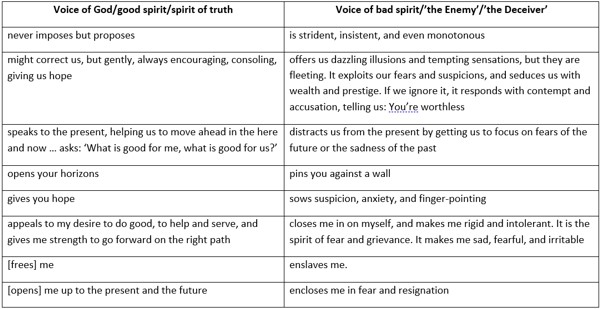
 David Lonsdale, teacher of Christian spirituality at Heythrop College, University of London, and author of Eyes to See, Ears to Hear: An Introduction to Ignatian Spirituality and Dance to the Music of the Spirit: The Art of Discernment, notes that in his account of the differences between the two ‘spirits’, Pope Francis reveals his debt to Saint Ignatius Loyola's Rules for the Discernment of Spirits (SpExx §§313-336), especially those in which Ignatius describes the contrasting signs and effects by which the two can be recognised. For example, he states that for those who are going forward in their love and service of God, ‘it is typical of the bad spirit to harass, sadden and obstruct and to disturb the soul with false reasoning’. The ‘good spirit’ on the other hand, will typically give courage and strength, consolations, tears, inspirations and quiet, making things easy and removing all obstacles, so that the person may move forward in doing good. (SpExx §315) 


Francis refers to the ‘spirits’ as ‘voices’, which call us in different directions, speak in different languages and use ‘different ways to reach our hearts.’ (p.61) His understanding of the key differences between them can be clearly seen if we put them side by side (pp.61-2).8


https://www.thinkingfaith.org/sites/default/files/20210629_1discernment_table.jpg

References

1

(n.d.). Exodus, CHAPTER 34 | USCCB. Retrieved July 27, 2021, from https://bible.usccb.org/es/node/3263?6= 

2

(n.d.). Psalms, PSALM 103 | USCCB. Retrieved July 27, 2021, from https://bible.usccb.org/bible/psalms/103 

3

(n.d.). Matthew, CHAPTER 13 | USCCB. Retrieved July 27, 2021, from https://bible.usccb.org/bible/matthew/13 

4

(n.d.). Creighton U Daily Reflections - Online Ministries - Creighton University. Retrieved July 27, 2021, from https://onlineministries.creighton.edu/CollaborativeMinistry/072721.html 

5

(n.d.). Daily Scripture Readings and Meditations. Retrieved July 27, 2021, from https://www.dailyscripture.net/daily-meditation/?ds_year=2021&date=jul27 

6

(n.d.). The Word Among Us: Homepage. Retrieved July 27, 2021, from https://wau.org/meditations/2021/07/27/190393/ 

7

(n.d.). Daily Meditations Archive: 2021 - Center for Action and Contemplation. Retrieved July 27, 2021, from https://cac.org/healing-generational-wounds-2021-07-27/ 

8

(2021, June 28). Re-imagining the world: Discernment of spirits in Let Us Dream .... Retrieved July 27, 2021, from https://www.thinkingfaith.org/articles/re-imagining-world-discernment-spirits-let-us-dream