Showing posts with label divinity. Show all posts

Wednesday, February 1, 2023

Discipline and Rejection

The texts from the Roman Catholic Lectionary today challenge our understanding of our relationship to Christ in our reaction to discipline and to the fullness of Jesus divinity and humanity.


Prophets and Progress


The reading from the Letter to the Hebrews shares warnings against rejecting God’s Grace.


* [12:113] Christian life is to be inspired not only by the Old Testament men and women of faith (Heb 12:1) but above all by Jesus. As the architect of Christian faith, he had himself to endure the cross before receiving the glory of his triumph (Heb 12:2). Reflection on his sufferings should give his followers courage to continue the struggle, if necessary even to the shedding of blood (Heb 12:34). Christians should regard their own sufferings as the affectionate correction of the Lord, who loves them as a father loves his children. (Hebrews, CHAPTER 12, n.d.)


Psalm 103 offers thanksgiving for God’s Goodness.


* [Psalm 103] The speaker in this hymn begins by praising God for personal benefits (Ps 103:15), then moves on to God’s mercy toward all the people (Ps 103:618). Even sin cannot destroy that mercy (Ps 103:1113), for the eternal God is well aware of the people’s human fragility (Ps 103:1418). The psalmist invites the heavenly beings to join in praise (Ps 103:1922). (Psalms, PSALM 103, n.d.)


The Gospel of Mark describes the rejection of Jesus at Nazareth.


* [6:3] Is he not the carpenter?: no other gospel calls Jesus a carpenter. Some witnesses have “the carpenter’s son,” as in Mt 13:55. Son of Mary: contrary to Jewish custom, which calls a man the son of his father, this expression may reflect Mark’s own faith that God is the Father of Jesus (Mk 1:1, 11; 8:38; 13:32; 14:36). The brother of James…Simon: in Semitic usage, the terms “brother,” “sister” are applied not only to children of the same parents, but to nephews, nieces, cousins, half-brothers, and half-sisters; cf. Gn 14:16; 29:15; Lv 10:4. While one cannot suppose that the meaning of a Greek word should be sought in the first place from Semitic usage, the Septuagint often translates the Hebrew ’āh by the Greek word adelphos, “brother,” as in the cited passages, a fact that may argue for a similar breadth of meaning in some New Testament passages. For instance, there is no doubt that in v. 17, “brother” is used of Philip, who was actually the half-brother of Herod Antipas. On the other hand, Mark may have understood the terms literally; see also 3:3132; Mt 12:46; 13:5556; Lk 8:19; Jn 7:3, 5. The question of meaning here would not have arisen but for the faith of the church in Mary’s perpetual virginity.

* [6:4] A prophet is not without honor except…in his own house: a saying that finds parallels in other literatures, especially Jewish and Greek, but without reference to a prophet. Comparing himself to previous Hebrew prophets whom the people rejected, Jesus intimates his own eventual rejection by the nation especially in view of the dishonor his own relatives had shown him (Mk 3:21) and now his townspeople as well. (Mark, CHAPTER 6, n.d.)


Steve Scholer comments that self-discipline is easier said than done. Think back to a month ago, to our New Year’s resolutions. How firm and committed we were on January 1st, to a dry January, 10,000+ steps a day, or attending daily Mass. Truth be told, probably close to half of us were not able to follow through on our resolutions for even a month. So, how do we improve? They say that one of the best ways to discipline yourself and to achieve your goals is to team up with someone.


Who better to partner with on our most personal goals and aspirations, than Christ? For Christ is always at our side and more than anyone else, wants us to succeed and be the very best person we can be.  


As we go about our busy lives, trying to become better Christians, take the time to share your thoughts and goals with Jesus. In prayer, let Jesus know how you want to become better and ask Jesus to guide and influence you through your day, so you can live up to your own expectations and to Christ’s expectations of us.


With this dynamic partnership, there is nothing we cannot accomplish or overcome. (Scholer, n.d.)


Don Schwager quotes “Distinguishing God's power and our faith,” by Origen of Alexandria (185-254 AD).


"And perhaps, as in the case of metallic substances there exists in some a natural attraction toward some other thing, as in the magnet for iron, and in naphtha for fire, so there is an attraction in such faith toward the divine power according to what Jesus said: 'If you have faith as a grain of mustard seed, you shall say unto this mountain, 'Move to another place,' and it shall be moved' (Matthew 17:20). Matthew and Mark wished to present the all-surpassing value of that divine power as a power that works even in those who do not believe. But they did not deny that grace works even more powerfully among those who have faith. So it seems to me that they accurately said not that the Lord did not do any mighty works because of their unbelief, but that he did not do many there (Mark 6:5). Mark does not flatly say that he could do no mighty work there at all, and stop at that point, but added, 'except that he laid his hands upon a few sick folk and healed them' (Mark 6:5). Thus the power in him overcame even their unbelief." (excerpt from COMMENTARY ON MATTHEW 10.19) (Schwager, n.d.)


The Word Among Us Meditation: Mark 6:1-6 comments that we might also have a problem with being too familiar with Jesus, but in the opposite direction. We might take offense at the fact that Jesus was really a human being like ourselves. We’ve grown up knowing him as the God who redeemed us by his cross and resurrection. It can scandalize us to think that he was like us in every way but sin.


We celebrated the birth of Jesus only five weeks ago, but the incarnation is a mystery of our faith that we can meditate on all year long. God stooped down to earth to become just like one of his lowly creatures. But don’t let that offend you! He did it out of pure love for you and for each one of us. So let’s rejoice today. Jesus is our Lord and Savior, yes, but because he is human, he is also our brother and friend.


“Jesus, in your humanity, draw me close to you.” (Meditation: Mark 6:1-6, n.d.)


Friar Jude Winkler discusses the discipline that suffering imposes on our lives in which we have the opportunity for purification of our intentions. Accepting Jesus as the “Son of God” was particularly challenging for Hebrew believers. The relationship of “brothers and sisters” to Jesus is interpreted differently by Roman Catholic, Orthodox, and Protestant Christians. Friar Jude reminds us that we often see the flaws in those close to us that others may not appreciate.


Brian McLaren charts growth in spiritual life as coming to greater fullness when we move beyond the simplicity of the First Season of Faith.


Nearly all of us in this dynamic season of Simplicity tend to share a number of characteristics. We see the world in simple dualist terms: we are the good guys who follow the good authority figures and we have the right answers; they are the bad guys who consciously or unconsciously fight on the wrong side of the cosmic struggle between good and evil. We feel a deep sense of identity and belonging in our in-group…. This simple, dualist faith gives us great confidence.  


This confidence, of course, has a danger, as the old Bob Dylan classic “With God on Our Side” makes clear: “You don’t count the dead when God’s on your side.” [1] The same sense of identification with an in-group that generates a warm glow of belonging and motivates sacrificial action for us can sour into intolerance, hatred, and even violence toward them. And the same easy, black-and-white answers that comfort and reassure us now may later seem arrogant, naive, ignorant, and harmful, if we don’t move beyond Simplicity in the fullness of time. (McLaren, 2023)


We ponder our spiritual journey recalling the ecstasy and certainty as we implore the help of the Spirit with the challenges of the transitions we are invited to accept on the journey to fullness of life.


References

Hebrews, CHAPTER 12. (n.d.). USCCB. Retrieved February 1, 2023, from https://bible.usccb.org/bible/hebrews/12?4 

Mark, CHAPTER 6. (n.d.). USCCB. Retrieved February 1, 2023, from https://bible.usccb.org/bible/mark/6?1 

McLaren, B. D. (2023, February 1). The First Season of Faith — Center for Action and Contemplation. Center for Action and Contemplation. Retrieved February 1, 2023, from https://cac.org/daily-meditations/the-first-season-of-faith-2023-02-01/ 

Meditation: Mark 6:1-6. (n.d.). The Word Among Us: Homepage. Retrieved February 1, 2023, from https://wau.org/meditations/2023/02/01/599098/ 

Psalms, PSALM 103. (n.d.). USCCB. Retrieved February 1, 2023, from https://bible.usccb.org/bible/psalms/103?1 

Scholer, S. (n.d.). Creighton U. Daily Reflection. Online Ministries. Retrieved February 1, 2023, from https://onlineministries.creighton.edu/CollaborativeMinistry/020123.html 

Schwager, D. (n.d.). Jesus Marveled because of Their Unbelief. Daily Scripture Readings and Meditations – Daily Scripture Readings and Meditations. Retrieved February 1, 2023, from https://www.dailyscripture.net/daily-meditation/?ds_year=2023&date=feb1 


Thursday, May 7, 2020

A heritage of hope

The texts from the Roman Catholic Lectionary today invite contemplation of our salvation history and the support this narrative offers for Providence in our future.
Washing feet

The reading from the Book of Acts tells of the preaching of Paul and Barnabas in the synagogue in Antioch of Pisidia.

In Psalm 89, the community ardently prays God to be faithful to the original promise to David.

In the Gospel of John, Jesus declares His connection to the Father and demonstrates Love as the nature of God.

John Shea, S.J. comments Jesus also imparts a duty to his disciples. After washing their feet and reminding them that no slave is greater than his master, he tells them, “blessed are you if you do it.” In other words, this profound act of service performed by Jesus must continue through the hands of his disciples. Imitating Jesus, we must continue to serve one another, washing each other’s feet. In the Spiritual Exercises of St. Ignatius, we reflect on the three questions: “What have I done for Christ? What am I doing for Christ? What ought I do for Christ?”

Don Schwager quotes “The Master wants his servants to reach their potential,” by Origen, 185-254 A.D.

The Word Among Us Meditation on John 13:16-20 comments on a night suffused with great promise and hope, Jesus showed his disciples what kind of coronation he would receive and what kind of kingdom he was establishing. By washing his disciples’ feet, he showed them that he is a king who serves his servants. Over the next few days, they would see a king who lays down his own life for his subjects. They would see a king who defeats even death, a king who offers to cleanse them every day by washing away their sins.

Friar Jude Winkler comments on the separation between John Mark and Paul mentioned in Acts. The Divinity of Jesus is presented strongly throughout John’s Gospel. Friar Jude reminds that washing feet and dying for others are manifestations of Divinity.

Fr. Richard Rohr, OFM, comments that Jesus’ experience of divine kinship, which Beatrice Bruteau described yesterday, naturally led to the creation of an equitable community. His community was very different from the larger society in which he lived—and the individualistic, largely unfettered capitalist society in which we live today. In fact, Jesus’ community looks very similar to networks of mutual aid which are springing up to help one another during this global pandemic. The type of community that Beatrice Bruteau describes is an essential part of the Jesus “program.”

As the Spirit moves us to action by washing feet and serving others we may find ourselves more aware of opportunities to extend Jesus Way to the wider community.

Friday, January 10, 2020

Spirit of Witness and Healing

The texts from the Roman Catholic Lectionary today invite contemplation of the healing action of the Presence of God in our life.
Healing Presence

The reading from the First Letter of John establishes testimony concerning the Son of God in his Divinity and Humanity through our experience of the indwelling Spirit.
* [5:6–12] Water and blood (1 Jn 5:6) refers to Christ’s baptism (Mt 3:16–17) and to the shedding of his blood on the cross (Jn 19:34). The Spirit was present at the baptism (Mt 3:16; Mk 1:10; Lk 3:22; Jn 1:32, 34). The testimony to Christ as the Son of God is confirmed by divine witness (1 Jn 5:7–9), greater by far than the two legally required human witnesses (Dt 17:6). To deny this is to deny God’s truth; cf. Jn 8:17–18. The gist of the divine witness or testimony is that eternal life (1 Jn 5:11–12) is given in Christ and nowhere else. To possess the Son is not acceptance of a doctrine but of a person who lives now and provides life.1 
Psalm 147 exhorts the holy city to recognize it has been re-created and made the place of disclosure for God’s word.
 * [Psalm 147] The hymn is divided into three sections by the calls to praise in Ps 147:1, 7, 12. The first section praises the powerful creator who restores exiled Judah (Ps 147:1–6); the second section, the creator who provides food to animals and human beings; the third and climactic section exhorts the holy city to recognize it has been re-created and made the place of disclosure for God’s word, a word as life-giving as water.2
Jesus cleanses a leper in the Gospel of Luke.
* [5:14] Show yourself to the priest…what Moses prescribed: this is a reference to Lv 14:2–9 that gives detailed instructions for the purification of one who had been a victim of leprosy and thereby excluded from contact with others (see Lv 13:45–46, 49; Nm 5:2–3). That will be proof for them: see note on Mt 8:4.3 
Kimberly Grassmeyer comments that Judas, in the Jesus Christ Superstar production, thought that Jesus could have planned better, flown under the radar as it were, so as to keep safe. But Jesus knew well the ultimate consequence of his actions and he took them anyway.
 Deep down we, too, usually know or can predict the consequences that will follow from our choices – for ill or for good.  Sometimes we pray about them, and sometimes we even listen. Sometimes we still choose incorrectly: we eat poorly, smoke that cigarette, hurt someone with an unkind word, spend too much.  But we all have the capacity to choose the right thing. Even when it is difficult, even when it might come at some personal expense, even when we need to withdraw to a quiet place to pray about it.  We can choose, as Jesus did, to be with and for the other.4
Don Schwager quotes “Jesus' healing demonstrates the power of the kingdom of heaven,” by Ambrose of Milan, 339-397 A.D.
 "The authority of power in the Lord is here compared with the steadfastness of faith manifest in the leper (Luke 5:12-13). He fell on his face because it is a mark of humility and modesty that each feel shame for the sins of his life, but shyness did not restrict his confession. He showed the wound, he begged for the remedy, and the very confession is full of piety and faith. 'If you will,' it says, 'you can make me clean'” He conceded the power to the Lord's will. But he doubted concerning the Lord's will, not as if unbelieving in piety, but as if aware of his own impurity, he did not presume. The Lord replies to him with a certain holiness. 'I will: be clean. And immediately the leprosy departed from him.' For there is nothing between God's command and his work, because the work is in the command. Thus he spoke, and they came into being (Psalm 33:9). You see that it cannot be doubted that the will of God is power. If, therefore, his will is power, those who affirm that the Trinity is of One will affirm that it is of one power. Thus the leprosy departed immediately. In order that you may understand the effect of healing, he added truth to the work." (excerpt from EXPOSITION OF THE GOSPEL OF LUKE 5.2–3)5
The Word Among Us Meditation on Luke 5:12-16 notes that according to the World Health Organization, the number of people with leprosy, or Hansen’s disease, has decreased dramatically over the past twenty years: from 5.2 million people down to just over 175,000. But while instances of Hansen’s disease are becoming rarer, instances of social isolation and exclusion are growing exponentially. People on every part of the social and economic spectrum struggle to feel connected, valued, and loved. Longing for human contact, they feel like Veronica, friend of John Bradburne, a British man, Secular Third Order Franciscan, who died in 1979 after spending fifteen years serving people with leprosy in Zimbabwe, or like the man in today’s Gospel.
You can be Christ to these people. By the grace of his Spirit, you can learn to see them through his eyes of love. You may or may not be able to bring them physical healing or healing of their memories. You may or may not be able to help them reconcile with someone who has hurt them. But you can bring them the healing that comes from encountering Jesus. Through your words and actions, you can show them that they are not alone. You can show them that Jesus sees them, values them, and loves them deeply.6 
Friar Jude Winkler complements the comments of Matt in Logos Made Flesh by connecting the First Letter of John to the sacraments of Baptism and Eucharist. The realized eschatology of John is experienced the moment Jesus is in our lives and is with us through death. Friar Jude reminds us of the theme in Luke that portrays Christians as the New Israel.


Fr. Richard Rohr, OFM, comments that those who have gone to their own depths through contemplation uncover an indwelling Presence. Austrian philosopher Martin Buber (1878–1965) called this intimacy an “I-thou” relationship. It is a deep and loving “yes” to God and to life that is inherent within each of us. In Christian theology, this Presence would be described as the Indwelling Holy Spirit, which is precisely God as immanent, within us, and our deepest and truest self. God is the very ground of our being!
 Some saints and mystics have described this Presence as “closer to me than I am to myself” or “more me than I am myself.” Thomas Merton and others call it the True Self. The paradox is that this True Self is immortal and indestructible, and yet it must also be awakened and chosen. The Holy Spirit is totally given and given equally to all, but it must be consciously received. The Presence needs to be recognized, honored, and drawn upon to become a Living Presence.

… saints and mystics nevertheless dare to believe that they are ontologically (“in their very being”) whole, and that it is totally a gift from God. It has nothing to do with our own private “me”—with anything we could do to earn or deserve it!

The Holy Spirit is never created by our actions or behavior. It is naturally indwelling, our inner being with God. (In Catholic theology, we called the Holy Spirit “Uncreated Grace.”) Culture and usually even religion teach us to live out of the false or separate self of reputation, self-image, role, possessions, money, appearance, and so on. It is only as these things fail us, and they always do, that the True Self stands revealed and ready to guide us. Some enlightened souls surrender to this truth and presence early, usually by reason of suffering.7
The indwelling Spirit is witness to our intimacy with Christ that we can make visible to those in need of healing.

References

1
(n.d.). 1 John, chapter 5. Retrieved January 10, 2020, from http://www.usccb.org/bible/1john/5 
2
(n.d.). Psalms, chapter 147. Retrieved January 10, 2020, from http://www.usccb.org/bible/psalms/147 
3
(n.d.). Luke, chapter 5 - USCCB.org. Retrieved January 10, 2020, from http://www.usccb.org/bible/luke/5 
4
(n.d.). Daily Reflections - OnlineMinistries .... Retrieved January 10, 2020, from https://onlineministries.creighton.edu/CollaborativeMinistry/daily.html 
5
(n.d.). Daily Scripture Readings and Meditations. Retrieved January 10, 2020, from https://dailyscripture.servantsoftheword.org/ 
6
(n.d.). Christmas Weekday - Mass Readings and Catholic Daily .... Retrieved January 10, 2020, from https://wau.org/meditations/2020/1/10/ 
7
(2020, January 10). Naturally Indwelling — Center for Action and Contemplation. Retrieved January 10, 2020, from https://cac.org/naturally-indwelling-2020-01-10/ 

Friday, March 30, 2018

People motivated by Love

Good Friday of the Lord’s Passion is the second day of the continuing liturgy of the Triduum for which texts of the Roman Catholic Lectionary are chosen.
Looking up and delving deeper
The Book of the Prophet Isaiah tells of the fourth Song of the Suffering Servant for the sins of others.
* [53:4] Struck down by God: the Bible often sees suffering as a punishment for sin (e.g., Ps 6:2; 32:1–5), yet sin sometimes appears to go unpunished and the innocent often suffer (cf. Ps 73; the Book of Job). In the case of the servant, the onlookers initially judge him guilty because of his suffering but, in some way not explained, they come to understand that his sufferings are for the sins of others. One notes the element of surprise, for such vicarious suffering, in the form described here, is without parallel in the Old Testament.
The Letter to the Hebrews declares  Jesus as our High Priest who was tested in every way.
* [4:14–16] These verses, which return to the theme first sounded in Heb 2:16–3:1, serve as an introduction to the section that follows. The author here alone calls Jesus a great high priest (Heb 4:14), a designation used by Philo for the Logos; perhaps he does so in order to emphasize Jesus’ superiority over the Jewish high priest. He has been tested in every way, yet without sin (Heb 4:15); this indicates an acquaintance with the tradition of Jesus’ temptations, not only at the beginning (as in Mk 1:13) but throughout his public life (cf. Lk 22:28). Although the reign of the exalted Jesus is a theme that occurs elsewhere in Hebrews, and Jesus’ throne is mentioned in Heb 1:8, the throne of grace (Heb 4:16) refers to the throne of God. The similarity of Heb 4:16 to Heb 10:19–22 indicates that the author is thinking of our confident access to God, made possible by the priestly work of Jesus.
The Passion Narrative in the Gospel of John ties Jesus on the Cross to Baptism and Eucharist.
* [19:34–35] John probably emphasizes these verses to show the reality of Jesus’ death, against the docetic heretics. In the blood and water there may also be a symbolic reference to the Eucharist and baptism.
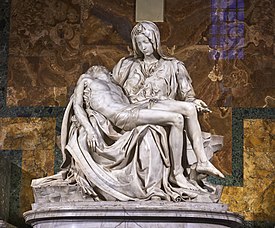
Candice Tucci, O.S.F. challenges us to gaze upon the crucified Jesus, or the dead Jesus in the picture detail of the Pieta by Michelangelo, and to see Him as if we are gazing in a mirror.
Does this mirror image take us deeper into our lives and experiences where we felt we were dead, or at the foot of the cross, and wept? Does it take us even deeper to recognize our own sinfulness, brokenness and imperfections that need forgiveness or transformation? Does it tell me how much I am loved and embraced by God? Does it take me to an image of a wounded world in need of healing, peace and wholeness? We may discover our own behaviors that could have contributed to such realities while at the same time we suffer from our own infirmities. As Sebastian Moore wrote, THE CRUCIFIED CHRIST IS NO STRANGER! We are both crucifier and crucified.
Her reflection quotes Sebastian Moore, OSB, a monk of Downside Abbey and the author of some of the most original and influential theological works of the past fifty years, who declares “THE CRUCIFIED CHRIST IS NO STRANGER! We are both crucifier and crucified.”

Friar Jude Winkler shares the connections between the texts of the Suffering Servant in Isaiah and Jesus Passion. The structure of the Gospel of John points to the centrality of the Divinity of Jesus, as Friar Jude explains.

A comprehensive article on the Passion of Jesus on the Web Site of the Spirit of St Stephen’s Community is connected to the theological work of Richard Rohr and Sebastian Moore and it builds on the faith of St Francis as interpreted by John Duns Scotus.

Fr. Richard Rohr, OFM, shares teaching on The Mystery of the Cross and the effect on those who “gaze upon” (John 19:37) the Crucified long enough.
Those who “gaze upon” (John 19:37) the Crucified long enough—with contemplative eyes—are always healed at deep levels of pain, unforgiveness, aggression, and victimhood. Contemplative gazing demands no theological education, just an “inner exchange” by receiving the image within and offering one’s soul back in safe return. C. G. Jung is supposed to have said that a naked man nailed to a cross is perhaps the deepest archetypal symbol in the Western psyche. [1]
The Passion of Jesus is the door to our becoming mature followers of Jesus who raise children for Christ aware that suffering is not the end but the means to becoming people motivated by Love. References


(n.d.). Isaiah, chapter 53 - United States Conference of Catholic Bishops. Retrieved March 30, 2018, from http://www.usccb.org/bible/isaiah53:17

(n.d.). Hebrews, chapter 4 - United States Conference of Catholic Bishops. Retrieved March 30, 2018, from http://www.usccb.org/bible/hebrews/4

(n.d.). John 19:26-27. Retrieved March 30, 2018, from http://www.usccb.org/bible/john/john19.htm
(n.d.). Creighton University's Online Ministries. Retrieved March 30, 2018, from http://onlineministries.creighton.edu/CollaborativeMinistry/online.html 

(n.d.). Spirit of St. Stephen's - The Mystery of the Cross (Richard Rohr, Ch. 9 .... Retrieved March 30, 2018, from http://spiritofststephens.org/resources/prayers-and-theme-readings/1380-the-mystery-of-the-cross-richard-rohr-ch-9-things-hidden-scripture-as-spirituality 

(2017, April 23). The Mystery of the Cross - Center for Action and Contemplation. Retrieved March 30, 2018, from https://cac.org/the-mystery-of-the-cross-2017-04-23/