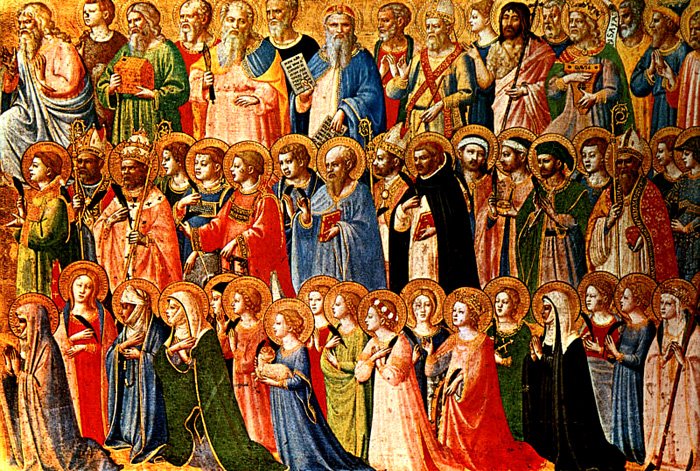
The texts from the Roman Catholic Lectionary today the Solemnity of All Saints invite us to the hope that our contemplation of the “blessed” will inspire our saintly action.

The Reading from the Book of Revelation proclaims the Triumph of the Elect.
* [7:2] East: literally, “rising of the sun.” The east was considered the source of light and the place of paradise (Gn 2:8). Seal: whatever was marked by the impression of one’s signet ring belonged to that person and was under his protection.
* [7:4–9] One hundred and forty-four thousand: the square of twelve (the number of Israel’s tribes) multiplied by a thousand, symbolic of the new Israel (cf. Rev 14:1–5; Gal 6:16; Jas 1:1) that embraces people from every nation, race, people, and tongue (Rev 7:9).
* [7:9] White robes,palm branches: symbols of joy and victory; see note on Rev 3:5.
* [7:10] Salvation comes from: literally, “(let) salvation (be ascribed) to.” A similar hymn of praise is found at the fall of the dragon (Rev 12:10) and of Babylon (Rev 19:1).* [7:14] Time of great distress: fierce persecution by the Romans; cf. Introduction. (Revelation, CHAPTER 7 | USCCB, n.d.)
Psalm 24 calls the people to affirm their fidelity before being admitted into the sanctuary.
* [Psalm 24] The Psalm apparently accompanied a ceremony of the entry of God (invisibly enthroned upon the ark), followed by the people, into the Temple. The Temple commemorated the creation of the world (Ps 24:1–2). The people had to affirm their fidelity before being admitted into the sanctuary (Ps 24:3–6; cf. Ps 15). A choir identifies the approaching God and invites the very Temple gates to bow down in obeisance (Ps 24:7–10). (Psalms, PSALM 24 | USCCB, n.d.)
The Reading from the First Letter of John proclaims our gift as true children of God.
* [3:1–3] The greatest sign of God’s love is the gift of his Son (Jn 3:16) that has made Christians true children of God. This relationship is a present reality and also part of the life to come; true knowledge of God will ultimately be gained, and Christians prepare themselves now by virtuous lives in imitation of the Son.
* [3:2] When it is revealed: or “when he is revealed” (the subject of the verb could be Christ). (1 John, CHAPTER 3 | USCCB, n.d.)
The Gospel of Matthew presents The Sermon on the Mount.
* [5:3–12] The form Blessed are (is) occurs frequently in the Old Testament in the Wisdom literature and in the psalms. Although modified by Matthew, the first, second, fourth, and ninth beatitudes have Lucan parallels (Mt 5:3 // Lk 6:20; Mt 5:4 // Lk 6:21b; Mt 5:6 // Lk 6:21a; Mt 5:11–12 // Lk 5:22–23). The others were added by the evangelist and are probably his own composition. A few manuscripts, Western and Alexandrian, and many versions and patristic quotations give the second and third beatitudes in inverted order.
* [5:3] The poor in spirit: in the Old Testament, the poor (’anāwîm) are those who are without material possessions and whose confidence is in God (see Is 61:1; Zep 2:3; in the NAB the word is translated lowly and humble, respectively, in those texts). Matthew added in spirit in order either to indicate that only the devout poor were meant or to extend the beatitude to all, of whatever social rank, who recognized their complete dependence on God. The same phrase poor in spirit is found in the Qumran literature (1QM 14:7).
* [5:4] Cf. Is 61:2, “(The Lord has sent me)…to comfort all who mourn.” They will be comforted: here the passive is a “theological passive” equivalent to the active “God will comfort them”; so also in Mt 5:6, 7.
* [5:5] Cf. Ps 37:11, “…the meek shall possess the land.” In the psalm “the land” means the land of Palestine; here it means the kingdom.
* [5:6] For righteousness: a Matthean addition. For the meaning of righteousness here, see note on Mt 3:14–15.
* [5:8] Cf. Ps 24:4. Only one “whose heart is clean” can take part in the temple worship. To be with God in the temple is described in Ps 42:3 as “beholding his face,” but here the promise to the clean of heart is that they will see God not in the temple but in the coming kingdom.
* [5:10] Righteousness here, as usually in Matthew, means conduct in conformity with God’s will.
* [5:12] The prophets who were before you: the disciples of Jesus stand in the line of the persecuted prophets of Israel. Some would see the expression as indicating also that Matthew considered all Christian disciples as prophets. (Matthew, CHAPTER 5 | USCCB, n.d.)
Eileen Wirth comments that in the Beatitudes, Jesus identifies the “blessed” among us and says how they have earned the designation. Then he tells them what consolations and rewards to expect.
I’m struck by how helpful they are as we struggle with sorrow and suffering. Jesus is not talking abstractly when he tells us that those who mourn will be comforted or that those who endure persecution for the sake of righteousness will win the Kingdom of heaven. After all, authorities harshly criticized him for challenging religious traditions and he lived under oppressive Roman rule. He’s throwing out a lifeline to people who risk following him because in the end, this will all work out. That was true then and remains true today…
It’s almost a pity that the Beatitudes are presented so concisely because we tend to try to grasp them holistically when we could profitably meditate on each of them. But collectively they offer ordinary strivers like us a beautiful path toward becoming saints.
So rejoice and be glad! Celebrate the saints living and dead who have blessed your lives and believe that the kingdom of heaven awaits.. (Wirth, n.d.)
Don Schwager quotes “Perfect blessedness is humility of spirit,” by Hilary of Poitiers (315-367 AD).
"'Blessed are the poor in spirit, for theirs is the kingdom of heaven.' The Lord taught by way of example that the glory of human ambition must be left behind when he said, 'The Lord your God shall you adore and him only shall you serve' (Matthew 4:10). And when he announced through the prophets that he would choose a people humble and in awe of his words [Isaiah 66:2], he introduced the perfect Beatitude as humility of spirit. Therefore he defines those who are inspired as people aware that they are in possession of the heavenly kingdom... Nothing belongs to anyone as being properly one's own, but all have the same things by the gift of a single parent. They have been given the first things needed to come into life and have been supplied with the means to use them." (excerpt from commentary ON MATTHEW 4.2) (Schwager, n.d.)
Friar Jude Winkler comments on the texts for today.The Book of Revelations proclaims 144 thousand will receive the seal of the living God. In Ezekiel, the Tau, the first letter of the Law and even today the phylacteries, are small black leather boxes with Torah verses worn by Jewish men. The 144 thousand is 12 x 12 x 1000 representing the twelve patriarchs and the twelve tribes. This is symbolic of the old and new Israel one thousand times over. Note the numeric multiplication indicates more than the eye can see. Seven attributes reflect the perfect number indicating all possible praise is due. Children, now and in the future. We should approach living tabernacles in love and service. Jesus' sermon on the Mount is a proclamation of the new Law for the New Israel. In Matthew's Gospel there are 8 blessings. Luke presents four blessings and four curses. Matthew is more spiritual than Luke who may be using a traditional Jewish style. Friar Jude comments that the poor in spirit are living with humility. Mourning is the time when we reach out for consolation. The meek follow Jesus' example of righteousness. In Matthew, righteousness is redefined as compassion. Friar Jude notes that the merciful are clean of heart and are persecuted for righteousness consistent with people of integrity.
The Word Among Us Meditation on Revelation 7:2-4, 9-14 comments that in recalling the Second Vatican Council’s universal call to holiness, Pope Leo XIV said, “Holiness . . . is not a privilege for the few, but a gift that requires every baptized person to strive for . . . the fullness of love towards God and towards one’s neighbor” (Audience, April 8, 2026).
As the Council fathers put it, “The classes and duties of life are many, but holiness is one” (Lumen Gentium, 41). The one thing every saint has in common is that they let the Lord lead them as they grow in love for him and for the people around them.
How encouraging! The way we get there might differ, but our destination is the same: heaven, where we will praise God with that “great multitude”!
“Jesus, help me to follow you so that I can join all the saints in heaven!” (Meditation on Revelation 7:2-4, 9-14, 2026)
Father Richard Rohr, OFM, uses the language of “ripening” to describe the process of aging with wisdom and grace. There must be a direction to ripening, but we must also recognize that any steps toward maturity are by necessity immature. An understanding of ripening basically teaches us the wisdom of timing, love, and patience, and allows us to be wise instead of judgmental.
Ripening, at its best, is a slow, patient learning, and sometimes even a happy letting go—a seeming emptying out to create readiness for a new kind of fullness—which we are never sure about. If we do not allow our own ripening, an ever-increasing resistance and denial sets in, an ever-increasing protection around an over-defended self. At our very best, we learn how to hope as we ripen, to move outside and beyond self-created circles. Youthful hopes have concrete goals, whereas the hope of older years is usually aimless hope, hope without goals, even naked hope—perhaps real hope.
Such stretching is the agony and the joy of later years, although one can avoid both of these rich experiences too. Old age, as such, is almost a complete changing of gears and engines from the first half of our lives, and does not happen without many slow realizations, inner calmings, lots of inner resistance and denials, and eventual surrenders. All of them by God’s grace work with our ever-deepening sense of what we really desire and who we really are. (Rohr, n.d.)
Richard L. Floyd comments that “So Great a Cloud of Witnesses” is such an important way to think about the church. We have been learning to think of the church ecumenically; to consider the breadth of the church across denominational lines and national boundaries.
But how quickly we forget the length of the church, its trans–temporal reality across the generations. That is where the role of tradition comes to play in the church, the place where the communion of saints gets their say. As GK. Chesterton put it, “Tradition is only democracy extended through time.”
And that’s important because a church that forgets what the saints have learned from generation to generation will hardly be equipped to be the church in its own generation. So, the church rightly remembers the communion of saints, and even more than that, claims that in Christ, we share with them in the divine life. (Floyd, n.d.)
We seek the Wisdom of the Spirit as we contemplate our membership in the “Great Cloud of Saints” and ask blessing on our action, today, to witness to our faith.
References
Floyd, R. L. (n.d.). “So Great a Cloud of Witnesses” A Sermon on Hebrews 12: 1-2. Richard Floyd. Retrieved November 1, 2026, from https://richardlfloyd.com/2024/11/03/so-great-a-cloud-of-witnesses-a-sermon-on-hebrews-12-1-2/
Matthew, CHAPTER 5 | USCCB. (n.d.). Daily Readings. Retrieved November 1, 2026, from https://bible.usccb.org/bible/matthew/5?1
Meditation on Revelation 7:2-4, 9-14. (2026, November 1). The Word Among Us. Retrieved November 1, 2026, from https://wau.org/meditations/2026/11/01/1705476/
1 John, CHAPTER 3 | USCCB. (n.d.). Daily Readings. Retrieved November 1, 2026, from https://bible.usccb.org/bible/1john/3?
Psalms, PSALM 24 | USCCB. (n.d.). Daily Readings. Retrieved November 1, 2026, from https://bible.usccb.org/bible/psalms/24?
Revelation, CHAPTER 7 | USCCB. (n.d.). Daily Readings. Retrieved November 1, 2026, from https://bible.usccb.org/bible/revelation/7?
Rohr, R. (n.d.). Maturity and Patience. Center for Action and Contemplation. Retrieved November 1, 2026, from https://cac.org/daily-meditations/maturity-and-patience/
Schwager, D. (n.d.). Rejoice and Be Glad, for Your Reward Is Great in Heaven. Daily Scripture Readings and Meditations – Daily Scripture Readings and Meditations. Retrieved November 1, 2026, from https://www.dailyscripture.net/daily-meditation/?ds_year=2026&date=nov1a
Wirth, E. (n.d.). Daily Reflection. Creighton Online Ministries. Retrieved November 1, 2026, from https://onlineministries.creighton.edu/daily-reflections/daily-reflection-november-1-2026