The texts from the Roman Catholic Lectionary today alert us to proclaim the New Covenant in which the Love of God written on our heart calls us to act in Jesus name.
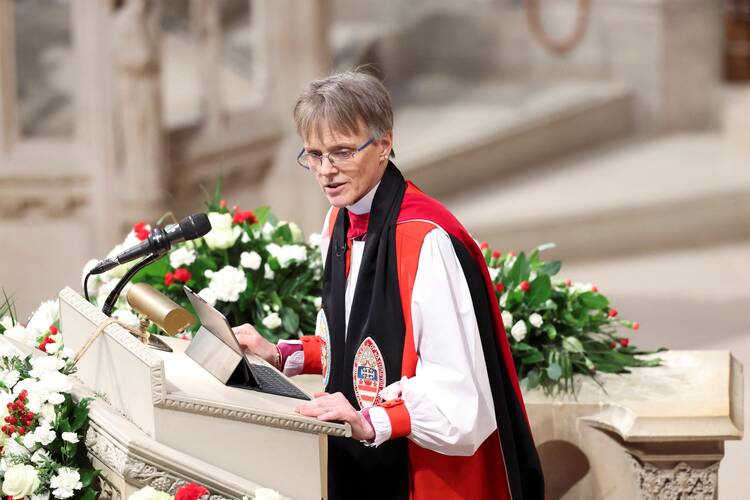
Bishop Mariann Edgar Budde delivers the sermon at a national prayer service Jan. 21, 2025, at the Washington National Cathedral with U.S. President Donald Trump, first lady Melania, U.S. Vice President JD Vance and second lady Usha Vance in attendance. (OSV News photo/Kevin Lamarque, Reuters)
The reading from the Letter to the Hebrews proclaims the New Covenant.
* [8:7–13] Since the first covenant was deficient in accomplishing what it signified, it had to be replaced (Heb 8:7), as Jeremiah (Jer 31:31–34) had prophesied (Heb 8:8–12). Even in the time of Jeremiah, the first covenant was antiquated (Heb 8:13). In Heb 7:22–24, the superiority of the new covenant was seen in the permanence of its priesthood; here the superiority is based on better promises, made explicit in the citation of Jer 31:31–34 (LXX: 38), namely, in the immediacy of the people’s knowledge of God (Heb 8:11) and in the forgiveness of sin (Heb 8:12).
* [8:8–12] In citing Jeremiah the author follows the Septuagint; some apparent departures from it may be the result of a different Septuagintal text rather than changes deliberately introduced.
* [8:13] Close to disappearing: from the prophet’s perspective, not that of the author of Hebrews. (Hebrews, CHAPTER 8 | USCCB, n.d.)
Psalm 85 is a prayer for the Restoration of God’s Favour.
* [Psalm 85] A national lament reminding God of past favors and forgiveness (Ps 85:2–4) and begging for forgiveness and grace now (Ps 85:5–8). A speaker represents the people who wait humbly with open hearts (Ps 85:9–10): God will be active on their behalf (Ps 85:11–13). The situation suggests the conditions of Judea during the early postexilic period, the fifth century B.C.; the thoughts are similar to those of postexilic prophets (Hg 1:5–11; 2:6–9). (Psalms, PSALM 85 | USCCB, n.d.)
In the Gospel of Mark, Jesus Appoints the Twelve
* [3:13] He went up the mountain: here and elsewhere the mountain is associated with solemn moments and acts in the mission and self-revelation of Jesus (Mk 6:46; 9:2–8; 13:3). Jesus acts with authority as he summoned those whom he wanted and they came to him.
* [3:14–15] He appointed twelve [whom he also named apostles] that they might be with him: literally “he made,” i.e., instituted them as apostles to extend his messianic mission through them (Mk 6:7–13). See notes on Mt 10:1 and 10:2–4.
* [3:16] Simon, whom he named Peter: Mark indicates that Simon’s name was changed on this occasion. Peter is first in all lists of the apostles (Mt 10:2; Lk 6:14; Acts 1:13; cf. 1 Cor 15:5–8). (Mark, CHAPTER 3 | USCCB, n.d.)
Mirielle Leonard reflects on the people who felt God’s call in such a way that they left their entire lives behind to travel the world spreading the Gospel and helping communities. She has to think a little smaller. In fact, most of us will never hear such a dramatic calling.
What will we hear? What about the nudge to include a new coworker or classmate at a social gathering? Do I feel called to donate to a particular cause? Has someone been on my mind a lot lately who may need prayers? What about a conviction to work on myself in some way? I think many “callings” are smaller than we imagine. The bible is full of grand, inspiring stories that may make us feel like our everyday lives cannot compare, but these “small” callings are just as impactful to the Kingdom of God. Imagine the changes that listening more intently to God’s calls could bring. (I like to call them God’s nudges, because the influence of God is a subtlety I work to discern). (Leonard, 2025)
Don Schwager quotes “The renaming of Matthew by Jesus,” by Bede the Venerable, 672-735 A.D.
"We must not pass over the fact that Matthew had two names, for he was also called Levi, and that name too bears witness to the grace granted to him. Levi means 'added' (or 'a joining') or 'taken up,' signifying that he was 'taken up' through being chosen by the Lord, and 'added' to the number of the apostolic band. Mark and Luke generously chose to use this name alone, so as to not make glaringly conspicuous his former way of life, for he was now their companion in the work of the Gospel (Mark 2:14, Luke 5:27). In setting down the list of the twelve apostles, they simply called him Matthew, not mentioning Levi (Mark 3:18, Luke 6:15). Matthew himself, on the other hand (in accord with what is written, 'The just man is the first accuser of himself; his friend came and searched him out' - Proverbs 18:17), calls himself by his ordinary name when telling of being called from his tax-collector's place, but adds pointedly 'the publican' (Matthew 10:3) - 'Thomas,' he says, 'and Matthew the publican.' In this way he offers to publicans and sinners greater confidence in securing their salvation." (excerpt from HOMILIES ON THE GOSPELS 1.21) (Schwager, n.d.)
The Word Among Us Meditation on Mark 3:13-19 comments that Jesus knows what kind of fruit he’s looking for, and he knows who can produce that fruit—because he’s the one who “planted” them in the first place. He chose them because he knew who they could become. That’s why he picked the men he did. He knew that the time they spent with him and the working of the Holy Spirit in their hearts would lift them up and change the way they thought and acted. He knew that each of these men could bring his gospel to the world.
Jesus still summons those he wants today—and he wants you! Maybe you’re not called to be an apostle, but you are called to be a disciple. Jesus knew what he was doing when he chose you. Yes, he sees your flaws and weaknesses. But, as with the apostles, he sees your goodness as well and all that you can become. He knows the fruit you will bear, and it’s fruit that only you can bear.
The Lord wants you in his garden. He has a special place for you.
“Lord, here I am. Help me to bear fruit for your kingdom today!” (Meditation on Mark 3:13-19, n.d.)
Connor Hartigan, an O'Hare Fellow and former editorial intern at America Media, comments that when Bishop Mariann Budde of the Episcopal Diocese of Washington took to the pulpit of the National Cathedral during a national prayer service on Tuesday, (January 21) the day after the inauguration of President Donald J. Trump, and spoke up on behalf of some of the most vulnerable people in the United States, she was performing one of the most essential tasks of Christian ministry.
Bishop Budde’s empathy for the persecuted may have annoyed or discomfited powerful politicians on Tuesday; this is a sign that she is doing her job. Her sermon is but the most recent in a long history of Christian exhortations to the powerful to abide by the values of the Gospel:
For I was hungry and you gave me food, I was thirsty and you gave me drink, a stranger and you welcomed me, naked and you clothed me, ill and you cared for me, in prison and you visited me…‘Amen, I say to you, whatever you did for one of these least brothers of mine, you did for me.’ (Hartigan, n.d.)
Friar Jude Winkler discusses the contrast in Hebrews between the Hebrew Covenant, written in stone with the New Covenant written on our hearts. The relationship with the Hebrew Covenant expressed in Matthew and in Good Friday prayers reaffirms the sanctity of the Covenant with the Jewish people. Friar Jude reminds us of the naming differences in the texts of some of the twelve apostles.
Fr. Richard Rohr, OFM, offers an encouraging reminder that we don’t need to be perfect in order to be loved and accepted by God.
What I like to call “holy dissatisfaction” gave me my instinct for reform, but it also chewed me up. In the first half of my life, I was constantly thinking, “It’s not supposed to be that way!” I was constantly noticing, “That isn’t it! That isn’t it!” It’s only in the second half of my life that I am finally able to live in the holy tension of accepting that a “remnant” or “critical mass” is enough. Scattered in each group are always a few who get it, a few who live and love the gospel. When that became enough, and even more than enough (even in myself), I was free. So, this scriptural image of “remnant” or “yeast”—to use Jesus’ words—is very important for me and my own liberation. If I’m going to wait for the reign of God to be fully realized before I can be happy, I’m never going to be happy. [2] (Rohr, n.d.)
We seek inspiration from the Spirit to rise to the challenge to proclaim the values of the Gospel in our words and actions as disciples of Jesus.
References
Hartigan, C. (n.d.). Bishop Budde, Trump and the history of faith leaders getting political. America Magazine | The Jesuit Review of Faith & Culture. Retrieved January 24, 2025, from https://www.americamagazine.org/faith/2025/01/23/bishop-budde-trump-mercy-249768?utm_source=piano&utm_medium=email&utm_campaign=2928&pnespid=q7RtATxcJaYY3P_a_iikAozXtU2_VINtNLPnyOd08gJm_.OQTqrWlvUr62TWJYDZs4n0pR38
Hebrews, CHAPTER 8 | USCCB. (n.d.). Daily Readings. Retrieved January 24, 2025, from https://bible.usccb.org/bible/hebrews/8?6
Leonard, M. (2025, January 24). Creighton U. Daily Reflection. Creighton U. Daily Reflection. Retrieved January 24, 2025, from https://onlineministries.creighton.edu/CollaborativeMinistry/012425.html
Mark, CHAPTER 3 | USCCB. (n.d.). Daily Readings. Retrieved January 24, 2025, from https://bible.usccb.org/bible/mark/3?13
Meditation on Mark 3:13-19. (n.d.). The Word Among Us: Homepage. Retrieved January 24, 2025, from https://wau.org/meditations/2025/01/24/1186294/
Psalms, PSALM 85 | USCCB. (n.d.). Daily Readings. Retrieved January 24, 2025, from https://bible.usccb.org/bible/psalms/85?8
Rohr, R. (n.d.). Releasing Any Need for Perfection. Center for Action and Contemplation. Retrieved January 24, 2025, from https://cac.org/daily-meditations/releasing-any-need-for-perfection/
Schwager, D. (n.d.). Daily Scripture Readings and Meditations – Daily Scripture Readings and Meditations. Retrieved January 24, 2025, from https://www.dailyscripture.net/daily-meditation/?ds_year=2025&date=jan24

