Showing posts with label Institution narrative. Show all posts

Sunday, June 22, 2025

Presence and Word

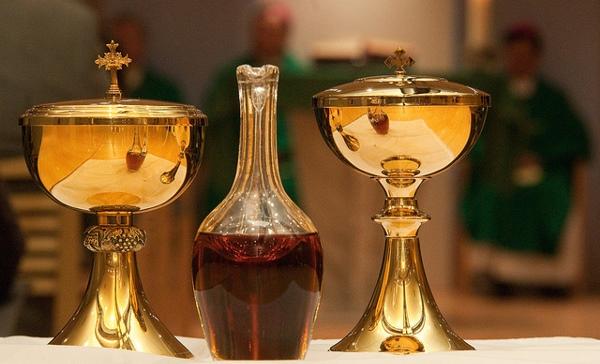
The texts from the Roman Catholic Lectionary, today, The Solemnity of the Most Holy Body and Blood of Christ, ( Corpus Christi), celebrate the Presence of Christ in the Eucharist as food for our full life.


Pursue our Journey


The reading from the Book of Genesis recalls Melchizedek, king of Salem, who brought out bread and wine.


* [14:18] Melchizedek, king of Salem (Jerusalem, cf. Ps 76:3), appears with majestic suddenness to recognize Abraham’s great victory, which the five local kings were unable to achieve. He prepares a feast in his honor and declares him blessed or made powerful by God Most High, evidently the highest God in the Canaanite pantheon. Abraham acknowledges the blessing by giving a tenth of the recaptured spoils as a tithe to Melchizedek. The episode is one of several allusions to David, king at Jerusalem, who also exercised priestly functions (2 Sm 6:17). Heb 7 interprets Melchizedek as a prefiguration of Christ. God Most High: in Heb. El Elyon, one of several “El names” for God in Genesis, others being El Olam (21:33), El the God of Israel (33:20), El Roi (16:13), El Bethel (35:7), and El Shaddai (the usual P designation for God in Genesis). All the sources except the Yahwist use El as the proper name for God used by the ancestors. The god El was well-known across the ancient Near East and in comparable religious literature. The ancestors recognized this God as their own when they encountered him in their journeys and in the shrines they found in Canaan. (Genesis, CHAPTER 14 | USCCB, n.d.)


Psalm 110 proclaims God who assures the king that his enemies are conquered.


* [Psalm 110] A royal Psalm in which a court singer recites three oracles in which God assures the king that his enemies are conquered (Ps 110:12), makes the king “son” in traditional adoption language (Ps 110:3), gives priestly status to the king and promises to be with him in future military ventures (Ps 110:47). (Psalms, PSALM 110 | USCCB, n.d.)


The reading from the First Letter to the Corinthians, Paul relates the tradition of the Institution.


* [11:2325] This is the earliest written account of the institution of the Lord’s Supper in the New Testament. The narrative emphasizes Jesus’ action of self-giving (expressed in the words over the bread and the cup) and his double command to repeat his own action. (1 Corinthians, CHAPTER 11 | USCCB, n.d.)


In the Gospel of Luke, Jesus Feeds the Five Thousand.


* [9:16] Then taking…: the actions of Jesus recall the institution of the Eucharist in Lk 22:19; see also note on Mt 14:19. (Luke, CHAPTER 9 | USCCB, n.d.)


Rev. Andy Alexan­der, SJ sus­pects that some of us, like he, at var­i­ous times in our lives, took the Eucharist for grant­ed and lost a sense of the sacred, the inti­mate bond of this gift of his entire self to/for us, and we lost a sense of how the Eucharist mis­sions us to share that self-giv­ing love for others.


Can this grace of a feel­ing close to our Lord be restored?  Can we open our hearts to receive that pow­er­ful, per­son­al expe­ri­ence of love he offers us with his very self being bro­ken and poured out for us?  Can we imag­ine a renewed spe­cial moment when the min­is­ter offers us his Body and his Blood, while we stretch out our arms with a big smile and say “Amen,” mean­ing “Yes,” to the whole gift: “Yes, I desire to receive you into my heart.  Yes, I so desire to let you heal me with your love and I real­ly want to feel mis­sioned by this sacra­ment to love as you’ve loved me”?


I believe this is pos­si­ble because I’m expe­ri­enc­ing a bit of it more and more these days, deal­ing with my dimin­ish­ment. That jour­ney has led me to re-dis­cov­er an impor­tant tool Ignatius offers us, that is, locat­ing and ask­ing for the grace we desire.   To ask for this gift of a “holy com­mu­nion of love” we receive in the Eucharist is sure­ly to ask for a grace our Lord dear­ly wants to give us. (Alexander, 2025)


Don Schwager quotes “Christ has yet to feed them with stronger food,” by Ambrose of Milan, 339-397 A.D.


"The order of the mystery is preserved everywhere. The first healing is bestowed on wounds through the remission of sins. Then the nourishment of the heavenly table abounds, although this multitude is not yet refreshed with stronger foods, nor do hearts hungry for more solid faith feed on the body and blood of Christ (Hebrews 5:12-14). He says, 'I gave you milk to drink, not meat. For you then were not strong, nor are you yet' (1 Corinthians 3:2). The five loaves are like milk, but the more solid meat is the body of Christ, and the stronger drink is the blood of the Lord (Luke 22:19-20). Not immediately at first do we feast on all foods, nor do we drink all drinks. 'First drink this,' he says. Thus there is a first, then a second thing that you drink. There is also a first thing that you eat, then a second, and then a third. At first there are five loaves, then there are seven (Matthew 15:34). The third loaf is the true body of Christ. So, then, let us never abandon such a Lord. He agrees to bestow on us nourishment according to the strength of each, lest either too strong a food oppress the weak or too meager a nourishment not satisfy the strong."(excerpt from EXPOSITION OF THE GOSPEL OF LUKE 6.71-72) (Schwager, n.d.)


The Word Among Us Meditation on Luke 9:11-17 comments that whether we experience a Eucharistic miracle or not, Jesus is still present at every Mass. Just as he multiplied the five loaves and two fishes that day, he takes something so small—a simple piece of bread—and transforms it into his very flesh, to feed his people.


Today, offer Jesus your very self. Yes, the little that you have to offer him is enough! Give him your worries, your cares, but also your blessings and gifts. Trust in his miracle-working love and power to do amazing things in and through you.


“Jesus, nothing is too small for you. I worship you in the Eucharist, and I offer you the little that I have. Come and work your wonders in me!” (Meditation on Luke 9:11-17, n.d.)


Harry Elias SJ, assistant in the Hurtado Jesuit Centre in Wapping, East London, reflects on the communion with Christ into which we and all of creation are welcomed through the Eucharist.


At the Last Supper, Christ took bread and wine, blessed them (gave thanks to God for them) and declared the bread and wine to be his own body and blood, his sacrificial body, the embodiment of his sacrificial offering. He then gave them to his disciples to share. Earliest church tradition attests that the bread and wine were not merely a sign of Christ’s sacrificial body but actually were his body: the bread and wine had become a new creation. By becoming Christ’s flesh and blood, their identity was that of the Word of God (John 1:1). In offering the bread and wine, and in their being eaten and drunk, we come to communion (koinonia) with Christ in spirit, and through him with the Father, ‘so that, just as Christ was raised from the dead by the glory of the Father, so we too might walk in newness of life’ (Romans 6:4). Through our faith in Christ handed down to us by the Church, the joy and spiritual strength of hope we receive from the bread of life, the heavenly manna (John 6:50-51), enables us to endure the misfortunes in the wilderness of our lives. The Lord invites each one of us to his supper, to relax, rest and be refreshed in his personal love and in the Father’s love. (Elias, n.d.)


Friar Jude Winkler comments on the passage in Genesis where Melchizedek offers bread and wine as sacrifice in response to Abram. He is seen as a foreshadowing of Jesus “the king of righteousness” as outlined in the Letter to Hebrews. The first written version of the Last Supper, in Corinthians preceded by two decades the accounts in the New Testament. Friar Jude notes the different expressions of “blood” or “Covenant” in accounts and the different understanding in Greek or in Aramaic of Jesus Words.


Brian McLaren explores Jesus’ call to live by the collective values of justice and solidarity, becoming salt and light for the world. Jesus advocates an identity characterized by solidarity, sensitivity, and nonviolence. He celebrates those who long for justice, embody compassion, and manifest integrity and nonduplicity. He creates a new kind of hero: not warriors, corporate executives, or politicians, but brave and determined activists for preemptive peace, willing to suffer with him in the prophetic tradition of justice. 


Our choice is clear from the start: If we want to be his disciples, we won’t be able to simply coast along and conform to the norms of our society. We must choose a different definition of well-being, a different model of success, a new identity with a new set of values….  


If we seek the kind of unconventional blessedness he proposes, we will experience the true aliveness of God’s kingdom, the warmth of God’s comfort, the enjoyment of the gift of this Earth, the satisfaction at seeing God’s restorative justice come more fully, the joy of receiving mercy, the direct experience of God’s presence, the honor of association with God and of being in league with the prophets of old. That is the identity he invites us to seek. (McLaren, n.d.)


We ponder the declaration in the beginning of the Gospel of John that the Word is made flesh and dwells among us as we receive Christ in the sacrament of the Eucharist. The Chosen episode offers an interesting interpretation of Jesus and the loaves and fishes.


References

Alexander, A. (2025, June 22). Daily Reflection June 22, 2025 | Creighton Online Ministries. Creighton Online Ministries. Retrieved June 22, 2025, from https://onlineministries.creighton.edu/daily-reflections/daily-reflection-june-22-2025 

Elias, H. (n.d.). Corpus Christi transforming creation. Thinking Faith: The online journal of the Jesuits in Britain. Retrieved June 22, 2025, from https://www.thinkingfaith.org/articles/corpus-christi-transforming-creation 

Genesis, CHAPTER 14 | USCCB. (n.d.). Daily Readings. Retrieved June 22, 2025, from https://bible.usccb.org/bible/genesis/14?18 

Luke, CHAPTER 9 | USCCB. (n.d.). Daily Readings. Retrieved June 22, 2025, from https://bible.usccb.org/bible/luke/9?11 

McLaren, B. (n.d.). Acting from Our Identity. Center for Action and Contemplation. Retrieved June 22, 2025, from https://cac.org/daily-meditations/acting-from-our-identity/ 

Meditation on Luke 9:11-17. (n.d.). The Word Among Us: Homepage. Retrieved June 22, 2025, from https://wau.org/meditations/2025/06/22/1310938/ 

1 Corinthians, CHAPTER 11 | USCCB. (n.d.). Daily Readings. Retrieved June 22, 2025, from https://bible.usccb.org/bible/1corinthians/11?23 

Psalms, PSALM 110 | USCCB. (n.d.). Daily Readings. Retrieved June 22, 2025, from https://bible.usccb.org/bible/psalms/110?1 

Schwager, D. (n.d.). All Ate and Were Satisfied. Daily Scripture Readings and Meditations – Daily Scripture Readings and Meditations. Retrieved June 22, 2025, from https://www.dailyscripture.net/daily-meditation/?ds_year=2025&date=jun22a 


Sunday, June 2, 2024

New Covenant Mediator

The texts from the Roman Catholic Lectionary today, The Solemnity of the Most Holy Body and Blood of Christ, Corpus Christi, connect us to the Covenant that is enfleshed by Christ and reveals our true identity as children of God.


Sign and Realisation of a new creation


The reading from the Book of Exodus describes ratification of the Covenant by Moses.


* [24:4] Sacred stones: stone shafts or slabs, erected as symbols of the fact that each of the twelve tribes had entered into this covenant with God; see 23:24; Gn 28:18. (Exodus, n.d.)


Psalm 116 is a thanksgiving for Recovery from Illness.


* [Psalm 116] A thanksgiving in which the psalmist responds to divine rescue from mortal danger (Ps 116:34) and from near despair (Ps 116:1011) with vows and Temple sacrifices (Ps 116:1314, 1719). The Greek and Latin versions divide the Psalm into two parts: Ps 116:19 and Ps 116:1019, corresponding to its two major divisions. (Psalm 116, n.d.)


The reading from the Letter to the Hebrews proclaims the Sacrifice of Jesus.


* [9:1114] Christ, the high priest of the spiritual blessings foreshadowed in the Old Testament sanctuary, has actually entered the true sanctuary of heaven that is not of human making (Heb 9:11). His place there is permanent, and his offering is his own blood that won eternal redemption (Heb 9:12). If the sacrifice of animals could bestow legal purification (Heb 9:13), how much more effective is the blood of the sinless, divine Christ who spontaneously offered himself to purge the human race of sin and render it fit for the service of God (Heb 9:14).

* [9:11] The good things that have come to be: the majority of later manuscripts here read “the good things to come”; cf. Heb 10:1.

* [9:13] A heifer’s ashes: ashes from a red heifer that had been burned were mixed with water and used for the cleansing of those who had become ritually defiled by touching a corpse; see Nm 19:9, 1421.

* [9:14] Through the eternal spirit: this expression does not refer either to the holy Spirit or to the divine nature of Jesus but to the life of the risen Christ, “a life that cannot be destroyed” (Heb 7:16).

* [9:1522] Jesus’ role as mediator of the new covenant is based upon his sacrificial death (cf. Heb 8:6). His death has effected deliverance from transgressions, i.e., deliverance from sins committed under the old covenant, which the Mosaic sacrifices were incapable of effacing. Until this happened, the eternal inheritance promised by God could not be obtained (Heb 9:15). This effect of his work follows the human pattern by which a last will and testament becomes effective only with the death of the testator (Heb 9:1617). The Mosaic covenant was also associated with death, for Moses made use of blood to seal the pact between God and the people (Heb 9:1821). In Old Testament tradition, guilt could normally not be remitted without the use of blood (Heb 9:22; cf. Lv 17:11). (Hebrews, n.d.)


The Gospel of Mark outlines the Passover with the Disciples and describes the Institution of the Lord’s Supper.


* [14:2224] The actions and words of Jesus express within the framework of the Passover meal and the transition to a new covenant the sacrifice of himself through the offering of his body and blood in anticipation of his passion and death. His blood of the covenant both alludes to the ancient rite of Ex 24:48 and indicates the new community that the sacrifice of Jesus will bring into being (Mt 26:2628; Lk 22:1920; 1 Cor 11:2325). (Hebrews, n.d.)


Robby Francis comments that the concept of sacrifice is central to the Christian faith. Today, as we celebrate the Solemnity of the Most Holy Body and Blood of Christ, we get a glimpse of what it means to sacrifice. The Eucharist itself is a celebration of the ultimate sacrifice – Jesus Christ giving us his body and blood. This act of love is the cornerstone of Christian belief, reminding us that true love often involves self-giving and surrender.


Moreover, sacrifice is not merely about loss; it is also about gain. Through sacrifice, we often find deeper meaning and fulfillment. By letting go of our own desires, we open ourselves to the possibility of something greater. The reading from Hebrews speaks of using the blood of animals for an external cleanse but expresses that the blood of Christ goes further – it cleanses our souls. It’s a reminder not to focus on the externals but to delve deeper into the internal. We can become so focused on the externals of our sacrifices, but we are encouraged to be attentive to the internal change, which has lasting effects. When we let go, something profound happens within.

Sacrifice is not merely about loss; it also involves gain. Through sacrifice, we often discover deeper meaning and fulfillment. By letting go of our desires, we open ourselves to the possibility of something greater. (Francis, n.d.)


Don Schwager quotes “Your Word will enlighten and save me,” by Clement of Alexandria, 150-215 A.D.


"The commandment of the Lord shines clearly, enlightening the eyes. Receive Christ, receive power to see, receive your light, that you may plainly recognize both God and man. More delightful than gold and precious stones, more desirable than honey and the honeycomb is the Word that has enlightened us (Psalm 19:10). How could he not be desirable, who illumined minds buried in darkness, and endowed with clear vision 'the light-bearing eyes' of the soul? ... Sing his praises, then, Lord, and make known to me your Father, who is God. Your Word will save me, your song instruct me. I have gone astray in my search for God; but now that you light my path, Lord, I find God through you, and receive the Father from you, I become co-heir with you, since you were not ashamed to own me as your brother. Let us, then, shake off forgetfulness of truth, shake off the mist of ignorance and darkness that dims our eyes, and contemplate the true God, after first raising this song of praise to him: 'All hail, O light!' For upon us buried in darkness, imprisoned in the shadow of death, a heavenly light has shone, a light of a clarity surpassing the sun's, and of a sweetness exceeding any this earthly life can offer." (excerpt from EXHORTATION TO THE GREEKS 11.8) (Schwager, n.d.)


The Word Among Us Meditation on Exodus 24:3-8 comments that the Israelites’ response to Moses is clearly admirable and pleasing to the Lord, but today’s feast of the Body and Blood of Christ invites us to consider another aspect of our response to him. We are so used to focusing on “doing,” but at its heart, the mystery of the Eucharist is focused on “being” more than “doing.” Just as the bread and wine become the Body and Blood of the Lord at Mass, so do we become the body of Christ when we gather for worship and receive him in Communion. So when we say “Amen” just before receiving the Eucharist, we can say in our hearts, “We will be everything the Lord has made us to be.”


Of course, it’s a good thing to do what God is asking us to do. But today is a perfect day to celebrate who you are becoming. Treasured and redeemed and beloved, you are taking on the likeness of the very One you are receiving!


“Jesus, thank you for giving me a share in your Body and Blood, your Soul and Divinity!” (Meditation on Exodus 24:3-8, n.d.)


Friar Jude Winkler comments on the Hebrew understanding of cutting a Covenant and the significant symbol of blood as providing a transfusion of life where sin had brought death. Archeology has supported the understanding that Jesus celebrated Passover in the Essene quarter of Jerusalem. He proclaims “This is me” in Aramaic at the Last Supper. Friar Jude compares the blood in the Cup in the words of Mark and Matthew with the Cup of the Covenant as expressed by Luke and Paul.


Harry Elias SJ, who assists in the Hurtado Jesuit Centre in Wapping, East London, comments that the enactment of the Church’s faith in the common remembrance of the new covenant in Christ’s sacrifice is not just a way of passing on knowledge, or merely a symbol shaping a community. The bread and wine is sacrament – both sign and realisation – of a new creation, binding it together and transforming it from within.


This is what Paul says about the Last Supper, which he calls the Lord’s Supper:


The cup of blessing that we bless, is it not a sharing in the blood of Christ? The bread that we break, is it not a sharing in the body of Christ? Because there is one bread, we who are many are one body, for we all partake of the one bread. (1 Corinthians 10:16-17).

The Lord’s Supper was for Paul a sharing, a partnership or communion (in Greek: koinonia) with the sacrificial offering of Christ by the eating and drinking of bread and wine, and through Christ with God. Mention is made of three interrelated embodiments of Christ’s self-offering: the body of Christ that was put to death; the bread, taken, blessed and shared; and the many who partake of this bread. (Elias, n.d.)


Fr. Richard Rohr, OFM, shares how contemplative practice offers access to a deeper, more loving response to the world. Neurosurgeon Eben Alexander writes, “True thought is not the brain’s affair. But we have—in part by the brain itself—been so trained to associate our brains with what we think and who we are that we have lost the ability to realize that we are at all times much more.” [1] In this moment, in every moment, we are much more than our physical brain and our physical body. 


True thought is pre-physical. This is the thinking behind the thinking, the consciousness behind our small ability to plug into it. If we stay at the horizontal level of calculating, judging, and labeling, we won’t plug into it very well because we don’t really believe in it. Many of us don’t really believe there’s anything spiritual beyond this material body. I think those of us in the West have probably been influenced by the materialistic worldview more than we realize, but Alexander and other scientists are coming to the recognition that there’s something more. The recognition that the real power, as in the Trinity, is in the capacity for relationship, for communion, for being mirrored, and therefore gaining the ability to mirror other people. This type of thinking isn’t dependent on linear deduction. It moves as fast as lightning, making connections on different levels. It might be hard to verbalize, but it’s experienced as a moment of insight, a spontaneous gift of compassionate, inner clarity. It will never be angry or violent, only a clarity of love. (Rohr, n.d.)


We ponder how the Covenant that Jesus declares invites us to deep communion with the Triune God as we contemplate our experiences of “thin places” where the spiritual and material are perceived in intimate connection.


References

Elias, H. (n.d.). Corpus Christi transforming creation. Thinking Faith: The online journal of the Jesuits in Britain. Retrieved June 2, 2024, from https://www.thinkingfaith.org/articles/corpus-christi-transforming-creation 

Exodus. (n.d.). USCCB. Retrieved June 2, 2024, from https://bible.usccb.org/bible/exodus/24

Francis, R. (n.d.). Daily Reflection Of Creighton University's Online Ministries. Creighton University's Online Ministries. Retrieved June 2, 2024, from https://onlineministries.creighton.edu/CollaborativeMinistry/060224.html 

Hebrews. (n.d.). USCCB. Retrieved June 2, 2024, from https://bible.usccb.org/bible/hebrews/9?11 

Mark. (n.d.). USCCB Daily Readings. Retrieved June 2, 2024, from https://bible.usccb.org/bible/mark/14?12 

Meditation on Exodus 24:3-8. (n.d.). Wikipedia. Retrieved June 2, 2024, from https://wau.org/

Psalm 116. (n.d.). USCCB. Retrieved June 2, 2024, from https://bible.usccb.org/bible/psalms/116?12 

Rohr, R. (n.d.). Contemplation Changes Everything. CAC Daily Meditations. Retrieved June 2, 2024, from https://cac.org/daily-meditations/contemplation-changes-everything/ 

Schwager, D. (n.d.). This Is My Blood of the Covenant, Which Is Poured out for Many. Daily Scripture net. Retrieved June 2, 2024, from https://www.dailyscripture.net/daily-meditation/?ds_year=2024&date=jun2a