Friday, November 15, 2019

The sudden change

The texts from the Roman Catholic Lectionary today invite us to contemplate the signs of the Jesus Presence in the world around us and in the creativity of artists.
Signs in Nature

The reading from the Book of Wisdom points to the foolishness of missing the Creator in our observation of Nature.
* [13:1–9] The author holds a relatively benign view of the efforts of the philosophers to come to know God from various natural phenomena. This is not a question of proving the existence of God in scholastic style. The author thinks that the beauty and might of the world should have pointed by analogy (v. 5) to the Maker. Instead, those “in ignorance of God” remained fixed on the elements (v. 2, three named, along with the stars). His Greek counterparts are not totally blameless; they should have gone further and acknowledged the creator of nature’s wonders (vv. 4–5). Cf. Rom 1:18–23; Acts 17:27–28.1
Psalm 19 proclaims the regular functioning of the heavens inform human beings of the Creator’s power and wisdom.
* [19:4] No speech, no words: the regular functioning of the heavens and the alternation of day and night inform human beings without words of the creator’s power and wisdom.2 
Jesus describes the sudden intrusion of the Day of the Son of Man into our lives in the Gospel of Luke.
* [17:20–37] To the question of the Pharisees about the time of the coming of God’s kingdom, Jesus replies that the kingdom is among you (Lk 17:20–21). The emphasis has thus been shifted from an imminent observable coming of the kingdom to something that is already present in Jesus’ preaching and healing ministry. Luke has also appended further traditional sayings of Jesus about the unpredictable suddenness of the day of the Son of Man, and assures his readers that in spite of the delay of that day (Lk 12:45), it will bring judgment unexpectedly on those who do not continue to be vigilant.3 
Mark Latta comments that our times today might seem like Noah’s time where everyone seems distracted, distanced from God, unable to concentrate on what is important.
Luke’s admonition is not centered on our activities of life but on our lack of attentiveness to what we are doing and what God is doing within us. Saint Ignatius in the Spiritual Exercises asks us to seek an inner freedom from disordered attachments in order to be open to God’s unconditional love for us—and to the movements of the Holy Spirit within us to guide our actions and activities.4 
Don Schwager quotes “Those working in the field are sowing the Word of God,” by Ambrose of Milan, 339-397 A.D.
"'He that will be on the housetop, do not let him go down. He that will be in the field, do not let him turn back.' How may I understand what is the field unless Jesus himself teaches me? He says, 'No one putting his hand to the plough (plow) and looking back is fit for the kingdom of God' (Luke 9:62). The lazy person sits in the farmhouse, but the industrious person plants in the field. The weak are at the fireplace, but the strong are at the plough. The smell of a field is good, because the smell of Jacob is the smell of a full field (Genesis 27:27). A field is full of flowers. It is full of different fruits. Plough your field if you want to be sent to the kingdom of God. Let your field flower, fruitful with good rewards. Let there be a fruitful vine on the sides of your house and young olive plants around your table (Psalm 127:3). Already aware of its fertility, let your soul, sown with the Word of God and tilled by spiritual farming, say to Christ, 'Come, my brother, let us go out into the field' (Song of Solomon 7:11). Let him reply, 'I have come into my garden, my sister, my bride. I have gathered my vintage of myrrh'  (Song of Solomon 5:1). What is better than the vintage of faith, by which the fruit of the resurrection is stored and the spring of eternal rejoicing is watered?" (excerpt from EXPOSITION OF THE GOSPEL OF LUKE 8.43.27)5 
The Word Among Us Meditation on Luke 17:26-37 is concerned that listening to reports of bad news, worrying about what might go wrong in our families, fear for our health—all those things can pull us down into a swamp of worry and apprehension. The more we focus on our anxious thoughts, the deeper we can sink.
Where do you see anxiety dragging you down? The next time you feel like you’re drowning in the quicksand of worry, try to relax and focus on Jesus and his plans for you today. His first coming launched a revolution of love and mercy. It built a solid foundation that can keep you from drowning. What’s even better, this solid foundation will grow ever stronger with every act of faith and trust you make.6 
Friar Jude Winkler describes how the Greek philosophers were caught up in the power and beauty of Creation yet lacked the human wisdom to find God as Creator. Jesus Resurrection was initially interpreted as a sign of the imminent end of the world. Friar Jude observes how the concept of “rapture” may be connected to the apparent lack of rhyme or reason in the timing of our death.


Fr. Richard Rohr, OFM, ponders how there must be a way to be both here and in the depth of here. Jesus is here. Christ is the depth of here. This is the essence of incarnation and the gift of contemplation.
We must learn to love and enjoy things as they are, in their depth, in their soul, and in their fullness. Contemplation is the “second gaze,” through which we see something in its particularity and yet also in a much larger frame. We know it by the joy it gives, which is far greater than anything it does for us in terms of money, power, or success. In its various forms, art provides this incarnational and contemplative insight. 
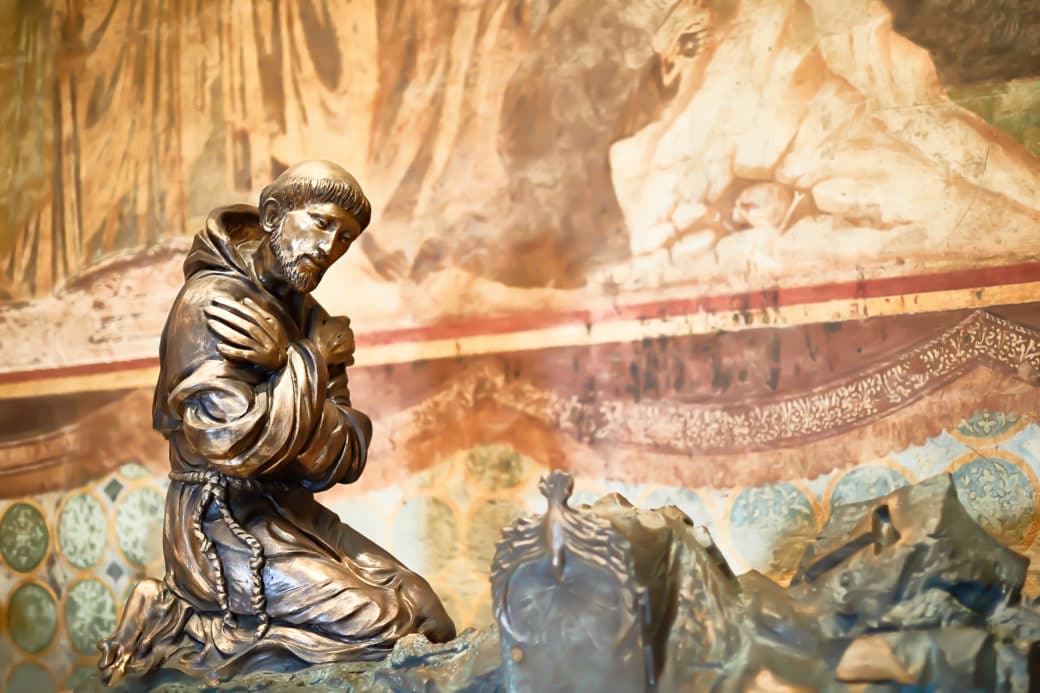
Sculpture of St. Francis of Assisi, artist unknown, Upper Church in the Basilica of Saint Francis of Assisi, Assisi, Italy; photo by K505/Shutterstock.
 Instead of looking upward as is usual, he gazes reverently and longingly downward—into the earth—where the Spirit is enmeshed with the earth. Francis understood that the Holy Spirit had in fact descended; she is forever and first of all here! There are many artists who inherently understand incarnation. They see art as a major transposition of sacred place from there to here.7
We ponder the mysteries of the universe and invoke the Spirit to connect us to the truth, beauty, and goodness that we forget is incarnate in our immediate surroundings.

References

1
(n.d.). Wisdom, chapter 13. Retrieved November 15, 2019, from http://www.usccb.org/bible/wisdom/13 
2
(n.d.). Psalms, chapter 19. Retrieved November 15, 2019, from http://www.usccb.org/bible/psalms/19 
3
(n.d.). Luke, chapter 17 - United States Conference of Catholic Bishops. Retrieved November 15, 2019, from http://www.usccb.org/bible/luke/17 
4
(n.d.). Daily Reflections - OnlineMinistries .... Retrieved November 15, 2019, from https://onlineministries.creighton.edu/CollaborativeMinistry/daily.html 
5
(n.d.). Daily Scripture Readings and Meditations. Retrieved November 15, 2019, from https://dailyscripture.servantsoftheword.org/ 
6
(n.d.). Meditations - The Word Among Us. Retrieved November 15, 2019, from https://wau.org/meditations/2019/11/15/ 
7
(2019, November 15). Changing Places — Center for Action and Contemplation. Retrieved November 15, 2019, from https://cac.org/changing-places-2019-11-15/ 

Thursday, November 14, 2019

Living in Wisdom of the Kingdom

The texts from the Roman Catholic Lectionary today invite contemplation of the characteristics of wisdom and creativity that bring truth, beauty and goodness to our life.
Seeking wisdom

The reading from the Book of Wisdom outlines the perfect nature of Wisdom.

* [7:22b–23] The twenty-one (7 × 3) attributes of the spirit in Wisdom reflect the influence of contemporary philosophy, especially the Stoa, but the personification rests also on Prv 8:22–31 and Sir 24.
* [7:25–26] Five strong metaphors underline the origins and closeness of Wisdom with God. See the use of this language in Heb 1:3; Col 1:15.1 

Psalm 119 declares the world manifests the Word by its permanence and reliability.
* [119:89–91] God’s word creates the world, which manifests that word by its permanence and reliability.2 
In the Gospel of Luke Jesus declares the coming of the Kingdom and remind us of the Day of the Son of Man.
* [17:21] Among you: the Greek preposition translated as among can also be translated as “within.” In the light of other statements in Luke’s gospel about the presence of the kingdom (see Lk 10:9, 11; 11:20) “among” is to be preferred.3 
Barbara Dilly comments that Jesus reminds us that the Kingdom of God is already with us, in every age.
 I find that those who find wisdom in the statutes and ordinances of the Lord and who stand firm in those truths bear abundant fruits that reveal an “aura of the might of God and a pure effusion of the glory of the Almighty.”  Who are these people among us? They are surely everywhere if we look for them. The words in the reading of Wisdom are helpful to me in identifying these fruitful believers. There are those among us who demonstrate a spirit of wisdom and truth that is “intelligent, holy, unique, manifold, subtle, agile, clear, unstained, and certain.”  This wisdom spirit is passed into holy souls from age to age and produces friends of God and prophets that we can surely find among us.4
Don Schwager quotes “Don't pursue human glory,” by John Cassian (360-435 AD).
 "If the devil has been driven out and sin no longer reigns, then the kingdom of God is established in us. As it is written in the Gospel, 'The kingdom of God does not come with observation, nor will they say, 'Lo here,' or 'Lo, there.' Truly I say to you that the kingdom of God is within you' (Luke 17:20-21). The only thing that can be 'within us' is knowledge or ignorance of the truth and the affection for righteousness or sin by which we prepare our hearts to be a kingdom of Christ or the devil. St. Paul described the nature of this kingdom in this way: 'For the kingdom of God is not food and drink, but righteousness and peace and joy in the Holy Spirit' (Romans 14:17). If the kingdom of God is within us and is righteousness, peace and joy, then someone that remains in these is surely within the kingdom of God. Someone that remains in unrighteousness, conflict and the melancholy that kills the life of the spirit is already a citizen of the devil's kingdom, of hell and of death. These are the signs whether it is God's kingdom or the devil's." (excerpt from  CONFERENCE 1.13.5)
[John Cassian was an early 5th century church father who lived for several years with the monks in Bethlehem and Egypt before founding a monastery in southern Gaul.]5
The Word Among Us Meditation on Luke 17:20-25 comment that Jesus teaches us about the most powerful unseen force of all: the kingdom of God. He explains that the coming of this kingdom isn’t accompanied with a lot of fanfare, and many don’t notice it. Jesus’ humble coming in the flesh was the inauguration of the kingdom, and that was a very quiet beginning. But from that point on, everything began to change. The kingdom’s forces are now at work in a new way, and it’s only a matter of time before Jesus takes up his reign in a much more public way.
So we live in an “already, but not yet” time. God’s kingdom truly is among us, but it is not yet fully visible. This isn’t always easy for us. We want to see more; we want to experience more, but God is asking us to exercise our faith and to trust in his unseen presence and his invisible power. He wants us to live in hope—not a wistful denial of reality, but a sure and certain assurance that his kingdom truly is with us. We can be peaceful and trusting, secure in the knowledge that Jesus, our King, is in control, and we will eventually see him return in unmistakable glory.6 
Friar Jude Winkler explains the superlative perfect description of Wisdom. The most perfect form of God’s Wisdom is Love given to those who seek her. Friar Jude reminds of the already but not yet eschatology of Luke.


Fr. Richard Rohr, OFM, shares that like contemporary theologian Dr. Diana L. Hayes, he has found healing through the creative process of writing. Dr Hayes writes:
 I am a Catholic womanist, standing firmly in the shoes my mothers made for me and walking toward a future in which all of God’s creation will be recognized and affirmed regardless of race, class, gender, or sexual orientation. I am black. I am Catholic. And by the grace of God, I am here. I invite you to share my journey of self-discovery and faith. . . . My spirituality, a womanist spirituality, that is, a spirituality forged in the awareness and experience of the multiplicative forms of oppression that are used to limit and restrain black women, has been honed and sharpened by my journey with God throughout my life. . . . Womanist spirituality is the encounter of black women and Jesus spelled out in song, poetry, novels, and memoirs that speak of the everlasting struggle as they continue to move themselves and their people one step closer to the Promised Land, a land to be found after death, yes, but more important, a land they know has been promised in this life as well. [2]7
Living in the Kingdom of Love connects us to Wisdom personified in God and opens our Spirit to creative endeavour.

References

1
(n.d.). Wisdom, chapter 7 - United States Conference of Catholic Bishops. Retrieved November 14, 2019, from http://www.usccb.org/bible/wisdom/7 
2
(n.d.). Psalms, chapter 119. Retrieved November 14, 2019, from http://www.usccb.org/bible/psalms/119 
3
(n.d.). Luke, chapter 17 - United States Conference of Catholic Bishops. Retrieved November 14, 2019, from http://www.usccb.org/bible/luke/17 
4
(n.d.). Daily Reflections - OnlineMinistries .... Retrieved November 14, 2019, from https://onlineministries.creighton.edu/CollaborativeMinistry/daily.html 
5
(n.d.). Daily Scripture Readings and Meditations. Retrieved November 14, 2019, from https://dailyscripture.servantsoftheword.org/ 
6
(n.d.). 32nd Week in Ordinary Time - Mass Readings and Catholic .... Retrieved November 14, 2019, from https://wau.org/meditations/2019/11/14/ 
7
(2019, November 14). Release and Healing — Center for Action and Contemplation. Retrieved November 14, 2019, from https://cac.org/release-and-healing-2019-11-14/ 

Wednesday, November 13, 2019

Errors of Entitlement

The texts from the Roman Catholic Lectionary today nudge us to reflect on the areas where our gratitude for events in our daily life has been tinged by a sense of entitlement.
Grateful for gifts

The passage from the Book of Wisdom has Kings stand in for the people of Israel who should seek Wisdom on this matter.
 * [6:1] Kings…magistrates: note the inclusion with v. 21 (“kings”). The address to earthly powers is in accord with the opening (1:1), but the true audience remains the Jewish community.1
In Psalm 82, God arises in the heavenly assembly to rebuke the unjust “gods.
* [Psalm 82] As in Ps 58, the pagan gods are seen as subordinate divine beings to whom Israel’s God had delegated oversight of the foreign countries in the beginning (Dt 32:8–9). Now God arises in the heavenly assembly (Ps 82:1) to rebuke the unjust “gods” (Ps 82:2–4), who are stripped of divine status and reduced in rank to mortals (Ps 82:5–7). They are accused of misruling the earth by not upholding the poor. A short prayer for universal justice concludes the Psalm (Ps 82:8).2 
Jesus comments on giving thanks as He cleanses ten lepers in the Gospel of Luke.
* [17:11–19] This incident recounting the thankfulness of the cleansed Samaritan leper is narrated only in Luke’s gospel and provides an instance of Jesus holding up a non-Jew (Lk 17:18) as an example to his Jewish contemporaries (cf. Lk 10:33 where a similar purpose is achieved in the story of the good Samaritan). Moreover, it is the faith in Jesus manifested by the foreigner that has brought him salvation (Lk 17:19; cf. the similar relationship between faith and salvation in Lk 7:50; 8:48, 50).3 
Steve Scholer asks can we be safe in assuming this reading is only about officials who are constantly in the public view, issuing orders and deciding guilt or innocence, or is there a deeper meaning? We all wear crowns, be it the crown of a spouse, a parent, a friend, a co-worker or even the crown of a stranger. And our heads may also be heavy with the responsibility that comes with a crown, but there a way to lessen its weight and burden.

St. Ignatius tackled this issue almost 500 years ago and gave us a roadmap to lightening the weight of the crown. From the beginning of the Jesuit order, Ignatius believed all members of the Society of Jesus were called to lead. But to be an effective leader, certain skills needed to be developed. What Ignatius said then is still true today: The key to leading is in understanding our own strengths and weaknesses. That knowledge and deeper understanding come through daily reflection – looking for God’s presence in our lives and asking for the help of the Spirit to guide our interactions.
Ignatius also stressed that leaders were those who engaged others with dignity, a positive attitude and an open heart, ready to love and accept. He charged the Society to govern using "all the love and modesty and charity possible." Ignatius knew that fear was not how one leads, but rather, by being mutually supportive and creating positive environments fueled by acceptance and affection.4 

Don Schwager reflects on the question: Why did only one leper out of ten return to show gratitude?
Gratefulness, a word which expresses gratitude of heart and a thankful disposition, is related to grace - which means the release of loveliness. Gratitude is the homage of the heart which responds with graciousness in expressing an act of thanksgiving. The Samaritan approached Jesus reverently and gave praise to God. Ingratitude leads to lack of love and kindness, and intolerance towards others If we do not recognize and appreciate the mercy and help shown to us, we will be ungrateful and unkind towards others. Ingratitude is forgetfulness or a poor return for kindness received. Ingratitude easily leads to lack of charity and intolerance towards others, as well as to other vices, such as complaining, grumbling, discontentment, pride, and presumption. 5
He quotes “Cleansing of the ten lepers,” by Cyril of Alexandria (376-444 AD).
"Why did [Jesus] not say, 'I will, be cleansed,' as he did in the case of another leper (Luke 5:13), instead of commanding them to show themselves to the priests? It was because the law gave directions to this effect to those who were delivered from leprosy (Leviticus 14:2). It commanded them to show themselves to the priests and to offer a sacrifice for their cleansing. He commanded them to go as being already healed so that they might bear witness to the priests, the rulers of the Jews and always envious of his glory. They testified that wonderfully and beyond their hope, they had been delivered from their misfortune by Christ's willing that they should be healed. He did not heal them first but sent them to the priests, because the priests knew the marks of leprosy and of its healing." (excerpt from COMMENTARY ON LUKE, HOMILIES 113-16)5 
The Word Among Us Meditation on Luke 17:11-19 notes that in today’s Gospel, Jesus gives a valuable gift to ten people who have a devastating disease—the gift of healing. He healed them because he loved them, and he wanted to do something good for them—the first reason for any gift. But it seems that only one of these ten grasped the second reason for this gift; he’s the only one who came back to thank Jesus and offer him worship. Out of all of these people, only this fellow understood that Jesus was inviting him to a closer relationship with him.
The same holds true today. God has given us many, many gifts: friends, family, a unique set of talents and abilities, his Church, and various signs of his love and presence in our lives. God has given all of them to us freely, out of love and a desire to draw us closer to his heart. Each and every one of these gifts contains within it a special invitation for us to learn more about him and to deepen our relationship with him. His gift of family reveals his commitment to us; friends show us the joy we can have by just being with him; our talents move us to want to serve him; the Church provides a home for us to live with him. And the list goes on.6
Friar Jude Winkler comments on the action of some in authority expected to enact justice and serve others, but they refuse. Those to whom much is given are expected to do much. Friar Jude reminds us that Luke is urging us to think outside our boundaries and consider our treatment of the “Good Taliban”.


Fr. Richard Rohr, OFM, connects to extending our boundaries as he comments that a creative life demands that we take risks. They may be calculated risks; they may yield entrepreneurial fruits, or they may simply enrich our own lives. Creative risk taking might not turn our life upside down but, rather, might right the drifting ship of our soul. When we make ourselves available for the inflow of [Spirit], we accept not only her generative power but also her ability to [overcome] whatever stands in the way of our full aliveness.
You do not always have to suffer for art. You are not required to sacrifice everything for beauty. The creative life can be quietly gratifying. The thing is to allow ourselves to become a vessel for a work of art to come through and allow that work to guide our hands. Once we do, we are assenting to a sacred adventure. We are saying yes to the transcendent and embodied presence of the holy.
Many of us seem to think we are too “old” to create something “new,” which is really too bad. Although my writing is certainly a creative act, it has been a long time since I have expressed myself freely with color, movement, or sound. If I’m honest, I would probably feel a little silly trying again at my age, but Mirabai Starr’s writing reminds me that I am the poorer for it. What joy, satisfaction, or even embodied presence are we missing out on by our self-consciousness?7  
Gratitude and affirmation of others are practices that act against our tendency to act out of a sense of entitlement.

References

1
(n.d.). Wisdom, chapter 6. Retrieved November 13, 2019, from http://www.usccb.org/bible/wisdom/6 
2
(n.d.). Psalms, chapter 82. Retrieved November 13, 2019, from http://www.usccb.org/bible/psalms/82 
3
(n.d.). Luke, chapter 17 - United States Conference of Catholic Bishops. Retrieved November 13, 2019, from http://www.usccb.org/bible/luke/17 
4
(n.d.). Daily Reflections - OnlineMinistries .... Retrieved November 13, 2019, from https://onlineministries.creighton.edu/CollaborativeMinistry/daily.html 
5
(n.d.). Daily Scripture Readings and Meditations. Retrieved November 13, 2019, from https://dailyscripture.servantsoftheword.org/ 
6
(n.d.). Meditations - The Word Among Us. Retrieved November 13, 2019, from https://wau.org/meditations/2019/11/13/ 
7
(2019, November 13). The Creative Life — Center for Action and Contemplation. Retrieved November 13, 2019, from https://cac.org/the-creative-life-2019-11-13/ 

Tuesday, November 12, 2019

Disciplined rescued obedient

The texts from the Roman Catholic Lectionary today challenge us to be creative and disciplined as we experience the journey of dutifully putting one foot in front of the other as a disciple of Jesus.
Service and creativity

Wisdom imagines the destiny of the righteous in communion with God.
 * [3:1–12] The author affirms that, for the righteous, sufferings are not punishments but purification and opportunities to show fidelity, whereas for the wicked suffering is truly a punishment.1
The psalmist can teach the “poor,” those who are defenseless, to trust in God alone.
* [Psalm 34] A thanksgiving in acrostic form, each line beginning with a successive letter of the Hebrew alphabet. In this Psalm one letter is missing and two are in reverse order. The psalmist, fresh from the experience of being rescued (Ps 34:5, 7), can teach the “poor,” those who are defenseless, to trust in God alone (Ps 34:4, 12). God will make them powerful (Ps 34:5–11) and give them protection (Ps 34:12–22).2 
In the Gospel of Luke, Jesus reminds us that we need to have the attitude of a servant towards our daily work.
* [17:7–10] These sayings of Jesus, peculiar to Luke, which continue his response to the apostles’ request to increase their faith (Lk 17:5–6), remind them that Christian disciples can make no claim on God’s graciousness; in fulfilling the exacting demands of discipleship, they are only doing their duty.3 
Ronald Fussell quotes the founder of the order, Brothers of the Sacred Heart, Fr. Andre Coindre “when you have done all you can, you have done all you must”.
 And, only after we have done what we have been commanded, Jesus instructs us to say “we are unprofitable servants; we have done what we are obliged to do” (Luke 17:10).  What does it mean to be an “unprofitable servant”? When I reflect on this phrase, I am drawn to the idea that the work that we do to glorify the Lord here on Earth is never transactional.  Rather, it is always for the greater good. Perhaps our prayer should reflect that. Today’s Gospel is a reminder that we should not be praying for own interests, but instead, we should be praying that we can continue to grow in how we bring glory to God in all that we do every day.  By being mindful of this subtle shift in perspective, and by always striving for greater service for those who need it most, we make ourselves more worthy for life with Christ.4
Don Schwager quotes “We are called to humble service,” by Ambrose of Milan, 339-397 A.D.

"You do not say to your servant, 'Sit down,' but require more service from him and do not thank him. The Lord also does not allow only one work or labor for you, because so long as we live we must always work.    "Know that you are a servant overwhelmed by very much obedience. You must not set yourself first, because you are called a son of God. Grace must be acknowledged, but nature not overlooked. Do not boast of yourself if you have served well, as you should have done. The sun obeys, the moon complies (Joshua 10:12-13; Baruch 6:60), and the angels serve... Let us not require praise from ourselves nor prevent the judgment of God and anticipate the sentence of the Judge but reserve it for its own time and Judge." (excerpt from EXPOSITION OF THE GOSPEL OF LUKE 8.31-32)5 

The Word Among Us Meditation on Wisdom 2:23–3:9 suggests that we imagine God holding each of us with tenderness but firmness, the way a seasoned father or grandfather might grasp a little one. In his solid but careful grasp, we are secure and at peace.
 But this great, comforting truth isn’t limited just to the hour of death. God holds us in his strong hands every moment of our lives, from our very beginning and through all the stages and seasons of our lives. The more we trust in this truth, the more convinced we will be that he won’t abandon us in the end.
If you have a loved one approaching death, believe that God’s hand remains on them. Even if they are suffering, look for God’s loving touch in the care of the people who surround them. And if you have recently lost someone dear to you, take today’s passage to heart. Believe that God will never release them from his tender hold!6
Friar Jude Winkler explores the Greek concept of afterlife that is reflected in the writing of the Book of Wisdom. Service (and hard work) is it’s own reward. Friar Jude reminds us to be wary of the belief that we plug our way in life to earn a place in heaven.


Fr. Richard Rohr, OFM, and his friend Mirabai Starr believe that each of has the capacity to offer something new to the world. It does not come quickly or easily, but few things of any depth or value ever do. Mirabai writes:
There is a vital connection between creativity and mysticism. To engage with the creative impulse is to agree to take a voyage into the heart of the Mystery. Creativity bypasses the discursive mind and delivers us to the source of our being. When we allow ourselves to be a conduit for creative energy, we experience direct apprehension of that energy. We become a channel for grace. To make art is to make love with the sacred. It is a naked encounter, authentic and risky, vulnerable and erotically charged.7 
Our journey is made up of opportunities to creatively offer our time, treasure, and talent in service to our mission in Christ. Mystical revelation often comes through making our way mindfully through mundane tasks.

References

1
(n.d.). Wisdom, chapter 3. Retrieved November 12, 2019, from http://www.usccb.org/bible/wisdom/3 
2
(n.d.). Psalms, chapter 34 - United States Conference of Catholic .... Retrieved November 12, 2019, from http://www.usccb.org/bible/psalms/34 
3
(n.d.). Luke, chapter 17 - United States Conference of Catholic Bishops. Retrieved November 12, 2019, from http://www.usccb.org/bible/luke/17 
4
(n.d.). Daily Reflections - OnlineMinistries .... Retrieved November 12, 2019, from https://onlineministries.creighton.edu/CollaborativeMinistry/daily.html 
5
(n.d.). Daily Scripture Readings and Meditations. Retrieved November 12, 2019, from https://dailyscripture.servantsoftheword.org/ 
6
(n.d.). Meditations - The Word Among Us. Retrieved November 12, 2019, from https://wau.org/meditations/2019/11/12/ 
7
(2019, November 12). Fallow Time — Center for Action and Contemplation. Retrieved November 12, 2019, from https://cac.org/fallow-time-2019-11-12/