Showing posts with label indifference. Show all posts

Wednesday, July 15, 2026

Humble Open Peacemaking Effort (HOPE)

 The texts from the Roman Catholic Lectionary today challenge us to reject indifference and approach our relationships with an attitude we observe in children of wonder, trust, and openness to love.

Our Lady of Hope Retreat Centre


The Reading from the Book of the Prophet Isaiah presents Judgment on Assyria.


* [10:534] These verses contain a series of oracles directed against Assyria. Verses 515 portray Assyria as simply the rod God uses to punish Israel, though Assyria does not realize this. The original conclusion to this unit may be the judgment found in vv. 2427a, which continues the imagery and motifs found in vv. 515. Verses 1623, because of the quite different imagery and motifs, may originally have been an insertion directed against Aram and Israel at the time of the Syro-Ephraimite War.

* [10:6] Impious nation: Judah. It was God’s intention to use Assyria merely to punish, not to destroy, the nation.

* [10:16] His fat ones: the strong men of the enemy army. (Isaiah, CHAPTER 10 | USCCB, n.d.)


Psalm 94 complains about oppression of the holy community by people within community


* [Psalm 94] A lament of an individual who is threatened by wicked people. The danger affects the whole community. Calling upon God as judge (Ps 94:12), the Psalm complains about oppression of the holy community by people within (Ps 94:37). Bold declarations of faith follow: denunciation of evildoers (Ps 94:811) and assurance to the just (Ps 94:1215). The Psalm continues with further lament (Ps 94:1619) and ends with strong confidence in God’s response (Ps 94:2023). (Psalms, PSALM 94 | USCCB, n.d.)


In the Gospel of Matthew, Jesus declares Praise of the Father in revelation to the childlike.


* [11:2527] This Q saying, identical with Lk 10:2122 except for minor variations, introduces a joyous note into this section, so dominated by the theme of unbelief. While the wise and the learned, the scribes and Pharisees, have rejected Jesus’ preaching and the significance of his mighty deeds, the childlike have accepted them. Acceptance depends upon the Father’s revelation, but this is granted to those who are open to receive it and refused to the arrogant. Jesus can speak of all mysteries because he is the Son and there is perfect reciprocity of knowledge between him and the Father; what has been handed over to him is revealed only to those whom he wishes. (Matthew, CHAPTER 11 | USCCB, n.d.)


Greg Dyche quotes Elie Wiesel, Holocaust survivor and a Nobel Peace Prize laureate,


“The opposite of love is not hate, it’s indifference. The opposite of art is not ugliness, it’s indifference. The opposite of faith is not heresy, it’s indifference. And the opposite of life is not death, it’s indifference.” 


How quick I can shift my mindset and think “By my own power I have done it.” I am often the Assyrian Axe thinking I am a self-made man. I am also Judah with the plunder of the poor in my house. I’ve dressed it up of course. I don’t go and rob the poor directly, but I don’t always worry about who’s making my clothes, harvesting my food, or labeling my data. I get busy and become indifferent.


God is not indifferent. God sent His Son. I find comfort when Jesus says “All things have been handed over to me.” As silly as it can sound to say out loud, I can forget the first commandment and think I’m in charge. (Dyche, 2026)


Don Schwager quotes “Revealed to babes,” by Epiphanius the Latin (late 5th century).


"And he revealed these things to children. To which children? Not those who are children in age but to those who are children in respect to sin and wickedness. To them Jesus revealed how to seek the blessings of paradise and the things to come in the kingdom of heaven, because thus it was well pleasing before God that 'they should come from the east and the west and that they should lie down with Abraham, Isaac and Jacob in the kingdom of heaven; but that the sons of this worldly kingdom should be cast into the outer darkness, where there will be weeping and gnashing of teeth (Matthew 8:11-12).'" (excerpt from INTERPRETATION OF THE GOSPELS 26) (Schwager, n.d.)


Friar Jude Winkler comments that Isaiah presents a prophecy about Assyria a powerful empire, and the conquest of the northern people of Israel as an agent of God but Assyria had become arrogant and had gone way beyond what God had intended. In the Gospel of Matthew, Jesus declares that God has revealed truth to the childlike who don’t have to figure it out but live in wonder. They are not analytical like adults, who strip away understanding with complications and lack of trust. Friar Jude notes that we develop Knowledge of the Father as the Son reveals who the Father is to those He wishes as we seek answers to “Who God is?” and “What He wants of us.”


The Word Among Us Meditation on Matthew 11:25-27 asks “What was the difference between the people of these towns and the people who received God’s revelation?” A “childlike” disposition. So let’s look at two qualities that help form this disposition—both in the disciples and in us.


Humility: When we’re humble, we see that we are completely dependent on God. The disciples were humble enough to understand that they didn’t have all the answers… 

Openness: A humble attitude helps us to be open—to be ready to hear and embrace God’s word. It enables us to be docile and teachable…


Like any good father, our heavenly Father wants us to know him and to feel free enough to draw near to him so that he can teach us. We know that the Father sent his only Son—the second Person of the Trinity, the One who has intimate knowledge of him and calls him Abba—to reveal himself to the world. All he’s looking for are humble, open hearts.


So let’s come to our Father today with a childlike attitude. Let’s come with humility, knowing that we don’t have all the answers. And let’s come with openness, willing to be taught and to allow our ideas to be challenged and reshaped.


“Father, give me the grace to become like a child before you.” (Meditation on Matthew 11:25-27, n.d.)


Father Richard Rohr, OFM, comments that this beatitude, “Blessed are the peacemakers: they shall be recognized as children of God. ( Matthew 5:9 ) places Jesus in a lineage of peacemakers who reject the false promises of violence. Fr Richard introduces pastor Rich Villodas who makes a distinction between peacemaking and peacekeeping.


Peacemakers are those who work for right relationships at the expense of their comfort. We don’t usually choose this route, nor do we understand what it really means. Jesus does not say, “Blessed are the peacekeepers.” [But] what’s the difference between peacekeeping and peacemaking?…


Peacekeeping tries not to rock the boat, avoids conflicts, and is superficial. It ensures that no one gets upset. That’s not real peace. When, out of fear, we avoid conflict and appease people, we are false peacemakers….


Here’s the thing with peacekeeping: sooner or later, it brings chaos—not peace—into your life. Peacemaking is quite different. Peacemakers don’t avoid conflict; in fact, sometimes peacemaking creates it. We see this with Jesus. As the epitome of love, he wasn’t always nice—at least not in the way modern people visualize niceness….


He burst into the temple and flipped over tables because poor, vulnerable people were being taken advantage of (see Matthew 21:12). When he saw the Pharisees putting yokes of religious condemnation on people, he confronted the religious leaders with harsh words. As Jesus’s life reveals, peacemaking is often met with resistance. [2] (Rohr, n.d.)


We are truly blessed to have children in our lives who are open to the wonder of learning and living in humble trust that making peace brings a better day for all.


References

Dyche, G. (2026, July 15). Daily Reflection July 15, 2026 | Creighton Online Ministries. Creighton Online Ministries. Retrieved July 15, 2026, from https://onlineministries.creighton.edu/daily-reflections/daily-reflection-july-15-2026 

Isaiah, CHAPTER 10 | USCCB. (n.d.). Daily Readings. Retrieved July 15, 2026, from https://bible.usccb.org/bible/isaiah/10

Matthew, CHAPTER 11 | USCCB. (n.d.). Daily Readings. Retrieved July 15, 2026, from https://bible.usccb.org/bible/matthew/11

Meditation on Matthew 11:25-27. (n.d.). Word Among Us. Retrieved July 15, 2026, from https://wau.org/meditations/2026/07/15/1623529/ 

Psalms, PSALM 94 | USCCB. (n.d.). Daily Readings. Retrieved July 15, 2026, from https://bible.usccb.org/bible/psalms/94

Rohr, R. (n.d.). Peacemaking Is Not Keeping the Peace. Center for Action and Contemplation. Retrieved July 15, 2026, from https://cac.org/daily-meditations/peacemaking-is-not-keeping-the-peace/ 

Schwager, D. (n.d.). Heavenly Things Revealed to Infants. Daily Scripture Readings and Meditations. Retrieved July 15, 2026, from https://www.dailyscripture.net/daily-meditation/ 


Monday, March 17, 2025

Wake Up Call!

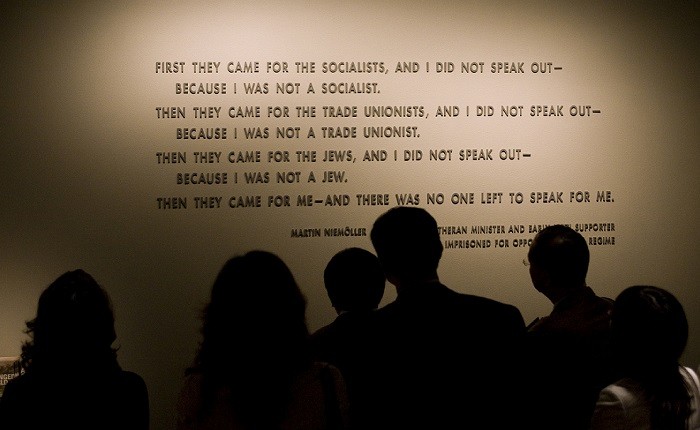
First they came for the socialists, and I did not speak out—because I was not a socialist.


Then they came for the trade unionists, and I did not speak out—because I was not a trade unionist.


Then they came for the Jews, and I did not speak out—because I was not a Jew.


Then they came for me—and there was no one left to speak for me.


—Martin Niemöller (Niemoller, n.d.)


 Visitors stand in front of the quotation from Martin Niemöller that is on display in the Permanent Exhibition of the United States Holocaust Memorial Museum. Niemöller was a Lutheran minister and early Nazi supporter who was later imprisoned for opposing Hitler's regime.

Credits:
  • US Holocaust Memorial Museum

This quote is attributed to the prominent German pastor Martin Niemöller. It is sometimes mistakenly referred to as a poem. 


After World War II, Niemöller openly spoke about his own early complicity in Nazism and his eventual change of heart. His powerful words about guilt and responsibility still resonate today.


References

Niemoller, M. (n.d.). Martin Niemöller: "First they came for.United States Holocaust Memorial Museum. Retrieved March 17, 3025from https://encyclopedia.ushmm.org/content/en/article/martin-niemoeller-first-they-came-for-the-socialists 


Tuesday, November 19, 2024

Works Indifference and Salvation

The texts from the Roman Catholic Lectionary today challenge us to assess the obstacles in our environment that impede our good works and reduce our commitment to conquering indifference.


Open the door against indifference


The reading from the Book of Revelation is the Message to Sardis and Laodicea


* [3:16] The letter to Sardis does not praise the community but admonishes its members to watchfulness, mutual support, and repentance (Rev 3:23). The few who have remained pure and faithful will share Christ’s victory and will be inscribed in the book of life (Rev 3:45).

* [3:1422] The letter to Laodicea reprimands the community for being lukewarm (Rev 3:1516), but no particular faults are singled out. Their material prosperity is contrasted with their spiritual poverty, the violet tunics that were the source of their wealth with the white robe of baptism, and their famous eye ointment with true spiritual perception (Rev 3:1718). But Christ’s chastisement is inspired by love and a desire to be allowed to share the messianic banquet with his followers in the heavenly kingdom (Rev 3:1921). (Revelation, CHAPTER 3 | USCCB, n.d.)


Psalm 15 asks Who shall abide in God’s Sanctuary?


* [Psalm 15] The Psalm records a liturgical scrutiny at the entrance to the Temple court (cf. Ps 24:36; Is 33:14b16). The Israelite wishing to be admitted had to ask the Temple official what conduct was appropriate to God’s precincts. Note the emphasis on virtues relating to one’s neighbor.(Psalms, PSALM 15 | USCCB, n.d.)


The Gospel of Luke describes the encounter of Jesus and Zacchaeus.


* [19:110] The story of the tax collector Zacchaeus is unique to this gospel. While a rich man (Lk 19:2), Zacchaeus provides a contrast to the rich man of Lk 18:1823 who cannot detach himself from his material possessions to become a follower of Jesus. Zacchaeus, according to Luke, exemplifies the proper attitude toward wealth: he promises to give half of his possessions to the poor (Lk 19:8) and consequently is the recipient of salvation (Lk 19:910). (Luke, CHAPTER 19 | USCCB, n.d.)


Tamara Whitney comments that even after Mother went into home hospice, last year, it was ten months after that when she died. We do not know the hour, even when we think we do. 


In the Gospel a short man called Zacchaeus wants to see Jesus, but he is too short to see over the crowd. I can relate to that. I too am short of stature and can never see the parade or the movie when there are tall people in front of me. Zacchaeus climbs a tree and gets the attention of Jesus who changes Zach’s life in this encounter. Jesus calls to him, and Zacchaeus answers the call. He welcomes Jesus into his home and more importantly into his heart. The churches need to answer the call and the people need to answer the call before it’s too late. (Whitney, n.d.)


Don Schwager quotes “To see Christ,” by Cyril of Alexandria (376-444 AD)


"Come and let us see what was the method of Zacchaeus's conversion. He desired to see Jesus and therefore climbed into a sycamore tree, and so a seed of salvation sprouted within him. Christ saw this with the eyes of deity. Looking up, he also saw Zacchaeus with the eyes of humanity, and since it was his purpose for all to be saved, he extends his gentleness to him. To encourage him, he says, 'Come down quickly.' Zacchaeus searched to see Christ, but the multitude prevented him, not so much that of the people but of his sins. He was short of stature, not merley in a bodily point of view but also spiritually. He could not see him unless he were raised up from the earth and climbed into the sycamore, by which Christ was about to pass. The story contains a puzzle. In no other way can a person see Christ and believe in him except by climbing up into the sycamore, by making foolish his earthly members of fornication, uncleanness, etc." (excerpt from COMMENTARY ON LUKE, HOMILY 127) (Schwager, n.d.)


The Word Among Us Meditation on Revelation 3:1-6, 14-22 comments that violence, and the idea of retribution or “getting even,” is commonplace. We may even have personal experience of a parent or teacher or other authority figure coming down on us too hard or making us feel guilty or inadequate. So it should be no surprise to discover that we assume that God acts the same way. When we have sinned, we might expect a wrath-filled, overpowering, and outsize reprisal.


God assured the Laodiceans that he chastises only out of love (Revelation 3:19). He showed them where they needed to change so they could once more know the joy of being in his presence. The same is true for you. Don’t let fear hold you back. Open the door and let God in!


“Father, thank you for loving me enough to want to heal me!” (Revelation 3:1-6, 14-22, n.d.)


Friar Jude Winkler notes that the Revelations passage addresses the deficiency of each city using imagery that is meaningful to the geography, history and lifestyle of the particular city. Zacchaeus was hated as tax collector and of short stature. He had to climb the sycamore tree where he could be attacked. Friar Jude reminds us that in John and Luke, salvation begins when we encounter Jesus.


Dr. Barbara Holmes’ book Joy Unspeakable explores contemplative practices in the Black church. She shows us how contemplation can be practiced through community, music, and movement. Holmes considers the transcendent nature of “ecstatic singing”:  


It is anointed singing from consecrated singers … that allows access to the holy, but more specifically it is the repetition of verses that shifts perception … [and] allows individuals to fill in their own story, silently or through the cries of recognition and affirmation. This is the contemplative moment, the recognition that each and every member of the congregation shares the same angst over the troubles of the world and the need for reunion…. The “ohs” are repeated over and over again until every person remembers a time when they cried out for God’s intervention. A deep listening abides between every note and stanza. Those who listen know that the Holy Spirit is in control. [2] (Holmes, n.d.)


We ponder the enthusiasm and action of Zacchaeus and express our openness to being called to full life in Christ by the Spirit.


References

Holmes, B. (n.d.). Contemplation in Community. Center for Action and Contemplation. Retrieved November 19, 2024, from https://cac.org/daily-meditations/contemplation-in-community/ 

Luke, CHAPTER 19 | USCCB. (n.d.). Daily Readings. Retrieved November 19, 2024, from https://bible.usccb.org/bible/luke/19?1

Psalms, PSALM 15 | USCCB. (n.d.). Daily Readings. Retrieved November 19, 2024, from https://bible.usccb.org/bible/psalms/15

Revelation 3:1-6, 14-22. (n.d.). The Word Among Us: Homepage. Retrieved November 19, 2024, from https://wau.org/meditations/2024/11/19/1132926/ 

Revelation, CHAPTER 3 | USCCB. (n.d.). Daily Readings. Retrieved November 19, 2024, from https://bible.usccb.org/bible/revelation/3?1 

Schwager, D. (n.d.). Zacchaeus Received Jesus Joyfully. Daily Scripture Readings and Meditations – Daily Scripture Readings and Meditations. Retrieved November 19, 2024, from https://www.dailyscripture.net/daily-meditation/?ds_year=2024&date=nov19

Whitney, T. (n.d.). Daily Reflection Of Creighton University's Online Ministries. OnlineMinistries. Retrieved November 18, 2024, from https://onlineministries.creighton.edu/CollaborativeMinistry/111824.html