Showing posts with label Russ Hudson. Show all posts

Monday, June 20, 2022

Betrayal and Hypocrisy

The texts from the Roman Catholic Lectionary today resonate with our experiences of being quick to rush to judgement as we miss or ignore the prompting of the Spirit to be open to mercy and compassion for those in need.


Addressing the Need


The reading from the Second Book of Kings outlines the circumstances under which Israel is carried captive to Assyria.


* [17:641] This brief section is the Deuteronomistic historian’s theological reflection on the causes and aftermath of Assyria’s conquest of the Northern Kingdom. The text contrasts the Israelites, who were deported (v. 6) because they abandoned the worship of the Lord (vv. 723), with the foreigners who were brought into the land (v. 24) and undertook, however imperfectly, to worship the Lord alongside their own traditional deities (vv. 2534a). The last verses recapitulate the apostasy of the Israelites (vv. 34b40) and the syncretism of the foreigners (v. 41). This is a deliberately disparaging, and not wholly accurate, account of the origin of the Samaritans; it reflects the hostility the Judahites continued to hold toward the inhabitants of the northern territories. (2 Kings, CHAPTER 17, n.d.)


Psalm 60 is a prayer for national victory after defeat.


* [Psalm 60] The community complains that God has let the enemy win the battle (Ps 60:35) and asks for an assurance of victory (Ps 60:67). In the oracle God affirms ownership of the land; the invasion of other nations is not permanent and will be reversed ultimately (Ps 60:810). With renewed confidence, the community resolves to fight again (Ps 60:11). The opening lament is picked up again (Ps 60:12), but this time with new awareness of God’s power and human limitation. (Psalms, PSALM 60, n.d.)


In the Gospel of Matthew, Jesus warns about judging others.


* [7:5] Hypocrite: the designation previously given to the scribes and Pharisees is here given to the Christian disciple who is concerned with the faults of another and ignores his own more serious offences. (Matthew, CHAPTER 7, n.d.)


Barbara Dilly comments that Jesus’ message for us today challenges us to not just to ignore the faults of others, but to first engage in self-reflection of our own sins. That is demanding work. But if we do that honestly, and try to resolve them, she thinks we might even be able to lovingly help others to resolve their own sins as well. It seems to her that a healthy Christian community is a place where we can all learn to engage in deep self-reflection of our own sins as we lovingly stand in solidarity with and learn to forgive each other.


Unfortunately, our larger society is not ready for this right now. There is too much self-righteousness on the part of people who pass judgment on others without any compassion for them. Jesus clearly warns us against that sort of behavior. I pray today that Christians can model self-examination and forgiveness for others in solidarity with them as we work together to create hope for our nation and the world. (Creighton U. Daily Reflection, n.d.)


Don Schwager quotes “Judge from justice, forgive from grace,” by Ephrem the Syrian, 306-373 A.D.


"Do not judge, that is, unjustly, so that you may not be judged, with regard to injustice. With the judgment that you judge shall you be judged (Matthew 7:2). This is like the phrase 'Forgive, and it will be forgiven you.' For once someone has judged in accordance with justice, he should forgive in accordance with grace, so that when he himself is judged in accordance with justice, he may be worthy of forgiveness through grace. Alternatively, it was on account of the judges, those who seek vengeance for themselves, that he said, 'Do not condemn.' That is, do not seek vengeance for yourselves. Or, do not judge, from appearances and opinion and then condemn, but admonish and advise." (excerpt from COMMENTARY ON TATIAN'S DIATESSARON 6.18B) (Schwager, 2020)


The Word Among Us Meditation on Matthew 7:1-5 comments that Jesus is giving us a choice. When we are tempted to judge someone, we can decide to step closer to them. Instead of choosing separation, we can ask the Spirit to help us find connection. We might just find that connection by recognizing the “beam” in our own eye (Matthew 7:5). Do they have a bad habit? We probably have some too. Did they offend us? Surely, we’ve offended people! Did they make bad choices? Who knows? We might have acted the same way in their shoes.


This is not just about redirecting the judgment to focus on ourselves; it’s about recognizing our common humanity. When we realize that we all fall short in one way or another, we discover that we can relate and even empathize with the person we are tempted to judge. Instead of cutting off the relationship, we can open the door to compassion and love. We need one another. Let’s not let judgments separate us. “Holy Spirit, help me not to judge anyone today.” (Meditation on Matthew 7:1-5, n.d.)


Friar Jude Winkler notes that the deportation to the northern kingdom did not include the poor people and the deportees were replaced with a pagan population. Is it possible that the initial deportees from the northern kingdom were able to unite with the exiles from Judah in a later deportation? Friar Jude reminds us to consider our own conscience to convert our own hearts prior to assisting in the conversion of others.


Fr. Richard Rohr, OFM, comments that emotional sobriety is found when we experience life from our True Self. There is something in us that is not touched by coming and going, by up and down, by for or against, by totally right or totally wrong. This part of us is patient with both goodness and evil, exactly as God is; it does not rush to judgement or demand closure now. Rather, it stands vigilant and patient in the tragic gap that almost every moment offers. Enneagram teacher Russ Hudson, writes of the importance of presence.


Most of my spiritual journey has been about learning how to be present and, from that grounding in presence, learning how to allow love to be what moves me. . . . Presence seems to be something received, that comes to us through a kind of willingness more than through some forceful effort. We come to understand that our will does not operate quite as we might imagine. There is an element of grace, of something miraculous arising in us which gives us the capacity to be awake to our experience. This is hard enough when conditions are favorable—when we are relaxed and not particularly stressed about anything. However, when powerful emotions arise, it is generally much more difficult to find a ground in us that can be compassionately awake with what we are feeling. . . . (Rohr, 2020)


Contemplation and self reflection are practices which open us to the Spirit that directs us to see the log in our own eye as we encounter situations that involve understanding the actions of others.


References

Creighton U. Daily Reflection. (n.d.). Online Ministries. Retrieved June 20, 2022, from https://onlineministries.creighton.edu/CollaborativeMinistry/062022.html 

Matthew, CHAPTER 7. (n.d.). USCCB. Retrieved June 20, 2022, from https://bible.usccb.org/bible/matthew/7?1 

Meditation on Matthew 7:1-5. (n.d.). The Word Among Us: Homepage. Retrieved June 20, 2022, from https://wau.org/meditations/2022/06/20/414731/ 

Psalms, PSALM 60. (n.d.). USCCB. Retrieved June 20, 2022, from https://bible.usccb.org/bible/psalms/60?3 

Rohr, R. (2020, April 17). A Riverbed of Mercy. Daily Meditations Archive: 2022. Retrieved June 20, 2022, from https://cac.org/daily-meditations/a-riverbed-of-mercy-2022-06-20/ 

Schwager, D. (2020, April 17). First Take the Log out of Your Own Eye. Daily Scripture net. Retrieved June 20, 2022, from https://www.dailyscripture.net/daily-meditation/?ds_year=2022&date=jun20 

2 Kings, CHAPTER 17. (n.d.). USCCB. Retrieved June 20, 2022, from https://bible.usccb.org/bible/2kings/17?5 


Monday, March 2, 2020

Moral Wholeness

The texts from the Roman Catholic Lectionary today invite us to contemplate the Holiness Code in the Hebrew Testament and seek the guidance of the Spirit in experiences that deepen our preparedness for transformation.
Compassion of parents

The reading from the Book of Leviticus presents a ritual and moral holiness including various rules of conduct.
 * [19:17–18] These verses form a unit and describe different attitudes and actions towards one’s fellow Israelites. A separate passage is necessary to advise a similar attitude toward aliens (vv. 33–34). Cf. 25:39–46. The admonition at the end of v. 18 came to be viewed in Judaism and Christianity as one of the central commandments. (See Mt 22:34–40; Mk 12:28–34; Lk 10:25–28; cf. Mt 19:19; Rom 13:8–10; Gal 5:14). The New Testament urges love for enemies as well as neighbors (Mt 5:43–48; Lk 6:27–36; cf. Prv 25:21–22).1
Psalm 19 declares God’s glory in Creation and the Law.
 * [Psalm 19] The heavenly elements of the world, now beautifully arranged, bespeak the power and wisdom of their creator (Ps 19:2–7). The creator’s wisdom is available to human beings in the law (Ps 19:8–11), toward which the psalmist prays to be open (Ps 19:12–14). The themes of light and speech unify the poem.2
The Gospel of Matthew sets the stage of the judgement of the Nations.
 * [25:31–46] The conclusion of the discourse, which is peculiar to Matthew, portrays the final judgment that will accompany the parousia. Although often called a “parable,” it is not really such, for the only parabolic elements are the depiction of the Son of Man as a shepherd and of the righteous and the wicked as sheep and goats respectively (Mt 25:32–33). The criterion of judgment will be the deeds of mercy that have been done for the least of Jesus’ brothers (Mt 25:40). A difficult and important question is the identification of these least brothers. Are they all people who have suffered hunger, thirst, etc. (Mt 25:35, 36) or a particular group of such sufferers? Scholars are divided in their response and arguments can be made for either side. But leaving aside the problem of what the traditional material that Matthew edited may have meant, it seems that a stronger case can be made for the view that in the evangelist’s sense the sufferers are Christians, probably Christian missionaries whose sufferings were brought upon them by their preaching of the gospel. The criterion of judgment for all the nations is their treatment of those who have borne to the world the message of Jesus, and this means ultimately their acceptance or rejection of Jesus himself; cf. Mt 10:40, “Whoever receives you, receives me.” See note on Mt 16:27.3
Tom Shanahan, S.J. comments that they ask: “When did we see you hungry, etc.” and Jesus famously answers them, “whatever you did for one of these least of my sisters or brothers, you did for me.”
 Notice the emphasis here.  Not on the grand deed, the enormous task, but on simple care for others.  I’m not asked to save Omaha, or Nebraska, or an even bigger chunk of real estate.  I am simply called to look outside myself to others as Jesus looked outside of himself and responded to people’s needs.
Lent is the perfect time to examine ourselves and to be challenged to be selfless... 
Our task for Lent is to let ourselves be opened outward – towards those who look for care.  Can I accept that challenge? Can I even become aware of their calling to me? And can I trust that Jesus means what he says to us all? 
Lord, keep us close to you during this Lenten season.  Help us to know in our hearts the love that you show us and the strength of our God who invites us all to imitate You in showing that love to our Sisters and Brothers.4
Don Schwager quotes “Gathering and Separating,” by an anonymous early author from the Greek church.
 "And he will separate them one from another as a shepherd separates the sheep from the goats." So then, people on earth are intermingled, and not only intermingled in that the righteous live side by side with the wicked, but they are also indistinguishable. Between the righteous and the wicked there is no apparent difference. Even as in wintertime you cannot tell the healthy trees apart from the withered trees but in beautiful springtime you can tell the difference, so too each person according to his faith and his works will be exposed. The wicked will not have any leaves or show any fruit, but the righteous will be clothed with the leaves of eternal life and adorned with the fruit of glory. In this way they will be separated by the heavenly shepherd and Lord. The earthly shepherd separates animals by their type of body, whereas Christ separates people by their type of soul. The sheep signify righteous people by reason of their gentleness, because they harm no one, and by reason of their patience, because when they are harmed by others, they bear it without resistance. He refers to sinners as goats, however, because these vices characterize goats - capriciousness toward other animals, pride and belligerence." (excerpt from INCOMPLETE WORK ON MATTHEW, HOMILY 54, the Greek fathers).5
The Word Among Us Meditation on Matthew 25:31-46 comments that Jesus says that we should see him in other people, especially the poor, the prisoner, the hungry, and the foreigner.
 A story about St. Francis of Assisi illustrates this truth perfectly. Thomas of Celano, one of Francis’ early disciples, described it this way:
So greatly loathsome was the sight of lepers to [Francis] . . . that, in the days of his vanity, he would look at their houses only from a distance of two miles and he would hold his nostrils with his hands. But now, when by the grace and the power of the Most High he was beginning to think of holy and useful things, . . . he met a leper one day and, made stronger than himself, he kissed him.Writing about this incident himself, Francis said, “What had previously nauseated me became a source of physical consolation for me. After that I did not wait long before leaving the world.”
What happened to Francis can happen to you. But don’t think you have to make such a radical change overnight—or all on your own. Thomas of Celano attributed Francis’ act of kindness to “the grace and the power” of God. Francis may have taken one or two steps in welcoming people with leprosy, but he knew that he was able to embrace that man only because he was “made stronger than himself.” In other words, it was a combination of Francis’ decision and God’s grace that changed his heart.6
Friar Jude Winkler comments on the text from Leviticus as part of the Holiness Code. Matthew is redefining righteousness as compassion. Friar Jude notes that compassion is a theme at the beginning and end of Matthew’s Gospel.


Fr. Richard Rohr, OFM, comments that Russ Hudson spent several years studying George Ivanovich Gurdjieff’s “Work,” as did his colleague Cynthia Bourgeault. In her book The Holy Trinity and the Law of Three, which draws on the teachings of Gurdjieff to more deeply explore the Trinity, Cynthia writes:
 The enneagram of personality has captured the popular imagination, that’s for sure. And you have to admit that there is something brilliant and even damnably strategic in its design. Using that classic ego bait—“let me learn my type, some interesting new thing about me”—it draws people in, only to put in their hands basic tools for self-observation and non identification. . . . Progressing enneagram students rapidly develop the capacity to see that they are in fact not their type; it is simply an impersonal, mechanical pattern that plays out within them... [3]
A shift in the sense of selfhood begins to occur, so that they reside less and less in their outer personality manifestations and more and more in their inner witnessing presence. Fixation upon the personality begins to wane as the deeper roots of identity emerge. Thus, the teaching has the possibility of moving people to a new level of interior freedom and encourages them to develop precisely those spiritual skills that Gurdjieff himself identified as essential to conscious transformation. . . .7
Our compassion is a path to deeper transformation of our lives and the discovery of the ways in which we are called by the Spirit to serve those in need.

References

1
(n.d.). Leviticus, chapter 19 - United States Conference. Retrieved March 2, 2020, from http://www.usccb.org/bible/leviticus/19 
2
(n.d.). Psalms, chapter 19 - United States Conference. Retrieved March 2, 2020, from http://www.usccb.org/bible/psalms/19 
3
(n.d.). Matthew, chapter 25 - United States Conference. Retrieved March 2, 2020, from http://www.usccb.org/bible/matthew/25 
4
(n.d.). Daily Reflections - OnlineMinistries .... Retrieved March 2, 2020, from https://onlineministries.creighton.edu/CollaborativeMinistry/daily.html 
5
(n.d.). Daily Scripture Readings and Meditations. Retrieved March 2, 2020, from https://dailyscripture.servantsoftheword.org/ 
6
(n.d.). 1st Week of Lent - Mass Readings and Catholic Daily .... Retrieved March 2, 2020, from https://wau.org/meditations/2020/03/02/ 
7
(2020, March 1). Enneagram Part Two: Heart Center — Center for Action and .... Retrieved March 2, 2020, from https://cac.org/themes/enneagram-part-two-heart-center/ 

Thursday, February 27, 2020

The choice for life

The texts from the Roman Catholic Lectionary today present a dualistic choice that establishes the tension in living on a journey to full life through relationship with God.
The Way of Life

The reading from the Book of Deuteronomy presents the choice Moses puts before Israel.
 See, I have set before you today life and prosperity, death and adversity1
The theme of the Two Ways in Psalm 1 expresses that the wise through their good actions will experience rootedness and life, and the wicked, rootlessness and death.
 * [Psalm 1] A preface to the whole Book of Psalms, contrasting with striking similes the destiny of the good and the wicked. The Psalm views life as activity, as choosing either the good or the bad. Each “way” brings its inevitable consequences. The wise through their good actions will experience rootedness and life, and the wicked, rootlessness and death.2
In the Gospel from Luke, Jesus teaches the Conditions of Discipleship include taking up our cross daily as He asks: “What does it profit them if they gain the whole world, but lose or forfeit themselves?”
 * [9:23] Daily: this is a Lucan addition to a saying of Jesus, removing the saying from a context that envisioned the imminent suffering and death of the disciple of Jesus (as does the saying in Mk 8:34–35) to one that focuses on the demands of daily Christian existence.3
Angela Maynard comments that nobody gets through this life without some kind of suffering. Some days there are disappointments, other days loss and the accompanying pain and suffering. Many of the saints and holy people have concluded that pain is a source of purification or a way one can become stronger. For today, let's allow ourselves some time for quiet reflection. When faced with crosses, do I fall apart, give up, or do I rise up, shoulder my crosses with courage, keeping in mind that Jesus shares the load?
 Suffering is nothing by itself. But suffering shared with the passion of Christ is a wonderful gift, the most beautiful gift, a token of love.”    -- St. Teresa of Calcutta   
“If God causes you to suffer much, it is a sign that He has great designs for you, and that He certainly intends to make you a saint. And if you wish to become a great saint, entreat Him yourself to give you much opportunity for suffering; for there is no wood better to kindle the fire of holy love than the wood of the cross, which Christ used for His own great sacrifice of boundless charity.”       -- St. Ignatius of Loyola4
Don Schwager quotes “God calls us to conversion,” by Augustine of Hippo, 354-430 AD.
 "God calls us to correct ourselves and invites us to do penance. He calls us through the wonderful gifts of his creation, and he calls us by granting time for life. He calls us through the reader and through the preacher. He calls us with the innermost force of our thoughts. He calls us with the scourge of punishment, and he calls us with the mercy of his consolation." (excerpt from Commentary on Psalm 102, 16)5
The Word Among Us Meditation on Deuteronomy 30:15-20 shares that following the Lord requires choosing. Each reading today says so. Moses gives his farewell address to the Israelites, and his main point is that if they want to receive God’s life, they have to choose to follow and obey him (Deuteronomy 30:15-20). Jesus predicts his passion and gives the disciples a list of things they need to choose to do: deny themselves, take up their crosses daily, and follow him (Luke 9:23). Even today’s psalm describes the blessed people who follow the Lord—they choose not to follow the counsel of the wicked; they delight in God’s law. As a result, they are like a well-watered, fruitful tree (Psalm 1:1-3).
 The same is true for us: choosing to follow God gives us life. So go ahead and spend a little more time in prayer or Scripture reading. Attend your parish’s Stations of the Cross. Give to the poor, whether you talk with the homeless man on the street corner or spend an afternoon preparing meals at a shelter. Wash your family’s dirty dishes or pick up after your loved ones with a smile.
This might sound like a spiritual to-do list. But there’s more to it than that. As you take more time to pray, you may notice a sense of joy welling up in you, even in difficulty. As you reach out to give to the needy, you may get a clearer glimpse of Jesus’ love for the poor. As you choose to serve your family even when you’re aggravated, you may discover a new sense of peace. Every decision to follow Jesus nourishes your soul like a river watering a tree (Psalm 1:3).
So rely on God’s grace and say yes to him. As you journey with Jesus through Lent, you’ll start resembling him more in your thoughts, words, and actions. That’s what his life does in you!6
Friar Jude Winkler reviews the dualistic choice of the Two Ways as he concedes our daily path often is in grey areas that are not so black and white. In the Gospel, Jesus resolves our tension of the Two Ways in the irony of taking up our cross. Friar Jude reminds us that the Way of the Cross is to abandon our self serving interests to give life for others.


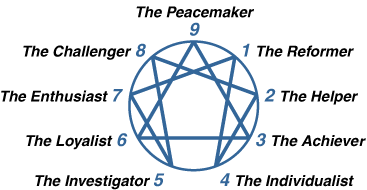
The tool of the Enneagram may help our service of others as we come to appreciate how the Essential Nature of people may be recaptured living as their True Self, blessed by God. Fr. Richard Rohr, OFM, shares Don Richard Riso and Russ Hudson explanation of how Nines reconnect with their Essential nature or True Self.
https://images.squarespace-cdn.com/content/v1/585179fe1b631b51e1837bac/1481830640417-7XR5WHQRDY4W9Y79DUC3/ke17ZwdGBToddI8pDm48kBNIdWBe6m2h5ULxAqKQvxpZw-zPPgdn4jUwVcJE1ZvWEtT5uBSRWt4vQZAgTJucoTqqXjS3CfNDSuuf31e0tVHiyWpKxdslTO8z3os2pqwmb2loCnT3wj3K5UXSzGjTa2bSd6kfRtgWHgNMDgGnmDY/image-asset.gif?format=500w

(see Ash Wednesday blog entry for definition of the terms Holy Ideas, Virtues, and Passions). Ultimately Nines reclaim their Essential nature by confronting their Basic Fear of losing connection and by letting go of the belief that their participation in the world is unimportant—that they do not have to “show up.” They realize that the only way to truly achieve the unity and wholeness they seek is not by “checking out” into the realms of the imagination but by fully engaging themselves in the present moment.
 Another Essential quality of the Nine is what Oscar Ichazo called “Holy Love.” . . . The Essential love to which we are referring is a dynamic quality of Being that flows, transforms, and breaks down all barriers before it. It overcomes feelings of separateness and isolation within ego boundaries, issues that plague the Instinctive Triad. This is why real love is frightening—it entails the dissolution of boundaries and the death of the ego. Yet as we learn to surrender to the action of Holy Love, we reconnect with the ocean of Being and realize that at our core, we are this Love. We are this endless, dynamic, transforming Presence of loving awareness, and it has always been so. [2]7
Our surrender to the action of Love in our lives and relationships with others will push forward to full life in the tension between the Two Ways.

References

1
(n.d.). Deuteronomy, chapter 30. Retrieved February 27, 2020, from http://www.usccb.org/bible/deuteronomy/30 
2
(n.d.). Psalms, chapter 1 - United States Conference. Retrieved February 27, 2020, from http://www.usccb.org/bible/psalms/1 
3
(n.d.). Luke, chapter 9 - United States Conference. Retrieved February 27, 2020, from http://www.usccb.org/bible/luke/9 
4
(n.d.). Daily Reflections - OnlineMinistries .... Retrieved February 27, 2020, from https://onlineministries.creighton.edu/CollaborativeMinistry/daily.html 
5
(n.d.). Daily Scripture Readings and Meditations. Retrieved February 27, 2020, from https://dailyscripture.servantsoftheword.org/ 
6
(n.d.). Thursday after Ash Wednesday - Mass Readings and Catholic .... Retrieved February 27, 2020, from https://wau.org/meditations/2020/02/27/ 
7
(2020, February 27). Type Nine: The Need for Peace — Center for Action and .... Retrieved February 27, 2020, from https://cac.org/type-nine-the-need-for-peace-2020-02-27/